



In modern composite manufacturing, resin systems alone are often not sufficient to meet increasingly demanding composite performance requirements. Whether the application involves construction, marine, transportation, or industrial equipment, additives play a critical role in optimizing processing behavior, surface quality, durability, and long-term durability of finished parts.
At Thousands Technology, we work closely with composite manufacturers to select and supply functional additives that enhance both manufacturing efficiency and final part performance.
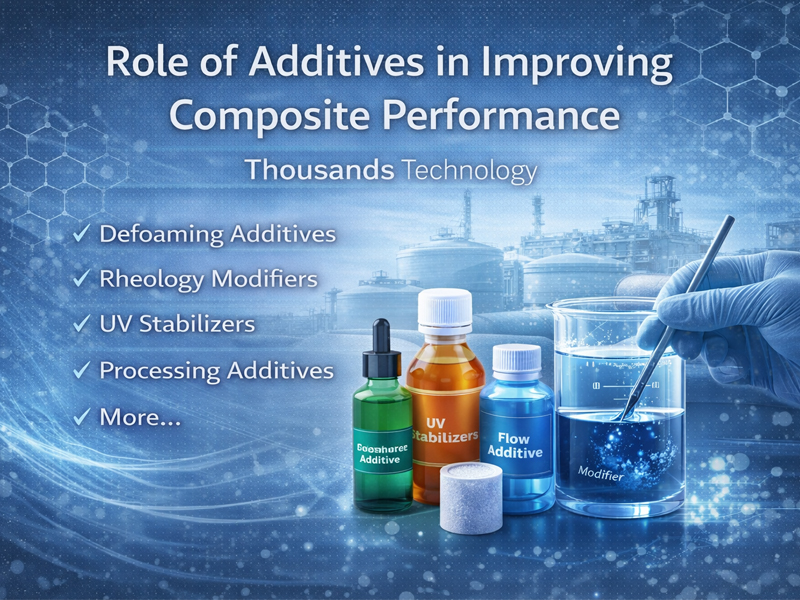
Why Additives Matter for Composite Performance
Composite additives are formulated in small quantities, but their impact on composite performance is significant. Proper additive selection can help manufacturers improve resin flow and wet-out, reduce defects such as air bubbles and pinholes, enhance mechanical strength and surface finish, increase resistance to heat, UV, chemicals, and aging, and optimize curing behavior and production consistency.
These benefits directly translate into higher-quality composite parts and more stable production processes, which is why additive selection deserves as much attention as resin selection when a formulation is being developed or adjusted.
Key Types of Additives and Their Functions
1. Defoaming and Air-Release Additives
Air entrapment is a common challenge in FRP and fiberglass manufacturing. Trapped air can lead to voids, surface defects, and reduced mechanical strength, all of which work against consistent part quality across a production run.
Defoaming and air-release additives help accelerate air bubble release during mixing and molding, improve surface smoothness, and reduce post-processing and repair costs. These additives are especially important in hand lay-up, spray-up, and RTM processes.
2. Rheology Modifiers and Thixotropic Agents
Controlling resin viscosity is essential for consistent application and part geometry. Rheology modifiers prevent resin sagging on vertical surfaces, improve fiber wetting, and enable better control during infusion or coating. They are widely used in gelcoats, adhesives, and structural laminates where predictable flow behavior supports repeatable composite performance from part to part.
3. UV Stabilizers and Anti-Aging Additives
For outdoor applications such as tanks, gratings, marine parts, and construction components, UV resistance is critical to long-term composite performance. UV stabilizers and antioxidants reduce discoloration and surface chalking, slow down resin degradation, and extend service life in harsh environments.
These additives are essential for maintaining both aesthetics and structural integrity over years of outdoor exposure.
Selecting the right additive package also means balancing multiple properties at once, rather than optimizing a single characteristic in isolation. Adding more of one additive to solve a surface defect, for example, can shift viscosity or cure speed enough to create a new processing challenge elsewhere in the batch.
This is one reason formulators generally test additive combinations in small trial batches before scaling up to full production, so any interaction between additives, resin, and fiber reinforcement can be identified early rather than discovered on a full production run.
4. Processing and Flow Additives
Processing additives are designed to improve manufacturing efficiency without compromising performance. Typical benefits include improved mold release, more uniform resin distribution, and enhanced compatibility between fillers, fibers, and resin systems. They help manufacturers achieve higher productivity and repeatable results across multiple production batches.
Additives as a System, Not a Single Solution
One common misconception is treating additives as standalone solutions. In reality, additives work best when optimized as part of the complete resin formulation, since a single additive rarely fixes a performance issue on its own.
At Thousands Technology, we emphasize compatibility with unsaturated polyester and vinyl ester resins, balance between processing ease and final performance, and application-specific recommendations based on customer processes. This system-level approach ensures reliable composite performance across different composite applications rather than isolated improvements in a single property.
What to Consider When Building an Additive Package
When formulators evaluate additives to improve composite performance, they typically start by identifying which property is limiting the current process or part, whether that is surface porosity, viscosity control, weathering resistance, or mold release consistency. From there, additive dosage and combination need to be tested against the specific resin system in use, since additive performance can vary between unsaturated polyester, vinyl ester, and epoxy formulations.
Batch-to-batch consistency is another factor worth confirming early, since even small variations in additive dosage or mixing time can affect the final result across a production run.
Buyers evaluating a new additive package for the first time should plan for a trial run under their own process conditions rather than relying solely on a supplier’s general recommendation, since mold geometry, ambient temperature, and equipment can all influence how an additive performs in practice.
Working with a supplier that can provide consistent documentation and responsive technical support can help reduce qualification time when introducing a new additive or adjusting an existing package. Test methods for properties such as air release, viscosity, and weathering resistance are commonly referenced against standards published by organizations such as ASTM International.
Common Signs an Additive Package Needs Adjustment
Certain recurring issues on the production floor often point back to the additive package rather than the base resin itself. Persistent pinholes or surface porosity, even after adjusting the mixing procedure, can indicate that the defoaming or air-release additive dosage needs review.
Resin sagging on vertical or overhead sections of a mold is typically a rheology issue rather than a resin issue, and it usually points to the thixotropic additive dosage rather than the base resin chemistry. Similarly, early chalking or fading on outdoor parts is generally a sign that the UV stabilizer package should be reviewed against the actual outdoor exposure conditions the part will face.
Recognizing these patterns early helps manufacturers isolate the affected additive category before making formulation changes, which is generally faster and less costly than reworking an entire resin system from scratch.
About Thousands Technology
Thousands Technology is a supplier of composite raw materials and functional additives, serving customers across fiberglass, FRP, and advanced composite industries. Our product portfolio includes carefully selected auxiliary agent products designed to improve processing efficiency, surface quality, and long-term durability of finished parts.
By combining technical expertise with stable supply and application support, Thousands Technology helps manufacturers achieve better composite performance, lower defect rates, and more competitive finished products.
FAQ
What types of additives most affect composite performance?
Defoaming and air-release additives, rheology modifiers, UV stabilizers, and processing additives are among the additive types with the most direct impact on composite performance.
Can additives be used with any resin system?
Additive compatibility should be confirmed against the specific resin system in use, since performance can vary between unsaturated polyester, vinyl ester, and epoxy formulations.
Why do additives need to be tested as a system rather than individually?
A single additive rarely resolves a composite performance issue on its own, so dosage and combinations are typically tested together within the complete resin formulation as a system.
Can you provide technical documentation and bulk pricing?
Yes, technical data sheets and SDS documentation are available on request, and our team can provide bulk pricing and lead times based on your target volume and delivery location.
Get in Touch About Your Composite Performance Needs
Contact our team to discuss additive selection, technical data sheets, or bulk supply for your composite manufacturing process. We support global shipping for manufacturers sourcing functional additives to improve part quality across fiberglass, FRP, and advanced composite applications.