



Mold release selection rarely reaches the purchasing agenda until a part sticks, a flange tears, or a tool has to be refinished mid-programme. For FRP fabricators and mold shops running long production cycles, the FREKOTE 44-NC release agent is one of the semi-permanent options worth evaluating against the wax systems many shops still use.
ChemicalsStore.com has added LOCTITE® FREKOTE 44-NC™ to its auxiliary agent catalog. This article summarises what the published product data states and what overseas buyers should confirm before placing an order.
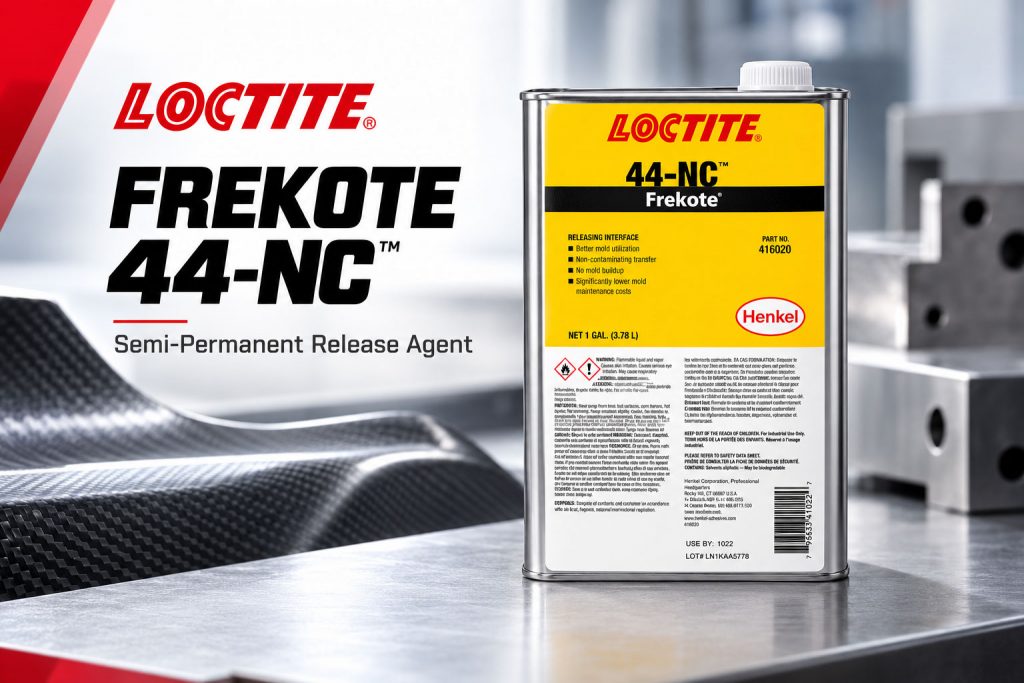
What Sets the FREKOTE 44-NC release agent Apart from Wax
The FREKOTE 44-NC release agent is a solvent-based, semi-permanent system that chemically bonds to the mold surface instead of sitting on it as a sacrificial layer. The result is a micro-thin film that stays on the tool rather than transferring to the part.
According to the product data, the cured film is thermally stable up to 400 °C, well above the conditions of most composite and plastics molding processes. Appearance is clear to slight blue tint, specific gravity runs 0.76 to 0.782 at 25 °C, and the release agent transfer rating is ≥4.
For purchasing, the practical difference is cycle economy rather than unit price. Fewer reapplications, no aggressive stripping between runs and less mold refinishing mean cost per pull can look very different from cost per litre.
4 Essential Questions to Ask Before You Order
1. Does Your Process Stay Inside the Temperature Window?
Application temperature for the FREKOTE 44-NC release agent runs from 13 °C to 60 °C, while the cured film tolerates up to 400 °C in service. If your shop floor drops below 13 °C in winter, a conditioned application area is needed before the first base coat goes on.
2. Is the Mold Sealed and Fully Cured?
New or freshly repaired fiberglass and epoxy molds should be fully cured per the mold manufacturer’s instructions — typically a minimum of two to three weeks at 22 °C — and sealed with an appropriate Frekote mold sealer first.
Every trace of a previous release agent also has to come off. Frekote PMC or Frekote 915WB are listed for heavy build-up, and skipping this step is a common reason a semi-permanent system underperforms.
3. Can the Line Absorb the Conditioning Routine?
The FREKOTE 44-NC release agent is applied by spraying, brushing or wiping with a clean, lint-free cloth, in 4 to 6 base coats with 10–15 minutes between coats for solvent evaporation. If spraying, the data calls for a dry air source or airless system with the nozzle 20–30 cm from the mold surface.
The final coat cures for 3 hours at 22 °C, or 15 minutes at 100–150 °C if the tool can be baked. One re-coat after the first few pulls further conditions the surface, after which only areas showing release difficulty are touched up.
4. How Will It Be Stored and Handled?
The FREKOTE 44-NC release agent is classified as flammable and moisture sensitive. Containers should be kept tightly closed, stored between 8 °C and 21 °C, and kept away from oxidizing agents and combustible materials.
Storage below 8 °C or above 28 °C can adversely affect product properties, so inland buyers should plan the last leg of cold-season transport, not only the port stage. Always work in a well-ventilated area and review the Safety Data Sheet before first use.
Where the FREKOTE 44-NC release agent Fits in Production
The product data lists use across automotive and transportation components, building and construction panels, electrical and electronics housings, marine vessel tooling and wind energy blade molds.
On the resin side it is described as releasing epoxies, polyester resins, thermoplastics, adhesives and rotationally molded plastics without contaminating the finished part. That matters when components move straight to bonding or painting.
This compatibility range is why the FREKOTE 44-NC release agent comes up in hand lay-up, spray-up and closed-mold work where secondary cleaning of the part is not practical.
Related Frekote Grades Worth Comparing
- LOCTITE® FREKOTE 700-NC™ — high-temperature, all-purpose mold release agent.
- LOCTITE® FREKOTE 55-NC™ — semi-permanent release for open and closed mold processes.
- LOCTITE® FREKOTE® B-15™ — internal release additive for gel coats and resins.
- LOCTITE® FREKOTE® PMC — mold cleaner for removing prior release build-up before recoating.
If it is not clear that the FREKOTE 44-NC release agent is the right fit, request data on these grades alongside it and compare on cure temperature, process type and mold condition. Frekote sits among the recommended international brand products we list, with supply chain resource support for the wider release-agent range; official technical literature is published by Henkel Adhesive Technologies.
FAQ
Is the FREKOTE 44-NC release agent compatible with polyester resin FRP?
Yes. The published data lists polyester resins alongside epoxies, thermoplastics, adhesives and rotationally molded plastics among the materials it releases.
How many coats are needed for a new mold?
4 to 6 base coats, with 10–15 minutes between coats, followed by a 3-hour cure at 22 °C or a 15-minute bake at 100–150 °C.
Will it transfer onto the finished part?
The film is described as non-transferring and non-contaminating, with a release agent transfer rating of ≥4, so it stays on the tool rather than the part.
What service temperature does the FREKOTE 44-NC release agent withstand?
The cured film is rated thermally stable at up to 400 °C, which covers the great majority of composite, plastics and rubber molding conditions.
One-Stop Sourcing for Release Agents and Composite Inputs
ChemicalsStore.com is a B2B marketplace for composite and chemical raw materials, combining resins, auxiliary agents, organic peroxides, fiberglass and gelcoat in one catalog. We provide sourcing support, technical documentation such as TDS and SDS on request, and responsive customer service, so a mold shop can consolidate release agents and resin inputs into a single order rather than chasing several suppliers.
Explore our product page: LOCTITE® FREKOTE 44-NC™
You may also be interested in:
Send us your mold type, process temperature and annual consumption at info@chemicalsstore.com, and we will help you confirm stock, pack size and get a quote.