



Choosing an initiator looks like a small line item on a purchase order, but it decides how your resin gels, how hot the part gets, and how many parts end up as scrap. For most FRP and composite buyers, the decision comes down to MEKP vs BPO, with cumene hydroperoxide (CHP) as a third option for specific jobs.
This guide compares the three organic peroxides from a sourcing point of view: which resin systems and processes each one suits, which accelerator it needs, and what to check before you place an order.
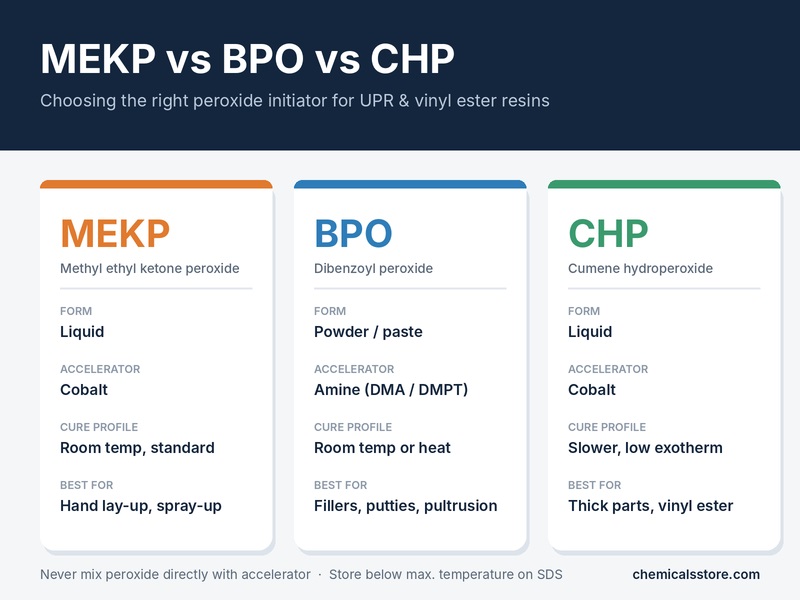
MEKP vs BPO vs CHP at a Glance
All three are organic peroxides that generate free radicals to start the crosslinking of unsaturated polyester (UPR) and vinyl ester resins. The difference lies in how they decompose, which accelerator activates them, and the cure profile they produce.
- MEKP (methyl ethyl ketone peroxide): liquid, activated by cobalt accelerators at room temperature. It is the standard choice for hand lay-up, spray-up and most open-mold work.
- BPO (dibenzoyl peroxide): powder or paste, activated by amine accelerators at room temperature, or used alone at elevated temperatures.
- CHP (cumene hydroperoxide): liquid, cobalt-activated, with a slower cure and a lower peak exotherm than MEKP.
When MEKP Is the Right Choice
MEKP is the most widely used room-temperature initiator for unsaturated polyester resin. As a liquid, it meters easily through spray-up guns and dispensing equipment and blends quickly into resin. Typical addition levels fall around 1–2% of resin weight, but always follow the resin supplier’s technical data sheet.
It works with pre-promoted resins that already contain cobalt, which is why it fits boat building, FRP tanks, pipes, sanitaryware and general laminating. MEKP grades are not identical, however. Active oxygen content, the ratio of peroxide species and the solvent type all change gel time and the reactivity curve.
When you compare offers, compare grades with similar active oxygen and reactivity, not just the word “MEKP” on the label. One example on our platform is Butanox M-50 VR, a recommended international brand MEKP grade.
When BPO Makes More Sense
BPO does not respond to cobalt. At room temperature it needs an amine accelerator, such as DMA or DMPT. That makes BPO the usual choice for body fillers, putties, polymer concrete, artificial stone and other formulations where an amine cure system is preferred.
Without an accelerator, BPO is used as a heat-activated initiator in processes such as pultrusion and press molding, often together with other high-temperature peroxides. BPO paste is also popular because a colored paste gives a visual check that it has been fully mixed into the resin.
Where CHP Fits
CHP is a cobalt-activated liquid like MEKP, but it reacts more slowly and gives a lower peak exotherm. That suits thick laminates and large castings, where excess heat can cause cracking, discoloration or warping.
CHP and CHP-based blends are also widely used with vinyl ester resins. Standard MEKP can cause foaming in some vinyl ester systems, so check the resin data sheet for the recommended initiator.
MEKP vs BPO: Key Selection Factors for Buyers
The MEKP vs BPO decision is rarely about which peroxide is “stronger”. It comes down to whether the initiator matches your resin, your accelerator and your process. Use these factors as a quick filter.
1. Resin and Accelerator System
Cobalt-promoted resin points to MEKP or CHP. An amine-accelerated system points to BPO. Switching between MEKP vs BPO usually means reformulating the accelerator package, not simply swapping the peroxide.
2. Process and Cure Temperature
Room-temperature open molding favors MEKP. Heated processes and amine-cured fillers favor BPO. Thick sections that need a gentler exotherm favor CHP or a blended grade.
3. Physical Form and Handling
Liquids suit metering pumps and spray equipment. Pastes and powders suit manual mixing and filler production. In the MEKP vs BPO comparison, the physical form often decides which one fits your existing equipment.
4. Safety, Storage and Shipping
All organic peroxides are classified as dangerous goods and have a recommended maximum storage temperature. Never mix a peroxide directly with an accelerator, because the reaction can be violent. Add each one to the resin separately.
For hazard and exposure data, see the NIOSH Pocket Guide entry for methyl ethyl ketone peroxide, and always request the supplier’s SDS before ordering.
Common Sourcing Mistakes to Avoid
- Comparing MEKP grades by price only, without checking active oxygen and reactivity.
- Treating MEKP vs BPO as interchangeable on the same resin without adjusting the accelerator.
- Ordering more peroxide than you can use within its shelf life.
- Overlooking dangerous-goods shipping requirements, which affect lead time and freight cost.
- Skipping a small trial batch when changing supplier or grade.
FAQ
Can I replace MEKP with BPO in the same polyester resin?
Not directly. Most room-temperature polyester resins are pre-promoted with cobalt, which activates MEKP but not BPO. Moving from MEKP vs BPO normally requires an amine accelerator and a new trial to confirm gel time.
Which initiator is better for vinyl ester resin?
It depends on the resin. Many vinyl ester systems use CHP, CHP blends or low-foaming MEKP grades, while some use BPO with an amine. Follow the resin manufacturer’s recommendation.
How much MEKP should I add?
A common range is about 1–2% of resin weight, adjusted for temperature and the gel time you need. Avoid going below the minimum level, as under-curing can leave the part tacky or weak.
How should organic peroxides be stored?
Keep them in their original containers, in a cool, ventilated area away from heat, accelerators and reducing agents, and below the maximum storage temperature on the SDS.
Source Your Curing System in One Place
Whether your MEKP vs BPO decision lands on one, the other or a CHP blend, the initiator works best when it is sourced alongside the right resin, accelerator and additives. ChemicalsStore.com is a one-stop sourcing platform for resins, organic peroxides, additives, fiberglass and gelcoats, with sourcing support, technical documentation and responsive customer service.
Browse our catalog: Organic Peroxide
You may also be interested in: Resin, Auxiliary Agent, Glass Fiber, Nouryon
Send us your resin type, process and monthly volume at info@chemicalsstore.com, and we’ll help you confirm stock and get a quote.