



Buyers sourcing raw materials for polyurethane foam production are increasingly asking about PURANATE M26 polyisocyanate, a modified MDI-based polyisocyanate recently added to our catalog. This article covers what is documented about the product, the foam types it is referenced for, and what buyers should confirm before placing an order.
What Is PURANATE M26 Polyisocyanate?
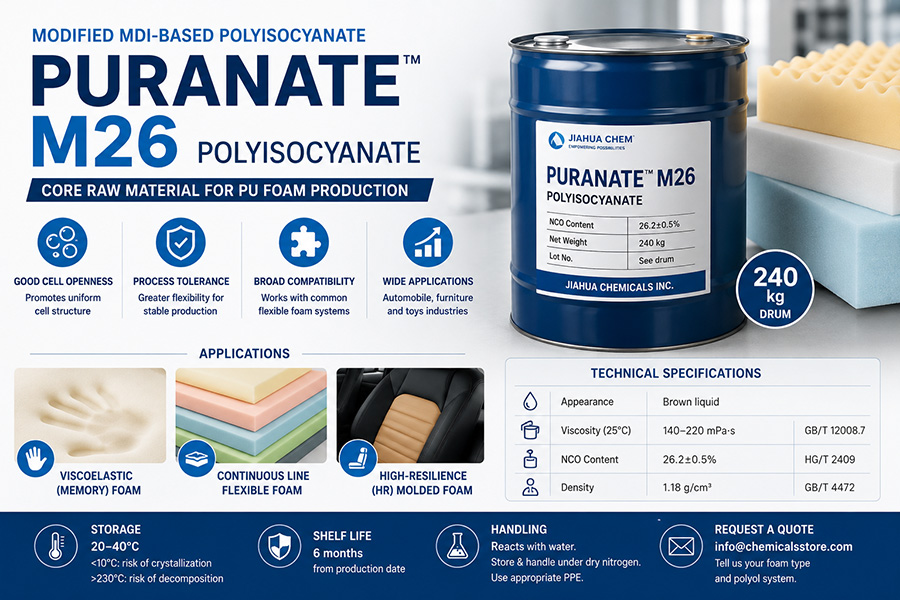
According to its product documentation, PURANATE M26 is a modified polyisocyanate supplied by Jiahua Chemicals Inc, based on MDI (diphenylmethane diisocyanate) chemistry. It is described as a brown liquid at ambient temperature, formulated for use as a core raw material in polyurethane foam production.
Key Features and Benefits of PURANATE M26
According to the product documentation, it is positioned around four documented performance areas relevant to foam manufacturers.
Cell Openness and Process Tolerance
The documentation describes this polyisocyanate as supporting good cell openness in the finished foam structure, along with a degree of process tolerance that gives foam producers flexibility when adjusting line speed or ambient conditions during production.
Foam Compatibility and End-Market Fit
The documentation also references broad compatibility with common flexible foam formulation systems, along with suitability across the end markets the product page lists, which include automobile, furniture, and toys industries.
Technical Specifications for PURANATE M26 Polyisocyanate
The product page lists the following documented technical specifications for PURANATE M26 polyisocyanate:
- Appearance: brown liquid
- Viscosity at 25°C: 140-220 mPa·s, tested per GB/T 12008.7
- NCO Content: 26.2±0.5%, tested per HG/T 2409
- Density: 1.18 g/cm³, tested per GB/T 4472
Buyers working with international quality systems should note that these listed test methods are Chinese national and industry standards; NCO content in polyisocyanates is also commonly verified internationally using methods such as ASTM D5155, and buyers with a specific compliance requirement should confirm which method their quality team expects before finalizing an order.
Applications for PURANATE M26 Across Foam Types
The product documentation lists three foam production types for this polyisocyanate.
Viscoelastic and Memory Foam
PURANATE M26 polyisocyanate is referenced for viscoelastic, or memory, foam production, a foam category widely used in cushioning applications where slow recovery and pressure distribution are priorities.
Continuous Line Flexible Foam
The documentation also lists continuous line flexible foam as an application, relevant to producers running high-volume slabstock foam lines for furniture and bedding markets.
High-Resilience Molded Foam
High-resilience (HR) molded foam is the third documented application, a foam type commonly used in automotive seating and other molded cushioning parts where resilience and durability matter alongside comfort.
Storage, Handling, and Safety for PURANATE M26
According to the documentation, PURANATE M26 polyisocyanate should be stored between 20°C and 40°C. Storage below 10°C carries a risk of crystallization, while temperatures above 230°C can cause decomposition, so buyers should plan warehouse conditions accordingly. The documented shelf life is six months from the production date under recommended storage conditions.
The safe handling notes on the product page state that this polyisocyanate reacts with water and should be protected under dry nitrogen during storage and handling. Appropriate personal protective equipment is required when handling the material, consistent with standard practice for isocyanate-based chemicals. The product is documented as packaged in 240 kg drums.
Sourcing PURANATE M26
Buyers evaluating PURANATE M26 polyisocyanate for a new foam formulation should request the current technical data sheet and safety data sheet to confirm dosage guidance, compatibility with their existing polyol system, and current lead time, since production schedules and packaging availability can vary by order volume. Because reactivity and process tolerance can differ between foam lines, small-scale trials are generally worthwhile before committing to a full production run.
Frequently Asked Questions
What is PURANATE M26 polyisocyanate used for?
It is a modified MDI-based polyisocyanate used as a raw material in polyurethane foam production, referenced for viscoelastic/memory foam, continuous line flexible foam, and high-resilience molded foam.
What industries use PURANATE M26?
According to its documentation, it is referenced for automobile, furniture, and toys industries, primarily through foam components such as seating, cushioning, and molded parts.
How should PURANATE M26 polyisocyanate be stored?
It should be stored between 20°C and 40°C. Storage below 10°C risks crystallization, and temperatures above 230°C can cause decomposition. Documented shelf life is six months from production under recommended conditions.
What is the NCO content of PURANATE M26 polyisocyanate?
The documented NCO content is 26.2±0.5%, tested per HG/T 2409.
What packaging is PURANATE M26 available in?
It is documented as packaged in 240 kg drums.
ChemicalsStore.com provides sourcing support, technical documentation, and responsive customer service for buyers evaluating PURANATE M26 polyisocyanate alongside other resin, additive, and auxiliary agent products.
Explore our product page: PURANATE M26
Send us your target foam type and polyol system at info@chemicalsstore.com, and we’ll help you confirm stock and get a quote.