



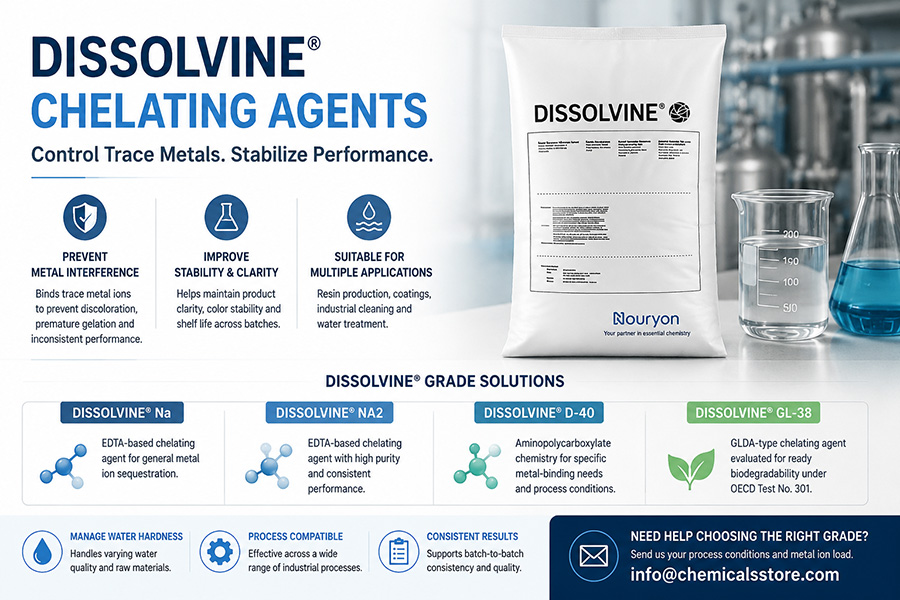
For formulators working on resin production, coatings, and industrial cleaning formulations, a Dissolvine chelating agent is often introduced to control trace metal ions that would otherwise interfere with catalysis, color stability, or product clarity. This guide looks at how different Dissolvine grades compare, where chelating agents fit into resin and coatings production, and what buyers should confirm before selecting a grade for a specific process.
What Does a Dissolvine Chelating Agent Do in Resin Production?
A chelating agent binds trace metal ions such as iron, copper, or calcium that are naturally present in raw materials or process water, preventing those metals from catalyzing unwanted side reactions, discoloration, or premature gelation during resin manufacturing. In coatings and cleaning formulations, the same binding action helps maintain product clarity and stabilize performance across batches with varying water hardness or raw material purity.
Without adequate metal ion control, formulators may see inconsistent cure behavior, off-color batches, or reduced shelf stability, particularly when raw material sources or process water quality change over time. Introducing a chelating agent at the appropriate stage of production is one way manufacturers manage this variability without reformulating the entire system.
Comparing Dissolvine Chelating Agent Grades
EDTA-Based Grades for General Metal Sequestration
Grades such as Dissolvine Na and Dissolvine NA2 are EDTA-based chelating agents commonly referenced for general metal ion sequestration across a range of industrial processes, including resin production and water treatment applications.
Aminopolycarboxylate Grades for Specific Process Needs
Dissolvine D-40 and Dissolvine M-40 represent other aminopolycarboxylate chemistries, each suited to particular metal-binding profiles and process conditions depending on the formulation requirements involved.
Readily Biodegradable Grades
Dissolvine GL-38 is a GLDA-type (glutamic acid diacetic acid) chelating agent, a chemistry class that has been evaluated for ready biodegradability under recognized test methods, which is relevant for formulators working under environmental or regulatory constraints that favor more readily biodegradable alternatives to traditional EDTA chemistry.
Selecting a Dissolvine Chelating Agent for Your Process
Water Hardness and Metal Ion Load
The right grade depends partly on the type and concentration of metal ions present in the process, since water hardness and raw material purity can vary significantly between production sites and batches.
Regulatory and Biodegradability Considerations
Formulators working under environmental or discharge regulations may lean toward GLDA-type chemistry over traditional EDTA-based grades, since biodegradability profiles differ meaningfully between these chemical classes. Ready biodegradability is typically assessed using a recognized method such as OECD Test No. 301, which screens chemicals for biodegradation under aerobic aqueous conditions.
Dosage and Process Compatibility
Because chelating strength and optimal dosage vary by grade and by the specific metal ions being targeted, lab-scale trials are generally recommended before scaling a new Dissolvine chelating agent into full production.
Sourcing a Dissolvine Chelating Agent for Industrial Use
Buyers evaluating these grades for resin, coatings, or cleaning formulations should request current technical data sheets to confirm active content, recommended dosage range, and compatibility with their specific process water and raw materials before committing to a full-scale trial. Buyers can also review our broader auxiliary agent catalog when comparing chelating agents against other process additives.
Frequently Asked Questions
What is a Dissolvine chelating agent used for?
It is used to bind trace metal ions in resin, coatings, and cleaning formulations, preventing those metals from causing discoloration, premature gelation, or inconsistent performance.
What is the difference between EDTA-based and GLDA-type Dissolvine grades?
EDTA-based grades such as Dissolvine Na and NA2 are traditional chelating chemistries, while GLDA-type grades such as Dissolvine GL-38 belong to a chemical class that has been evaluated for improved biodegradability.
How do I know which Dissolvine chelating agent grade fits my process?
Grade selection depends on the type and concentration of metal ions in your process water and raw materials, so requesting a technical data sheet and running a small-scale trial is generally recommended.
Are Dissolvine chelating agents used outside of resin production?
Yes, these chelating chemistries are also used in coatings, industrial cleaning, and water treatment applications wherever trace metal ions need to be controlled.
What documentation should I request before ordering a Dissolvine chelating agent?
Buyers should request the current technical data sheet and safety data sheet for the specific grade, along with confirmation of dosage range and compatibility with their process.
ChemicalsStore.com provides sourcing support, technical documentation, and responsive customer service for buyers evaluating Dissolvine chelating agent grades alongside other resin and auxiliary agent products.
Explore our product page: Dissolvine NA2
You may also be interested in: Dissolvine GL-38, Dissolvine D-40, our Auxiliary Agent catalog, and the Nouryon supplier page
Send us your target process water conditions and metal ion load at info@chemicalsstore.com, and we’ll help you confirm stock and get a quote.