



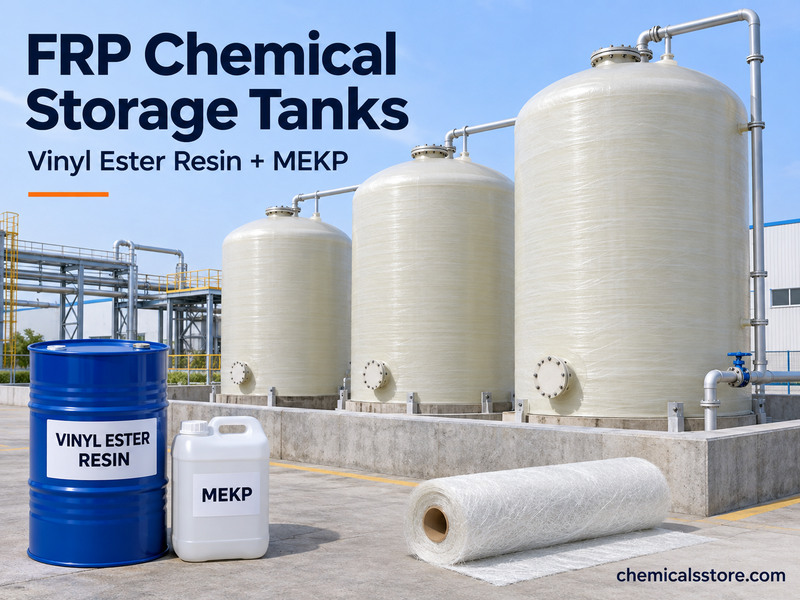
For fabricators building FRP chemical storage tanks, the purchasing decision starts with the liquid the tank will hold and the conditions it will face. A resin grade, a compatible curing system and a qualified laminate design all contribute to reliable service. On ChemicalsStore, buyers can review Atlac 430 vinyl ester resin and related grades alongside MEKP initiators, then request documentation for the exact materials being considered.
Start with the chemical service conditions
Prepare a service specification before comparing resin quotations. Record the chemical name, concentration range, impurities, normal operating temperature and maximum excursions. Include cleaning chemicals, exposure duration and any pressure or cyclic loading. AOC uses these details, together with the laminate construction and process, when assessing chemical resistance.
The chemical resistance guide must be read for the relevant substance and concentration. Mixed media and unusual cleaning cycles may need a separate technical assessment. Ask the resin manufacturer to confirm suitability for the complete service specification before approving the material.
Where Atlac 430 fits in corrosion-resistant tank fabrication
Atlac 430 is a bisphenol A epoxy vinyl ester resin dissolved in styrene. AOC identifies it for corrosive processing environments involving a range of acids, alkalis and bleaches, subject to the relevant service limits. Its processing options include filament winding, centrifugal casting, hand lay-up and spray-up, making it a candidate for evaluation in tank and pipe fabrication.
AOC’s chemical resistance guidance considers the chemical environment, temperature and exposure time. Use that assessment alongside the fabricator’s tank design requirements when choosing a resin.
Select the exact Atlac 430 series grade
The full grade name matters when ordering. Variants in the Atlac 430 series and AOC resin range differ in viscosity, promotion, thixotropy and intended processing behavior. Check the current, region-specific product data sheet for each candidate.
| Grade to review | Selection question |
|---|---|
| Atlac 430 | Does the base grade meet the chemical service and fabrication requirements? |
| Atlac 430 ACT | Is a pre-accelerated, thixotropic grade appropriate for the proposed lay-up? |
| Atlac 430 LV GT250 | Does the process require a lower-viscosity grade, and is its cure schedule qualified? |
| Atlac 430S | Do the grade-specific reactivity and processing data match the manufacturing method? |
For demanding chemical exposure, obtain confirmation for the selected formulation, including any thixotropic additives. A grade’s processing advantages should be evaluated together with the intended corrosion service.
Match the MEKP curing system to the resin
AOC’s published Atlac 430 guidance identifies low-reactivity MEKP with a cobalt accelerator as a curing option. Confirm whether the selected resin already contains an accelerator before finalizing the formulation. The approved system should specify the initiator grade, accelerator arrangement and cure conditions.
One MEKP grade to discuss during qualification is Butanox LPT-IN. Nouryon recommends it for vinyl ester curing and describes a longer gel profile with reduced foaming compared with standard MEKP formulations. These characteristics are relevant when evaluating working time for filament winding and large components. Suitability still needs confirmation in the selected Atlac grade.
MEKP products have different reactivity profiles. Compare supplier cure data using the same resin, temperature and test conditions. Our guide to MEKP active oxygen content and gel time explains the additional checks needed when comparing grades.
Follow the supplier’s approved handling procedure and SDS. Keep peroxide and accelerator separate, and never mix them directly.
Include post-cure and laminate qualification
AOC recommends post-curing Atlac 430 components intended for chemical contact to improve the final state of cure. Agree the schedule for the exact grade and finished tank construction, including how it will be monitored, before production begins. The tank’s geometry, tooling and assembly sequence should be considered when planning this step.
Specify the chemical resistance layer and structural laminate as part of the tank design. Record the resin batches, curing materials and production conditions so the fabricator can verify that the qualified process was followed. The commissioning plan should include the agreed cure checks and inspection criteria.
Prepare a complete material inquiry
Send ChemicalsStore the chemical service specification, fabrication method, full resin grade, required working time, order quantity and delivery destination. Include requests for the current TDS, SDS, batch documentation and manufacturer guidance on chemical resistance and curing.
Explore the Atlac 430 product links above and our MEKP and organic peroxide catalog to prepare a sourcing list. Include the resin and curing system in the same inquiry so the proposed materials can be reviewed together before quotation and production trials.