



Butanox® M-60 and Butanox® HBO-50 both list 9.8–10.0% total active oxygen. Yet Nouryon describes M-60 as a standard-gel grade and HBO-50 as a fast-gelling grade. For buyers comparing methyl ethyl ketone peroxide (MEKP) for composite production, the difference matters. Active oxygen tells you how much peroxide functionality the product contains by weight. Gel time tells you how quickly a particular resin system reaches its gel point under specified conditions. Nouryon curing agents guide
What does total active oxygen mean on an MEKP TDS?
On a technical data sheet (TDS), total active oxygen is a weight percentage that expresses the peroxide functionality of the commercial formulation as an oxygen equivalent. The convention counts one oxygen atom per peroxide bond. For example, Butanox® M-50 has a total active oxygen specification of 8.8–9.0% by weight. That range applies to the formulated product as supplied. MEKP concentration, hydrogen peroxide content and total active oxygen are separate specifications. Japanese Organic Peroxide Industry Association glossary · Butanox M-50 data sheet
How does MEKP active oxygen affect gel time?
MEKP generates radicals that initiate curing. At the same addition rate by weight, a grade with a higher active oxygen percentage introduces more active oxygen into the resin. The gel time also depends on which peroxide species are present and how quickly the formulation generates radicals in that resin system. Resin grade, accelerator type and level, and starting temperature all matter. Gelation marks the point at which the resin reaches a defined loss of flow. The cure continues after that point. NOF organic peroxide technical overview · Nouryon curing agents guide
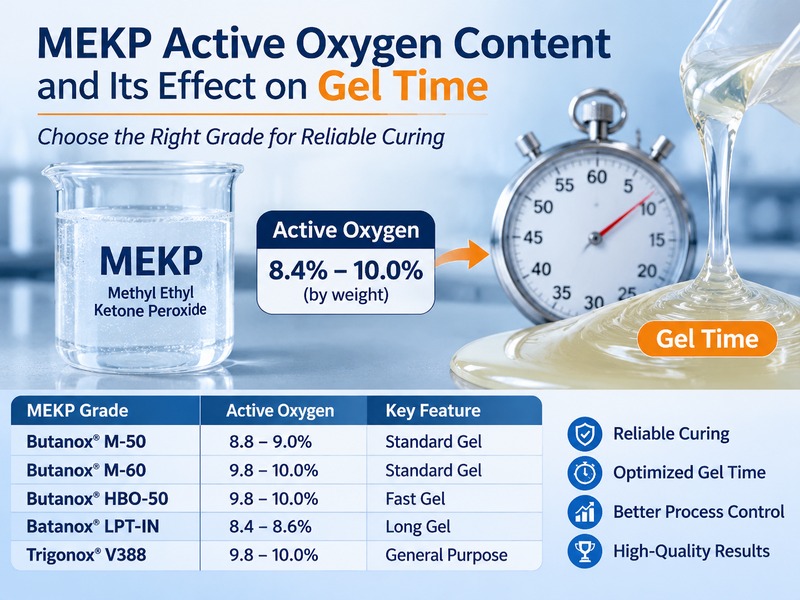
MEKP grade comparison
| MEKP grade | Total active oxygen by weight | Manufacturer’s application or gel profile |
|---|---|---|
| Butanox® M-50 | 8.8–9.0% | General-purpose grade with a standard gel profile for applications such as laminating and gelcoats. TDS |
| Butanox® M-60 | 9.8–10.0% | Higher-active-oxygen general-purpose grade, classified in the standard-gel group. TDS |
| Butanox® HBO-50 | 9.8–10.0% | Fast-gelling grade for applications that need quicker gelation and initial cure. TDS |
| Butanox® LPT-IN | 8.4–8.6% | Long-gel grade suited to processes that need more working time, such as filament winding and large-part production. TDS |
| Trigonox® V388 | 9.8–10.0% | General-purpose grade for laminating resins and castings. Ask for gel-time data for the intended resin system. TDS |
The profiles above describe how Nouryon positions each grade. To compare gel times in minutes, ask for results obtained under matching test conditions.
How to compare MEKP technical data sheets
- Check the exact grade and active oxygen range. Use the full product name, including any suffix. If you need to verify a specific batch, request its certificate of analysis (COA).
- Read the conditions behind each gel-time figure. Check the resin grade, whether it is pre-accelerated, the accelerator and peroxide levels used, the starting temperature, sample size and gel-point method. If the TDS lists active oxygen alone, request an application guide or comparative cure data.
- Qualify the grade against your production requirements. Start with grades approved by your resin supplier and verify gel time in your resin system under representative conditions. If demolding or heat buildup matters, check demold time or peak exotherm separately.
Source MEKP on ChemicalsStore
If you are reordering an approved grade, use the full product name in your inquiry. If you are qualifying a grade for a new application, share your resin grade, process, typical production temperature and target gel time. Include the quantity and delivery destination when requesting a quote, and ask for the grade-specific TDS and SDS. Browse the ChemicalsStore organic peroxide catalog · View Butanox M-50 · View Trigonox V388