



Thixotropic additives are a practical starting point for gelcoat and adhesive formulators developing new products with consistent application behavior. A gelcoat must spread across a mold surface and remain in place. An adhesive must flow through dispensing equipment while maintaining the intended bead shape. Pigments and fillers also need to remain manageable throughout storage.
Thixotropic additives can help address these requirements, but selection depends on the complete formulation. This formulation update looks at established fumed silica technologies for new development projects, with a focus on AEROSIL grades available in the ChemicalsStore product range.
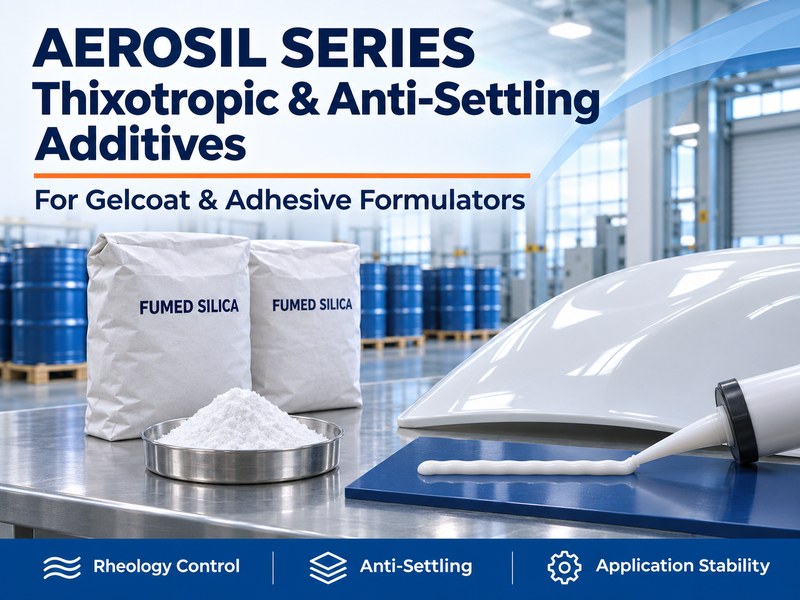
What Should Thixotropic Additives Deliver?
A useful screening program considers three separate outcomes. Flow during mixing and application determines processing behavior. Recovery after application influences shape retention. Sediment condition after storage determines how easily the material can be returned to a uniform state.
Thixotropy describes a time-dependent reduction in viscosity under shear followed by recovery at rest. A single viscosity reading cannot describe this behavior. Anti-settling performance also requires its own storage test, particularly in highly filled or heavily pigmented products. Formulators should therefore define application and storage targets before comparing additive grades.
11 AEROSIL Thixotropic Additives and Related Formulation Options
Surface chemistry and structure help distinguish AEROSIL grades. Hydrophilic grades, hydrophobic grades and structure-modified grades offer different starting points. The tables below cover the relevant products currently listed on ChemicalsStore, with application directions drawn from Evonik product information and selection guides.
Hydrophilic Grades for Gelcoat, Adhesive and Sealant Trials
| Product | Selection direction | Trial priority |
|---|---|---|
| AEROSIL 200 | A reference candidate for polyester and vinyl ester gelcoat rheology, also listed for several adhesive chemistries. | Compare sag resistance, application flow and recovery in the complete formulation. |
| AEROSIL 300 | Listed in Evonik’s guide for epoxy, acrylate and other adhesive systems. | Screen against 200 for the required dispensing profile and cured properties. |
| AEROSIL 380 | A high-surface-area hydrophilic grade with manufacturer-listed applications in unsaturated polyester resins, adhesives and sealants. | Check dispersion demand and application viscosity before selecting a loading. |
| AEROSIL 200 V | A densified hydrophilic grade with handling and incorporation benefits, including adhesive and sealant applications. | Evaluate powder feeding, incorporation time and final rheology using production equipment. |
| AEROSIL 200 HV | A hydrophilic option with manufacturer-listed sealant applications, including RTV-1K silicone sealants. | Confirm grade-specific processing, cure and storage performance for the intended sealant. |
These grades broaden the screening range. A higher surface area alone does not establish the best result in every binder. Treat densified 200 V and 200 HV as separate products with their own documentation and qualification requirements.
Hydrophobic and Structure-Modified Grades for Adhesives
| Product | Selection direction | Trial priority |
|---|---|---|
| AEROSIL R 972 | A hydrophobic candidate listed for polyurethane, MS/SMP/SPU and acrylate adhesives, among other systems. | Evaluate suspension, extrusion and compatibility with the selected binder. |
| AEROSIL R 974 | A DDS-treated hydrophobic grade listed for selected polyurethane, silane-modified and acrylate formulations. | Measure bead stability and storage viscosity at the intended process temperature. |
| AEROSIL R 202 | A hydrophobic rheology option with manufacturer-listed epoxy, vinyl ester, adhesive and sealant applications. | Compare viscosity development and stability in the actual resin and filler package. |
| AEROSIL R 106 | A hydrophobic grade included in manufacturer adhesive and sealant literature, including MS/SMP/SPU systems. | Check suspension and appearance alongside dispensing and cure behavior. |
| AEROSIL R 812 | Included in Evonik application literature for selected adhesive suspension, clarity and drop-profile requirements. | Verify the exact grade designation and assess appearance and bead profile. |
| AEROSIL R 8200 | A structure-modified, HMDS-treated grade with low thickening effects, relevant when reinforcement and processability must be balanced. | Assess reinforcement and loading capability. Establish anti-sag performance independently. |
R 8200 deserves a separate role in the comparison because its manufacturer emphasizes low thickening and good processability at higher loading. It should not be ranked as the strongest thixotrope. R 812 and R 812 S also have distinct grade designations. Recommendations naming R 812 S should not automatically be transferred to the R 812 product listed here.
Matching Thixotropic Additives to the Application
Gelcoat development. Use the polyester and vinyl ester application literature to build a resin-specific shortlist. AEROSIL 200 is a useful reference, while 380 offers an additional manufacturer-listed unsaturated polyester option. Evaluate spray or brush behavior, vertical film build and surface quality together. Adhesive recommendations for other grades require separate validation before use in gelcoat.
Epoxy adhesives and bonding pastes. Evonik’s adhesive guide includes 200, 300 and R 202, among other grades. R 8200 can enter the comparison where reinforcement and manageable viscosity matter. Test both components and the mixed adhesive under the intended dispensing conditions.
Polyurethane and silane-modified adhesives. Shortlist from the binder-specific recommendations in the tables, then compare suspension and bead handling. Include moisture content, catalyst package and storage behavior in the qualification plan.
Appearance-sensitive adhesives and sealants. R 106 and R 812 appear in Evonik’s application literature for selected clarity requirements. Clarity in a specific resin remains a test result. Use the actual formulation and intended film or bead thickness when assessing it.
AEROSIL 200 for Gelcoat Formulation Trials
AEROSIL 200 hydrophilic fumed silica is a relevant candidate when developing rheology in polyester and vinyl ester gelcoats. Evonik’s technical literature discusses fumed silica as a thickening and thixotropic agent in these resin families, including the influence of dispersion equipment and mixing conditions.
For a new gelcoat, start with a reference batch and record resin grade, pigment loading, additive loading and mixing temperature. Apply each trial at the intended wet film thickness on horizontal and vertical panels. Assess sag, leveling, air release and the cured surface under the same conditions.
A useful acceptance sheet should include a defined vertical sag limit and agreed surface criteria. Record any change in cure behavior as well. Repeat the application test after storage to see whether the initial handling profile survives aging.
AEROSIL R 974 for Selected Adhesive Systems
AEROSIL R 974 hydrophobic fumed silica is surface-treated with dimethyldichlorosilane. Evonik’s adhesive and sealant selection guide includes this grade among the options for polyurethane and MS/SMP/SPU systems. The appropriate choice still depends on the binder, fillers and production process.
Adhesive trials should reproduce the actual dispensing method. Compare extrusion force or dispensing pressure, bead profile, slump and substrate wetting at a controlled temperature. For two-component adhesives, evaluate the mixed material at the specified ratio as well as the storage behavior of each component.
Use cured specimens to check the properties relevant to the intended joint. A convenient application viscosity does not establish bond performance. Testing should cover the actual substrates, cure schedule and service conditions required by the customer.
How to Compare Anti-Settling Performance
A practical screening matrix combines additive loading with a controlled dispersion process. Keep the remaining formulation constant during the first comparison. Record mixing sequence, time, temperature and equipment so the preferred laboratory result can be reproduced.
- Initial condition. Record viscosity at defined measuring conditions and inspect for agglomerates.
- Application behavior. Compare flow, sag or slump using the intended application method.
- Storage condition. Assess separation, sediment hardness and ease of redispersion after an agreed period.
- Performance after aging. Repeat application and cure checks on the stored material.
Accelerated storage can support screening, but its relationship to actual shelf life needs validation. Agree on pass criteria before selecting a winner. This keeps the decision tied to production and customer requirements.
Preparing a Product Inquiry
When requesting thixotropic additives, share the resin or adhesive chemistry, solvent or water content, filler package, application method and the problem being observed. A sample of the present viscosity profile and storage history can make technical discussions more useful.
Explore the linked AEROSIL product pages above or browse the Evonik product range on ChemicalsStore. Share your formulation requirements through a product inquiry to request current technical documents, discuss sample evaluation and confirm availability.
Technical references