



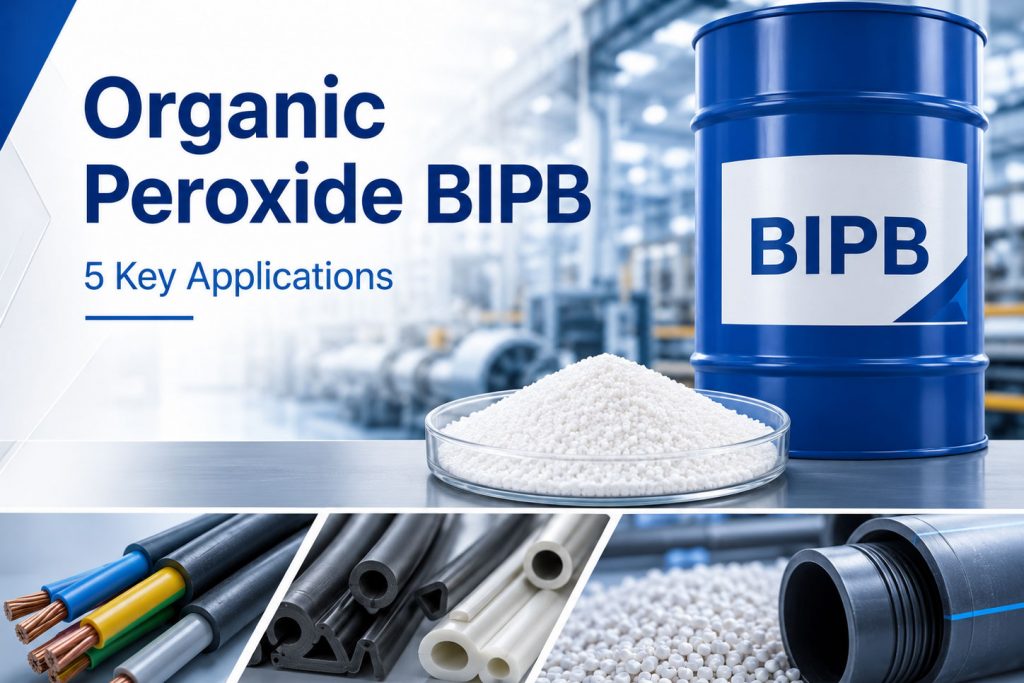
Organic peroxide BIPB — formally known as 1,3-bis(tert-butylperoxyisopropyl)benzene — is a high-temperature cross-linking initiator widely used in rubber and polymer processing. As procurement teams seek stable, technically proven peroxide solutions, organic peroxide BIPB stands out for its balanced reactivity, low volatility, and broad compatibility across polymer substrates. This guide covers five essential applications, key selection criteria, and common sourcing mistakes to avoid when purchasing BIPB from global suppliers.
What Is Organic Peroxide BIPB?
Organic peroxide BIPB belongs to the dialkyl peroxide family. Its decomposition temperature range (approximately 170–195°C) makes it well-suited for high-temperature vulcanization and cross-linking processes. Compared to shorter-lived peroxides, BIPB offers lower odor, improved scorch safety, and fewer volatile byproducts — all critical factors in demanding production environments. It is commercially available in powder and masterbatch forms, with active content typically ranging from 40% to 96% depending on the carrier. ILO chemical safety guidance on organic peroxides provides internationally recognized handling and classification references for procurement and EHS teams.
5 Essential Applications of Organic Peroxide BIPB
1. EPDM Rubber Cross-Linking
EPDM rubber cross-linked with organic peroxide BIPB demonstrates excellent heat resistance, compression set resistance, and long-term aging stability. These properties are critical for automotive seals, roofing membranes, and industrial gaskets. Because BIPB does not require sulfur, it is preferred for low-odor and low-migration applications where cleanliness and purity standards are strict.
2. Wire and Cable Insulation (XLPE and EPR)
In wire and cable production, BIPB is used to cross-link polyethylene (XLPE) and ethylene-propylene rubber (EPR). The resulting material achieves higher thermal class performance — up to 90°C and beyond — making it a preferred initiator for medium-voltage cables and heat-resistant wiring in infrastructure and energy projects.
3. Silicone Rubber Vulcanization
High-temperature vulcanizing (HTV) silicone compounds benefit from BIPB due to its low volatility, which reduces surface blistering during curing. Its high decomposition temperature supports press vulcanization for silicone profiles, gaskets, and components where surface finish and dimensional accuracy are critical.
4. Thermoplastic Elastomer (TPE/TPV) Processing
In thermoplastic vulcanizate (TPV) production — such as PP/EPDM dynamic vulcanization — BIPB functions as both a cross-linking and reactive blending initiator. This allows fine-tuning of rubber phase morphology, improving mechanical performance in automotive interior trims, consumer goods, and construction sealing profiles.
5. Polyolefin Modification and Reactive Compounding
BIPB is also applied in controlled rheology modification of polypropylene and maleic anhydride grafting reactions for polymer compatibilization. These processes are essential in recycled polymer upgrading and specialty compounding where melt flow index adjustment is required. Browse our organic peroxide product range to explore available grades for polymer modification applications.
Key Sourcing Criteria for Organic Peroxide BIPB
When evaluating organic peroxide BIPB from different suppliers, procurement teams should assess the following factors to avoid common mistakes that lead to supply disruptions or quality failures:
Active content and form: Pure BIPB with ≥96% active content is preferred for precision dosing; pre-dispersed masterbatch forms (40–50% on silica or polymer carrier) offer better handling safety in production environments.
Thermal stability data: Request TGA (thermogravimetric analysis) reports to verify decomposition onset temperature. The initiator should have a 10-hour half-life temperature above 100°C, ensuring scorch safety during mixing operations.
Regulatory and transport classification: BIPB at high concentrations is classified as a Class 5.2 dangerous good (Type D or E depending on concentration). Confirm your supplier provides complete SDS documentation and compliance with UN 3106 or UN 3109 transport requirements.
Cold-chain logistics: The peroxide requires temperature-controlled storage below 30°C, away from direct sunlight and heat sources. Verify the supplier can maintain cold-chain integrity throughout cross-border shipping — a detail often overlooked that causes quality issues on arrival.
Supply flexibility: For manufacturers with stable monthly consumption, bulk contracts provide better pricing and supply continuity. Confirm the supplier supports both trial sample orders and full production volumes without extended lead times.
Frequently Asked Questions
What is the difference between organic peroxide BIPB and DCP?
Both are dialkyl peroxides, but BIPB has a higher decomposition temperature and produces significantly less acetophenone byproduct, making it preferred for low-odor applications. DCP is more common in general XLPE cable and foam applications.
Can BIPB be used in carbon black-filled compounds?
Yes. It is compatible with carbon black-filled EPDM and polyolefin compounds. High-surface-area carbon blacks may require adjusted peroxide loading, as they can partially absorb the initiator and reduce crosslink density.
What are the storage conditions for BIPB?
Store below 30°C in a dry, ventilated area away from heat sources and reducing agents. Typical shelf life is 12 months from production date under proper conditions. Follow all supplier-specific SDS requirements.
Is BIPB halogen-free?
Yes. It contains no halogens and is commonly used alongside halogen-free flame retardants (HFFR) in wire and cable compounds to meet EN 50575 or IEC 60332 standards without compromising halogen-free certification.
How does organic peroxide BIPB perform in continuous vulcanization (CV) processes?
It performs well in salt bath (LCM) and fluidized bed CV at 200°C and above. Its long scorch safety window and fast cure rate at processing temperature support high-throughput cable and rubber profile lines.
Ready to Source BIPB?
Whether you are qualifying a new supplier, optimizing your cross-linking system, or consolidating your peroxide procurement, our team can support your sourcing with technical data sheets, competitive pricing, and reliable supply on organic peroxide BIPB and related initiator products. Explore our organic peroxide range or contact us to discuss your application requirements and supply chain needs.