



Pultrusion is one of the most cost-efficient continuous manufacturing processes for FRP (fiber-reinforced plastic) structural profiles. The quality and performance of pultruded products — from structural profiles and gratings to rods and tubes — depend heavily on the pultrusion resin system selected. Choosing the wrong resin or catalyst combination can result in poor surface finish, incomplete cure, dimensional inconsistency, or premature product failure in service. For FRP factories sourcing materials at scale, understanding how to evaluate pultrusion resin options is a critical procurement and quality decision.
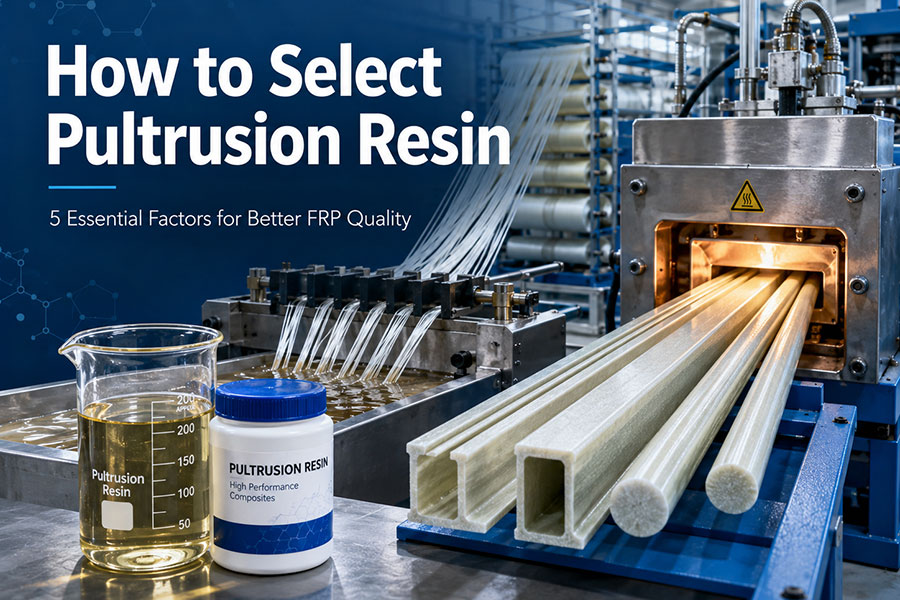
Why Pultrusion Resin Selection Is Critical for FRP Quality
Pultrusion resin must meet a unique set of performance requirements compared to resins used in hand lay-up or spray-up processes. The resin bath is maintained at ambient temperature while reinforcing fibers are continuously drawn through it, demanding precise control of viscosity, reactivity, and pot life. Once the fiber bundle enters the heated die, the resin must cure rapidly and uniformly to allow continuous, high-speed production without line stoppages.
The pultrusion resin system directly affects surface appearance and fiber wet-out quality, mechanical properties such as flexural strength and tensile modulus, chemical resistance of the finished profile, production line speed and process stability, and overall reject rate and manufacturing cost. Selecting materials without properly accounting for these parameters leads to costly line stoppages, product scraps, and delayed deliveries.
5 Essential Factors When Selecting Pultrusion Resin and Curing Agents
1. Resin Type: Polyester vs Vinyl Ester for Pultrusion
Unsaturated polyester resin is the most widely used pultrusion resin due to its balance of cost, processability, and mechanical performance. General-purpose and isophthalic-grade polyester resins are well suited for structural profiles, electrical insulation components, and construction applications. For applications requiring higher corrosion resistance — such as FRP pipes, chemical processing equipment, or offshore structures — vinyl ester resin offers significantly improved chemical resistance and toughness, though at higher material cost and with stricter process controls required.
Explore our resin product range to compare polyester and vinyl ester grades available for pultrusion applications.
2. Viscosity and Fiber Wet-Out Performance
Pultrusion resin must maintain a consistent low-to-medium viscosity — typically 200 to 800 mPa·s at ambient bath temperature — throughout a full production shift. Viscosity that is too high results in incomplete fiber wet-out, causing dry spots, voids, delamination, and increased reject rates. Viscosity that is too low may lead to resin drainage from the fiber bundle, uneven fiber loading, and surface defects on the finished profile.
When evaluating pultrusion resin for high-volume production, request TDS data covering viscosity at process temperature and viscosity drift over a standard shift duration. This confirms that the material maintains process consistency without frequent bath replenishment or viscosity correction.
3. Catalyst Selection and Curing Temperature Match
The curing system is as important as the pultrusion resin itself. Hot-die pultrusion typically operates at die temperatures ranging from 130°C to 180°C depending on the resin grade, profile cross-section, and line speed. The organic peroxide initiator must be matched to the die temperature profile to ensure complete cure in the die without premature gelation in the open resin bath.
Benzoyl peroxide-based initiators in paste form are among the most common choices for hot-die pultrusion, valued for their controlled reactivity and compatibility with unsaturated polyester pultrusion resin systems. Tert-butyl peroxybenzoate (TBPB) and tert-butyl peroxy-2-ethylhexanoate are also used for higher-temperature profiles. Dual-initiator systems combining two peroxides with different half-life temperatures are used where precise staged curing across different die zones is required.
Browse our organic peroxide product range for initiator grades suited to pultrusion curing temperatures from 130°C to 180°C.
4. Chemical Resistance Requirements of the End Application
For standard structural and construction FRP profiles, general-purpose or isophthalic pultrusion resin delivers adequate durability and service life. Where profiles will be exposed to acids, alkalis, solvents, or saline environments — such as in water treatment plants, chemical facilities, or marine infrastructure — the specification shifts toward isophthalic polyester or bisphenol-A vinyl ester grades. Referencing ASTM C581 for chemical resistance testing of thermoset resins helps procurement and engineering teams specify the correct pultrusion resin grade for the actual service environment.
5. Supply Chain Stability and Technical Support
For continuous pultrusion operations, supply interruptions cause direct and measurable production losses. Working with a material supplier that maintains consistent batch quality — with COA data, and technical support for resin-catalyst matching, die temperature optimization, and process troubleshooting — is a practical operational requirement rather than an optional preference.
When requesting samples or quotations for pultrusion resin, provide your current production parameters: resin grade and type, catalyst type and loading percentage, die temperature profile, line speed, and profile geometry. This allows the supplier to confirm material compatibility or recommend adjustments before full-scale production trials begin.
Common Pultrusion Defects and Their Material-Related Causes
Even with the right pultrusion resin selected, process variables can introduce quality issues. Understanding the material causes of common defects helps teams resolve problems faster and reduces reliance on trial-and-error adjustments.
Surface cracking or crazing: Often caused by excessive catalyst loading, die temperature set too high for the resin grade, or a resin that is too rigid for the thermal stresses experienced during cure and post-cure cooling. Reducing catalyst concentration or selecting a more flexible resin grade typically resolves this.
Incomplete cure (tacky surface or soft core): Indicates insufficient catalyst loading, die temperature below the required cure threshold, or line speed too fast for the resin/catalyst combination. Confirm the recommended catalyst loading range for your specific pultrusion resin grade and target die temperature profile.
Fiber bridging and voids: Result from inadequate fiber wet-out in the resin bath, typically caused by high resin viscosity, insufficient bath length, or fiber sizing incompatible with the resin chemistry. Adjusting bath temperature or resin viscosity resolves most cases.
Delamination under load: May indicate poor fiber-resin interfacial adhesion, contaminated fibers, or incompatible sizing chemistry on the glass fiber reinforcement. Ensure that fiberglass mat or woven roving used carries a sizing designed for compatibility with the pultrusion resin chemistry in your production system.
Frequently Asked Questions About Pultrusion Resin
What is the most common type of pultrusion resin?
Unsaturated polyester resin — particularly isophthalic grade — is the most widely used pultrusion resin for general structural and construction applications, offering a practical balance of cost, processability, and mechanical performance.
What catalyst is typically used in hot-die pultrusion?
Benzoyl peroxide-based initiators in paste form are among the most common catalysts for hot-die pultrusion due to their controlled reactivity profile. The specific catalyst grade is selected based on the die temperature and the required gel time in the open resin bath.
Can vinyl ester resin be processed through pultrusion?
Yes. Vinyl ester resin is used in pultrusion for applications requiring higher chemical resistance and toughness, such as FRP profiles for chemical processing plants, offshore platforms, and water treatment infrastructure. Process adjustments to resin bath temperature and catalyst loading are typically required compared to standard polyester pultrusion.
What is the difference between MEKP and benzoyl peroxide for pultrusion?
MEKP (methyl ethyl ketone peroxide) is designed for ambient or low-temperature cure systems such as hand lay-up and spray-up. Hot-die pultrusion requires high-temperature organic peroxide initiators such as benzoyl peroxide paste or TBPB, which are active at die temperatures of 130°C and above. MEKP will not provide adequate cure in a hot-die pultrusion system.
How can I request a sample or quotation for pultrusion resin?
Contact us with your process parameters — resin type, profile dimensions, die temperature profile, target line speed, and end-application requirements — and our team will recommend suitable resin and catalyst grades, arrange material samples, and provide a competitive sourcing quotation for your procurement review.
Source Pultrusion Resin and Curing Systems for Your FRP Operation
Whether you are qualifying a new pultrusion resin grade, scaling up an existing production line, or troubleshooting a curing defect, working with a supplier that offers both material depth and technical process support reduces sourcing risk and accelerates your production qualification timeline. Contact us to discuss your pultrusion resin and catalyst requirements, request samples, or receive a quotation tailored to your production scale and application environment.