



Organic peroxide BIPB — chemically known as 1,4-bis(tert-butylperoxyisopropyl)benzene — is one of the most thermally stable peroxide initiators in industrial rubber vulcanization and polymer crosslinking. For procurement teams sourcing materials for EPDM rubber compounding, silicone vulcanization, or polyethylene crosslinking, selecting the right organic peroxide BIPB grade directly affects product performance, processing efficiency, and production costs.
This guide covers key properties, applications, and sourcing criteria that B2B buyers need before placing international supply orders.
What Is Organic Peroxide BIPB?
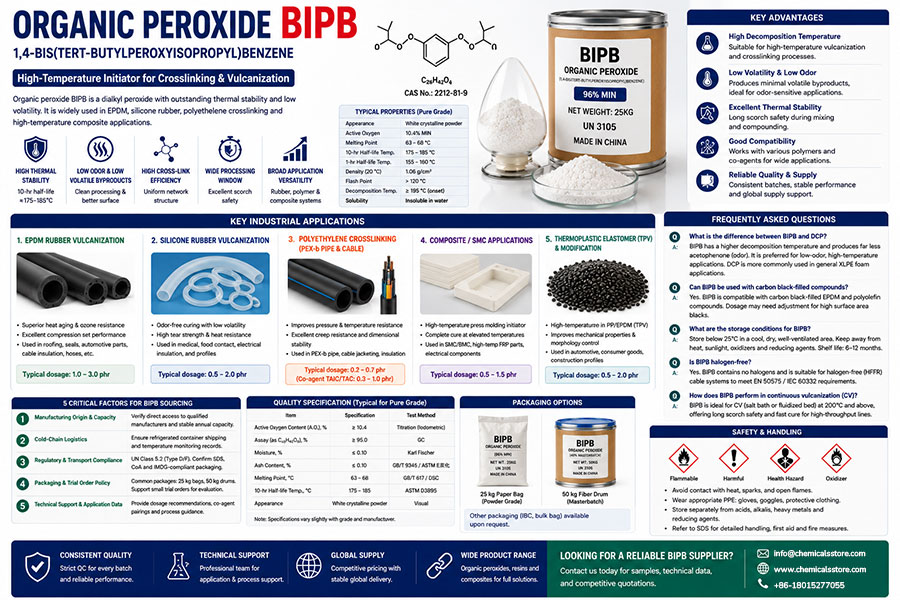
Organic peroxide BIPB belongs to the dialkyl peroxide family. Its high decomposition temperature — typically around 175–185°C for a 10-hour half-life — makes it suitable for high-temperature vulcanization processes where shorter-lived peroxides would decompose prematurely. Unlike diacyl peroxides, BIPB generates minimal volatile byproducts during crosslinking, which is critical for applications where surface appearance and dimensional stability matter.
BIPB is commercially available in two standard forms: pure powder (≥95% active oxygen content) and masterbatch or carrier-diluted forms (typically 40–45% concentration on silica or polymer carriers) for easier handling and dispersion in rubber matrices.
Key Industrial Applications of Organic Peroxide BIPB
EPDM and Silicone Rubber Vulcanization
The largest end-use segment for organic peroxide BIPB is EPDM rubber compounding, used in roofing membranes, automotive weatherstripping, sealing profiles, and wire and cable insulation. Peroxide-crosslinked EPDM delivers superior heat aging resistance and excellent compression set performance compared to sulfur-cured alternatives — properties essential for components operating under elevated temperatures over extended service life.
In silicone rubber applications, BIPB enables odor-free curing — important for food-contact profiles, medical tubing tooling, and high-voltage electrical insulation. Its low volatility ensures cleaner processing and better surface finish consistency.
Polyethylene Crosslinking for Pipe and Cable
Organic peroxide BIPB is widely used as a crosslinking agent for medium- and high-density polyethylene in pipe and wire applications. BIPB-based crosslinking (the PEXb method) produces a uniform network structure that improves pressure resistance, creep resistance at elevated temperatures, and long-term dimensional stability — properties critical for hot-water pipe systems and cable jacketing applications.
Specialty Composite and SMC Applications
In some FRP and specialty thermoset systems, BIPB serves as a high-temperature initiator where standard MEKP catalysts are insufficient. Composite manufacturers working with SMC (Sheet Molding Compound) formulations or high-temperature press molding often specify this peroxide class to achieve complete cure at elevated mold temperatures. For buyers working with FRP pipe, tank, or composite component systems, our organic peroxide product range provides detailed selection reference by application.
5 Critical Factors for Organic Peroxide BIPB Sourcing
Sourcing organic peroxide BIPB from international suppliers requires evaluation beyond price alone. The following five criteria are priorities for experienced procurement managers.
1. Manufacturing Origin and Capacity Verification. Confirm that the supplier has direct access to a qualified manufacturing facility, not a trading intermediary. Verified production capacity matters when scaling orders during demand peaks or supply disruptions.
2. Cold-Chain Logistics Capability. BIPB degrades under heat exposure during transit. Ask whether your supplier can provide refrigerated container shipping and temperature-monitoring records upon delivery.
3. Regulatory Documentation. For international shipments, UN Class 5.2 dangerous goods classification compliance is mandatory. Verify that proper hazardous goods declarations and IMDG-compliant packaging documentation are included with each shipment.
4. Packaging Flexibility and Trial Order Policy. Standard packaging includes 25 kg paper bags (powder grade) or 50 kg drums. For smaller evaluation orders, confirm whether the supplier accommodates trial quantities without significant price premiums.
5. Technical Support and Application Data. A qualified supplier should be able to provide recommended loading levels, co-agent pairings (such as TAIC or TAC for PE crosslinking), and processing condition guidance — distinguishing a supply chain partner from a commodity trading intermediary.
For buyers comparing peroxide options across different polymer applications, our resin and composites range also covers initiator compatibility for hand lay-up, pultrusion, and filament winding systems.
Quality Benchmarks for BIPB Specification Review
Before approving a new BIPB source, request a Certificate of Analysis (CoA) confirming active oxygen content (minimum 10.4% for pure grade), ash content below 0.1%, and thermal stability data. Cross-reference with the ASTM F876 standard for crosslinked polyethylene pipe when BIPB is used in PEX-b pipe manufacturing, and verify that reported values meet your downstream application specification.
Frequently Asked Questions
What is the shelf life of organic peroxide BIPB? When stored below 25°C in a cool, dry, well-ventilated area, sealed BIPB powder typically maintains a shelf life of 6–12 months. Refer to the product SDS for specific stability requirements.
Can BIPB be blended with MEKP in FRP applications? No. Organic peroxide BIPB and MEKP have incompatible decomposition temperature profiles and should never be blended. MEKP is appropriate for ambient-temperature FRP cure systems; BIPB is used in high-temperature press molding or polymer crosslinking processes.
What co-agents are recommended for PE crosslinking with BIPB? Triallyl isocyanurate (TAIC) and triallyl cyanurate (TAC) are the most widely used co-agents. They accelerate network formation and reduce total peroxide loading needed for equivalent crosslink density.
Is organic peroxide BIPB hazardous for international shipping? Yes. It is classified as a UN 3101 or UN 3105 organic peroxide (Type D or F depending on concentration). All shipments require hazmat documentation and temperature-controlled packaging.
How do I verify supplier quality before placing a bulk order? Request CoA data for active oxygen content, ash, and moisture per production lot. Evaluate whether reported values are consistent across batches — variability signals raw material or process control issues.
Work with a Qualified Supply Chain Partner
Whether you are scaling EPDM rubber production, expanding PE crosslinking output, or evaluating organic peroxide BIPB for high-temperature composite applications, supply chain reliability starts with verified quality, documented cold-chain logistics, and technical support aligned with your processing requirements.
Contact our team for application consultation, volume pricing, and sample requests. We support procurement across rubber compounding, wire and cable, FRP composite, and specialty polymer manufacturing.