



As global renewable energy expansion accelerates, wind power remains one of the fastest-growing segments—pushing the demand for advanced composite materials to new heights. In 2025 and beyond, the performance of wind turbine blades depends heavily on the industry’s progress in resin chemistry, surface protection systems, and lightweight reinforcement materials.
This article explores the core composite materials used for modern wind turbine blades, their role in structural performance, and the market trends shaping future procurement decisions.
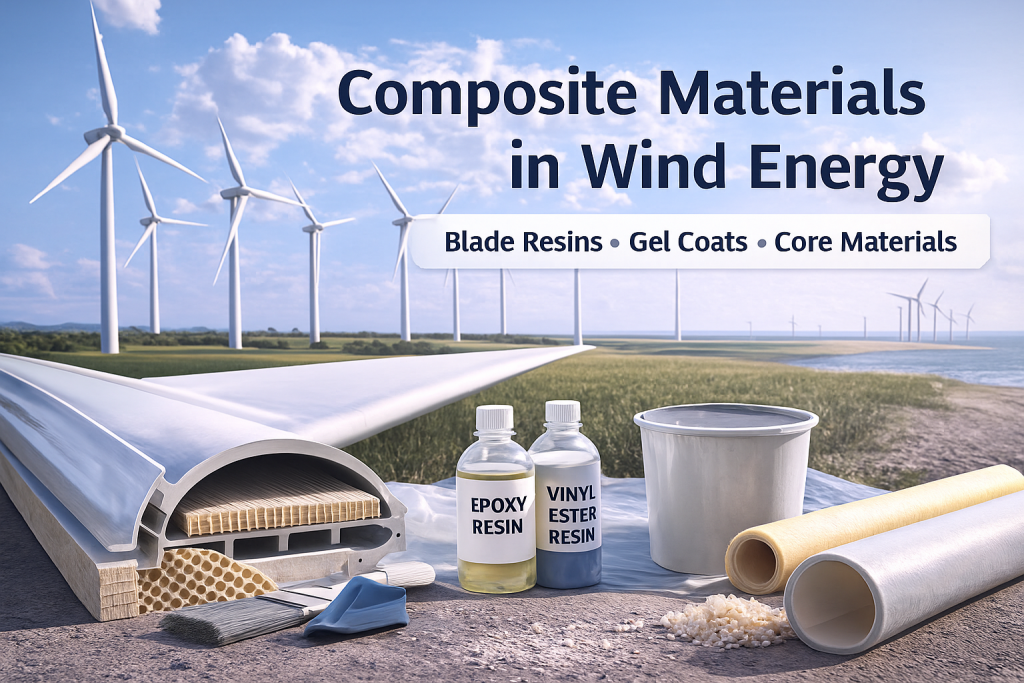
Why Composites Dominate Wind Turbine Blade Manufacturing
Wind turbine blades must deliver three critical characteristics simultaneously:
- High strength-to-weight ratio
- Long-term fatigue resistance
- Superior weather and UV durability
Conventional materials such as steel or aluminum cannot meet these requirements. Composite materials—specifically fiberglass, carbon fiber, vinyl ester resins, epoxy resins, gel coats, and lightweight core materials—have therefore become the industry standard.
The result is a material system capable of enduring decades of exposure to mechanical loading, saltwater, humidity, and extreme temperature changes.
Blade Resins: Vinyl Ester vs Epoxy
Vinyl Ester Resin: the Workhorse for Cost-Effective Blades
Vinyl ester resin (VER) has long been preferred for:
- High chemical resistance
- Excellent mechanical performance
- Faster curing cycles
- Better tolerance during manufacturing
It remains widely used in wind blades ranging from mid-size to utility scale. The material’s balance of cost and performance makes it ideal for resin infusion and hand lay-up processes.
Epoxy Resin: Preferred for High-End, Large Rotor Blades
For turbines exceeding 5 MW and offshore installations, epoxy resin systems dominate due to:
- Superior fatigue resistance
- Greater bond strength
- Lower shrinkage during curing
- Higher thermal stability
The industry shift toward longer blades—now exceeding 120 meters in length—continues to drive strong demand for high-performance epoxy resin systems.
Gel Coats: Protecting Blades Against Harsh Environments
Wind turbine blades face continuous exposure to:
- UV radiation
- Rain erosion
- Salt spray
- Sand abrasion
- Temperature fluctuations
To ensure long-term durability, advanced gel coat systems play a vital role. These coatings create a protective barrier that:
- Prevents moisture intrusion
- Enhances UV resistance
- Reduces surface cracking
- Extends blade service life
Modern gel coats for wind blades emphasize flexibility, anti-erosion performance, and excellent adhesion to both VER and epoxy laminates.
Core Materials: Lightweight Strength for Massive Blades
As blades grow longer, reducing weight without compromising strength has become a top priority.
Common core materials include:
Balsa Wood
- High compressive strength
- Good fatigue performance
- Natural and sustainable
PVC Foam Core
- Excellent impact resistance
- Easy to machine
- Attractive cost-performance ratio
PET Foam Core
- Increasingly popular for sustainability
- Recyclable and thermally stable
The combination of lightweight foam cores + fiberglass reinforcement + high-strength resin systems enables blade manufacturers to achieve the optimal balance between stiffness and weight.
Market Trend: Offshore Wind Drives High-Performance Composites
Global offshore wind installations are expected to grow sharply over the next decade, driven by:
- Larger turbines (12–20 MW)
- Longer blades
- Harsher operating environments
This shift is increasing the consumption of:
- Carbon fiber reinforcements
- Epoxy resin infusion systems
- Advanced erosion-resistant coatings
- High-density structural foam cores
Suppliers who can deliver consistent quality, stable supply, and advanced resin formulations will be best positioned to serve this evolving segment.
Digital Procurement: Simplifying Composite Material Sourcing for Wind Energy
As wind turbine manufacturers scale production, digital B2B procurement platforms are becoming a key resource for sourcing composite materials more efficiently.
Thousands Technology – Your Digital B2B Store for Composite Materials
Thousands Technology provides a streamlined, modern way to source wind energy materials such as:
- Epoxy resins
- Vinyl ester resins
- Gel coats
- Fiberglass reinforcements
- Additives and curing agents
Why buyers choose Thousands Technology:
- Direct supply from vetted manufacturers
- 100% self-operated & authenticity guaranteed
- Full after-sales support
- Faster comparisons and real-time availability
Whether you are manufacturing blades, nacelle components, towers, or composite substructures, Thousands Technology simplifies your procurement with a trusted digital marketplace.
Sourcing Wind Energy Composite Materials
Wind blade manufacturers and repair shops sourcing resin systems, gel coats, and core materials should confirm compatibility with their infusion or lay-up process, cure schedule, and target blade certification standards before committing to a supplier. We supply unsaturated polyester resin, vinyl ester resin, epoxy resin, and related gel coat and core material systems in bulk, with COA and MSDS provided for every shipment and technical support available to help match grades to your blade design and manufacturing process.
FAQ
What resin systems are commonly used for wind turbine blades?
Wind turbine blades are typically manufactured with epoxy resin or vinyl ester resin systems, chosen for their mechanical strength, fatigue resistance, and compatibility with vacuum infusion processes used in large blade production.
Why is gel coat important in wind blade manufacturing?
Gel coat provides the outer protective layer of the blade, offering weather resistance, UV protection, and a smooth aerodynamic surface finish that helps protect the underlying composite laminate over the blade’s operating life.
Can you supply resin and gel coat systems in bulk for blade manufacturing?
Yes, we supply resin, gel coat, and core material systems in bulk with COA and MSDS provided for every shipment. Contact our team with your blade design and volume requirements for a tailored quote.
What core materials are used alongside blade resins?
Common core materials include balsa wood and structural foams such as PVC and PET, selected based on stiffness-to-weight requirements, cost, and compatibility with the chosen resin infusion process.
Do you provide technical support for matching resin grades to blade specifications?
Yes, our technical team can help match resin, gel coat, and core material grades to your blade design, cure schedule, and certification requirements. Contact us with your project details.