



Trigonox K-80 is a widely used organic peroxide for FRP and composite curing, offering reliable free-radical initiation across a broad range of processing temperatures. For FRP manufacturers, boat builders, pipe and tank fabricators, and pultrusion operators sourcing curing agents, understanding when and how to deploy Trigonox K-80 can directly impact laminate quality, cycle time, and process consistency. This guide covers five key application areas, selection criteria, and practical handling considerations to support informed procurement decisions.
What Is Trigonox K-80?
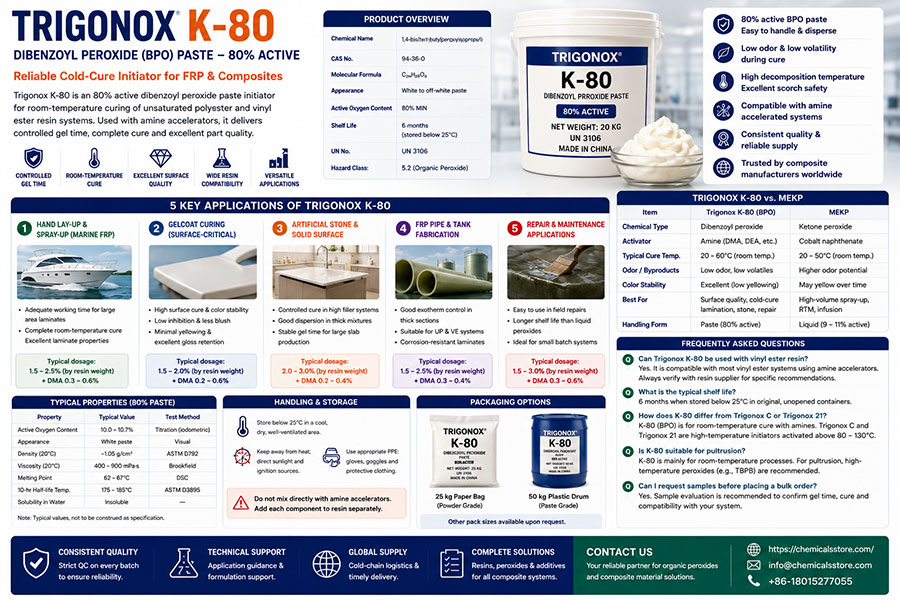
Trigonox K-80 is a dibenzoyl peroxide (BPO)-based organic peroxide supplied as an 80% active paste in a plasticizer carrier. It belongs to the diacyl peroxide family and is commonly used as a room-temperature or mildly elevated-temperature initiator in unsaturated polyester resin and vinyl ester resin systems. Its half-life characteristics make it suitable for applications where controlled gel time and cure speed are priorities.
As a member of the broader organic peroxide product family, Trigonox K-80 is typically used alongside amine accelerators such as DMA (N,N-dimethylaniline) or DEA (N,N-diethylaniline) to achieve room-temperature cure in cold-cure laminating systems.
5 Key Applications of Trigonox K-80 in Composite Manufacturing
1. Hand Lay-Up and Spray-Up for Marine FRP
In marine composite manufacturing — including hull laminates, deck panels, and structural components — Trigonox K-80 is frequently selected for its compatibility with amine-accelerated polyester systems. When formulated with an appropriate DMA level, it enables gel times of 15–45 minutes at 20–25°C, giving fabricators sufficient working time for large surface lay-ups while ensuring a complete room-temperature cure. This makes it a practical alternative to MEKP in facilities that require consistent performance without external heating equipment.
2. Gelcoat Curing in Surface-Critical Applications
Gelcoat quality is a primary concern for marine, sanitary ware, and architectural composite products. Trigonox K-80 is used in gelcoat formulations where surface cure completeness and color stability are critical. BPO-based systems tend to produce minimal surface inhibition and lower residual yellowing compared to some other peroxide types, making them a preferred initiator when final appearance is non-negotiable. Formulators typically adjust the BPO-to-accelerator ratio to tune both surface cure and through-cure speed based on ambient conditions.
3. Artificial Stone and Solid Surface Manufacturing
Artificial stone panels and solid surface materials — including engineered quartz composites, cultured marble, and filled resin countertop products — rely heavily on BPO/amine cure systems. Trigonox K-80 provides the controlled reactivity needed for these high-filler-loading formulations, where viscosity management and complete matrix cure are essential to achieving the density and mechanical uniformity required for finished slabs. The paste form of Trigonox K-80 also aids dispersion into high-viscosity filled resin blends compared to powder BPO grades.
4. FRP Pipe and Tank Fabrication
FRP pipe and tank fabricators operating filament winding and hand lay-up processes require initiators that deliver consistent gel and cure profiles across large structures. Trigonox K-80 is used in both isophthalic and orthophthalic unsaturated polyester resin systems for these applications, where controlled exotherm management during thick-section cure is important to prevent cracking or delamination. For chemical-resistant liners using vinyl ester resin, Trigonox K-80 is also compatible with systems requiring specific amine accelerator combinations for corrosion-resistant laminates.
5. Repair and Maintenance Applications
Field repair of FRP structures — boats, tanks, piping systems, and automotive panels — commonly uses BPO/amine cold-cure systems due to the absence of heat infrastructure on-site. Trigonox K-80 in repair resin kits provides a stable, pre-mixed paste that offers longer shelf life than liquid peroxide alternatives and easier dosage in small-batch applications. This makes it a practical choice for maintenance operations in marine yards, industrial facilities, and composite repair shops.
Trigonox K-80 vs. MEKP: Key Selection Considerations
Both Trigonox K-80 (BPO-based) and MEKP (methyl ethyl ketone peroxide) are widely used in polyester and vinyl ester composite systems, but they operate through different mechanisms and suit different process requirements. MEKP requires cobalt naphthenate or cobalt octoate as a promoter, while Trigonox K-80 uses amine accelerators. Key selection factors include:
- Cure system compatibility: BPO/amine systems are preferred where cobalt promoters may cause color issues in light-colored laminates or gelcoats, as cobalt can introduce discoloration over time.
- Temperature range: Trigonox K-80 is effective at room temperature and mildly elevated temperatures (20–60°C). MEKP systems can also cure at ambient conditions but may require promoter adjustment in cold environments.
- Process type: MEKP is dominant in high-volume spray-up and RTM processes. Trigonox K-80 is preferred in surface-quality-critical applications and cold-cure hand lay-up.
- Storage and handling: Trigonox K-80 paste has a more forgiving handling profile than liquid MEKP in terms of spill risk, though BPO still requires controlled storage temperature below 25°C.
Handling and Storage Guidelines for Trigonox K-80
Organic peroxides require careful storage and handling to maintain efficacy and ensure safety. For Trigonox K-80 specifically:
- Store below 25°C, away from heat sources and direct sunlight
- Keep separate from accelerators (amines, cobalt compounds) — do not mix directly; add each to the resin separately
- Use appropriate PPE: chemical-resistant gloves, eye protection, and ventilation in processing areas
- Refer to the current Safety Data Sheet (SDS) for transport classification (UN 3106 or similar) and regulatory requirements in your destination country
For detailed handling guidance, the ILO Chemical Safety guidance provides internationally recognized frameworks applicable to organic peroxide use in industrial settings.
Frequently Asked Questions
Can Trigonox K-80 be used with vinyl ester resin?
Yes. Trigonox K-80 is compatible with most vinyl ester resin systems when used with appropriate amine accelerators. However, formulators should verify compatibility with their specific resin grade, as some vinyl ester systems are optimized for MEKP/cobalt systems. Consult your resin supplier’s technical data sheet for recommended initiator systems.
What is the typical dosage level for Trigonox K-80 in hand lay-up?
Typical dosage levels range from 1.5% to 3% by weight of resin, adjusted based on ambient temperature, required gel time, and the accelerator concentration in the resin system. Lower temperatures generally require higher peroxide or accelerator levels to maintain target cure profiles.
How does Trigonox K-80 differ from Trigonox C or Trigonox 21?
Trigonox K-80 (BPO-based) is a cold-cure initiator used with amine accelerators. Trigonox C (tert-butyl peroxybenzoate) and Trigonox 21 (tert-butyl peroxy-2-ethylhexanoate) are thermally activated peroxides used at elevated temperatures (e.g., 80–130°C) in hot-press or oven-cure composite processes. Selection depends on whether your process uses ambient cure or thermal cure.
Is Trigonox K-80 available in different activity levels?
BPO is available in various concentrations and carrier systems. The “K-80” designation refers to an 80% active BPO paste in a liquid plasticizer. Other grades include 50% and 75% pastes as well as dry BPO powder. The paste grades are generally preferred in composite manufacturing for ease of dispersion and reduced dust exposure versus dry powder.
What are lead times and minimum order quantities for Trigonox K-80?
Lead times and MOQs vary by supplier location and order volume. For overseas buyers purchasing from Chinese composite chemical suppliers, typical lead times range from 2 to 6 weeks depending on destination, with FCL and LCL options available for different volume requirements. Contact our team for current availability and supply chain arrangement options specific to your procurement needs.
Sourcing Trigonox K-80 and Organic Peroxides for Your Production
Reliable supply of organic peroxides is a critical factor for composite manufacturers managing production schedules and material cost. Whether you are operating a single-product FRP facility or managing a multi-line composite plant with diverse resin systems, consistent access to quality-tested BPO-based initiators supports both product quality and process stability.
Our team works with overseas composite material buyers, FRP factories, and chemical traders to provide supply chain resource support for organic peroxides including BPO-based products, MEKP grades, and specialty peroxide initiators for pultrusion and filament winding. We offer technical pre-sales support to help match the right initiator to your specific resin system and process conditions.
Ready to discuss your organic peroxide requirements? Contact us to share your resin system, process type, and volume needs — our technical team will provide application-matched recommendations and a sourcing proposal tailored to your production schedule.