



Gelcoat topcoat grades are not interchangeable, and buyers who treat them that way usually find out the hard way — through print-through, slow cure, or a color mismatch on a finished FRP part. Search activity from overseas buyers shows steady interest in a wide range of specific waxed and unwaxed topcoat codes, which suggests formulators are actively comparing options rather than defaulting to whatever a supplier has on hand. That comparison shopping is a reasonable instinct, since two grades with similar descriptions can still behave very differently once they reach a spray gun or brush.
Gelcoat Topcoat Grades: Why So Many Codes Exist
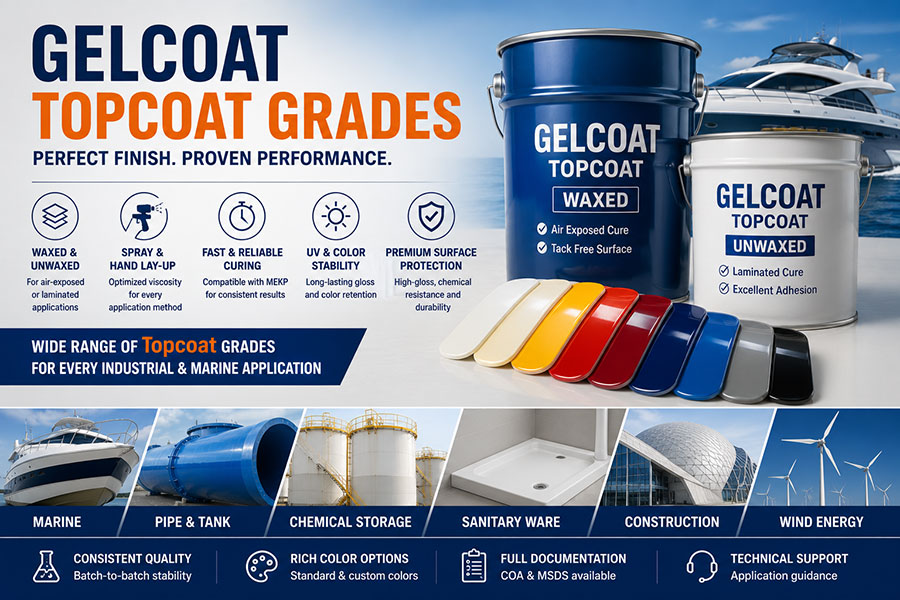
Topcoat gelcoats are the final layer applied over a laminate or a base gelcoat, so their job is almost entirely about the finished surface: color hold, gloss retention, and a fully cured, tack-free skin exposed to air. That last point is why gelcoat topcoat grades split into waxed and unwaxed versions in the first place. Waxed grades contain a surface-active additive that rises to the top during cure and seals out oxygen, which is what allows a topcoat to harden fully when it is left exposed rather than sandwiched under another layer of laminate. Unwaxed grades skip that additive because they are designed to bond to a subsequent layer, where a waxy surface would actually interfere with adhesion.
What Actually Separates One Grade From Another
Buyers researching specific topcoat codes are usually trying to resolve one of a few practical differences between gelcoat topcoat grades:
- Waxed vs. unwaxed — whether the surface is meant to cure exposed to air or under a subsequent layer
- Spray viscosity — how the grade behaves through spray equipment versus brush or roller application
- Cure profile with MEKP — how the grade is expected to respond to standard peroxide catalyst levels and shop temperature
- Color and UV package — how well the pigment system is expected to hold up in outdoor marine or construction exposure
None of these differences are usually visible from a product code alone, which is why buyers comparing gelcoat topcoat grades side by side often request a small trial panel before committing to a full drum order.
Matching Gelcoat Topcoat Grades to Your Application Method
Hand lay-up and spray-up shops tend to favor different viscosity ranges even when the underlying resin chemistry is similar, and artificial stone or heavily filled applications add their own constraints around how much filler the topcoat can carry before spray atomization suffers. Buyers switching suppliers or trying an alternate grade should treat viscosity and application method as a package, not two separate checkboxes — a grade that sprays well in one shop’s equipment can behave differently in another, particularly if gun setup, air pressure, or ambient shop temperature differ from what the original grade was tuned for.
Verifying Gelcoat Topcoat Has Fully Cured
Because waxed gelcoat topcoat grades are formulated to cure exposed to air, a surface that feels dry to the touch is not the same as confirming full cure through the film. Many FRP shops check this with a Barcol hardness test, historically standardized as ASTM D2583, using a portable impressor to measure indentation hardness directly on a finished part. Running a Barcol check on a trial panel is a practical way to confirm that a new gelcoat topcoat grade is reaching full hardness on your shop’s actual cure schedule, rather than assuming it behaves the same as the grade you switched from.
FAQ
How do I know which gelcoat topcoat grade to request?
Start with your application method (spray-up versus hand lay-up), whether the surface cures exposed to air or under another layer, and your color and UV exposure requirements. A supplier who can walk through these questions before quoting is generally easier to qualify against than one who only responds to a specific code.
Can I substitute one topcoat grade for another from a different supplier?
Often yes, but a small trial batch is the safest way to confirm cure behavior and color match before switching a production line over, since waxed content, pigment loading, and viscosity can all vary between suppliers even for a similar description.
Do you provide COA and MSDS documentation for gelcoat products?
COA and MSDS documentation is available on request to support your qualification and compliance process before you place an order.
What is the typical storage life for gelcoat topcoat products?
Storage life depends on the specific grade, temperature, and packaging, so we confirm current shelf life directly with each buyer at the time of quoting rather than quoting a single figure for every product.
What happens if a specific grade is out of stock?
We can help identify a comparable alternative based on your application method and cure requirements, so a delay on one specific code does not have to stall a production run.
ChemicalsStore.com sources resin, gelcoat, additives, and glass fiber together as part of a one-stop supply chain for FRP and composite manufacturers, backed by sourcing support, technical documentation, and responsive customer service on every order.
Explore our product page: Resin and Gelcoat Systems
You may also be interested in:
Send us your application method, cure requirements, and target color at info@chemicalsstore.com, and we’ll help you confirm stock and get a quote.