



Direct roving is one of the most order-sensitive glass fiber products in composite manufacturing, because a mismatch in tex count, sizing chemistry, or winding tension shows up only after the material is already on the machine. For buyers supplying filament winding lines, pultrusion profiles, or pipe and tank production, choosing the right roving is less about finding “a supplier” and more about confirming that a specific spec will run cleanly on a specific process. This guide walks through five checks that overseas composite buyers should run before placing a purchase order.
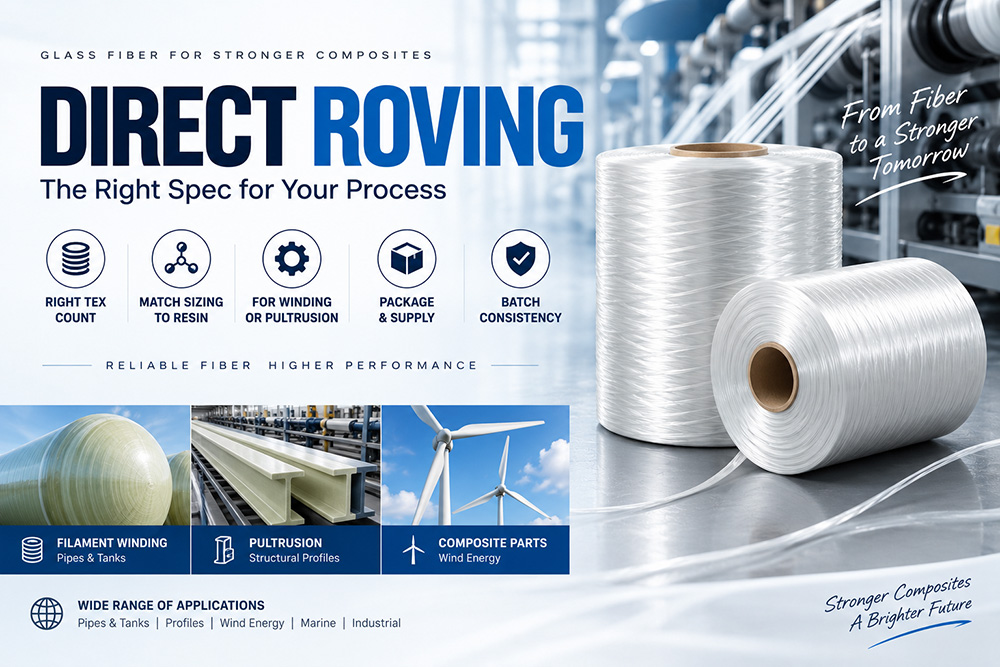
What Direct Roving Is Used For
Direct roving is a continuous glass fiber strand wound directly from the bushing onto a single package, without an intermediate assembly step. That single-strand construction gives it the smooth unwind and consistent tension needed for high-speed filament winding, pultrusion, and some weaving or braiding operations. It differs from assembled roving, which is built up from multiple strands and is more commonly used in spray-up or chopped-strand applications. Getting this distinction right at the sourcing stage avoids ordering a strand that technically contains glass fiber but is not built for the process it will run on.
5 Essential Checks Before You Order Direct Roving
1. Confirm Tex Count Against Your Equipment
Tex (grams per 1,000 meters) determines how the roving feeds, tensions, and wets out on your line. Filament winding typically runs lighter tex ranges for tight fiber placement, while pultrusion profiles for structural FRP pipe and tank walls often call for heavier tex to build wall thickness efficiently. Requesting the tex specification in writing, rather than relying on a generic product name, is the single most common gap buyers report when a new roving batch does not behave like the previous one.
2. Match Sizing Chemistry to Your Resin System
The sizing on direct roving is a chemical coating applied at the bushing, and it is formulated for compatibility with a specific resin family — unsaturated polyester, vinyl ester, or epoxy. A roving sized for polyester resin will not wet out or bond the same way in an epoxy filament winding system, which can show up later as fiber-resin interface weakness. Buyers switching resin systems, or qualifying a second supplier, should always request sizing compatibility data rather than assuming “glass is glass.”
3. Separate Filament Winding Roving from Pultrusion Roving
Even within direct roving, filament winding and pultrusion place different demands on the strand. Filament winding needs consistent unwind at high rotational speed with minimal fuzz generation, since fuzz interferes with fiber placement accuracy. Pultrusion needs a strand that can withstand pulling tension through a heated die without excessive filament breakage. Specifying which process the roving will run on — not just the tex and glass type — helps a supplier route you to the correct grade instead of a general-purpose one.
4. Check Package Format and Supply Stability
Package size, winding pattern, and whether the roving is supplied on a cardboard or plastic core all affect how it runs on creels and how much downtime is spent on package changes. For buyers running continuous production, confirming that a supplier can maintain consistent package format order over order — not just for a single sample shipment — is part of qualifying this material as a repeat-order product rather than a one-off purchase.
5. Ask for Batch-to-Batch Consistency Data
Fiber diameter, sizing pickup, and moisture content can drift between production lots even within the same nominal specification. Composite manufacturers running tight tolerance parts — wind turbine components, pressure pipe, or aerospace-adjacent structures — should ask whether batch test data (tex, filament diameter, loss on ignition) is available for each shipment, so that variation can be tracked over time rather than discovered on the production floor.
Why Sourcing Support Matters for Composite Buyers
Roving specifications reference recognized industry frameworks such as ASTM D578/D578M, the Standard Specification for Glass Fiber Strands, which defines nomenclature and general requirements for continuous and staple glass strand products. Referencing this framework when comparing supplier data sheets gives buyers a consistent basis for evaluating tex, filament diameter, and strand designation across different brands, rather than comparing incompatible internal naming systems.
Sourcing Glass Fiber Roving Through a One-Stop Platform
Because direct roving decisions depend on matching tex, sizing, and package format to a specific process, buyers benefit from working with a sourcing partner that can compare multiple glass fiber options rather than a single fixed catalog. ChemicalsStore.com lists this product alongside woven roving, chopped strand mat, and other glass fiber materials from recommended international brand suppliers, so filament winding, pultrusion, and pipe and tank manufacturers can compare specifications before committing to an order.
Frequently Asked Questions
What tex range is typical for direct roving in filament winding?
Tex requirements vary by winding speed, part geometry, and resin system, and should be confirmed against your specific equipment rather than assumed from a general range. Suppliers can provide tex options once the winding parameters are shared.
Can the same direct roving be used for both filament winding and pultrusion?
Some grades are marketed as general-purpose, but process-matched grades typically perform more consistently, since filament winding and pultrusion place different tension and fuzz-resistance demands on the strand.
Does roving sizing affect resin curing?
Sizing chemistry affects fiber wet-out and the fiber-resin interface rather than cure kinetics directly, but poor compatibility between sizing and resin can lead to wet-out issues that affect final part quality.
How is direct roving different from assembled roving?
It is wound as a single continuous strand directly from the bushing, giving smoother unwind for high-speed processes, while assembled roving is built from multiple strands and is more common in spray-up or chopped applications.
What information should I send a supplier when requesting a direct roving quote?
Process type (filament winding or pultrusion), target tex, resin system, required package format, and order volume allow a supplier to match the correct grade rather than offering a generic product.
For sourcing support, product data sheets, or a comparison of available glass fiber options — including roving from suppliers such as Jushi — send us your target tex, resin system, and process at info@chemicalsstore.com, and we’ll help you confirm stock and get a quote.