



What Is M0811V2 Mold Release Wax?
For composite manufacturers weighing up their next release agent order, M0811V2 mold release wax is a carnauba-based paste wax built specifically for FRP mold work. It is formulated mainly from high-quality Brazilian carnauba wax and is designed to protect composite molds while leaving a high-gloss surface finish on the molded part. Unlike solvent-based semi-permanent release systems, this product is applied, buffed, and polished by hand or with simple tooling, which makes it practical for both small touch-up jobs and full production runs.
For sourcing managers comparing wax-based options against semi-permanent or internal release systems, the checkpoints below cover what M0811V2 mold release wax actually offers on the mold, on the shop floor, and in the box — based only on the specifications published on its product page.
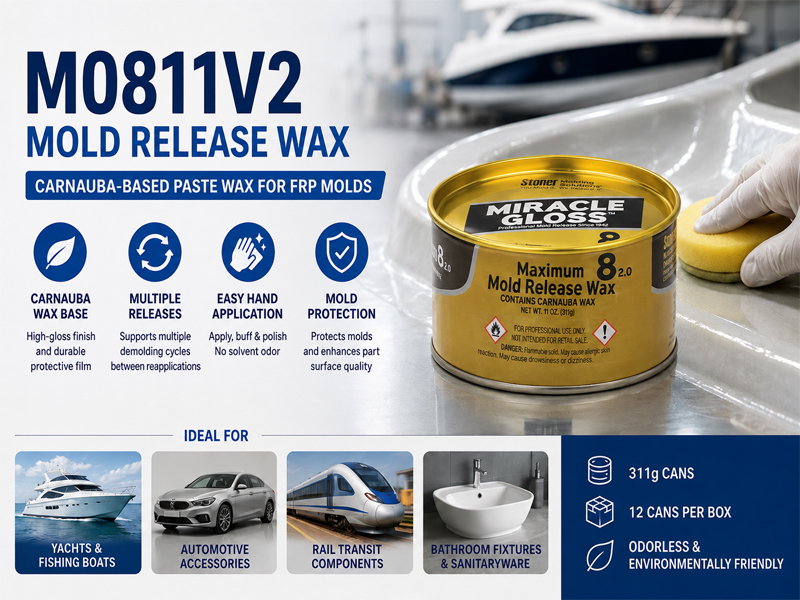
Key Features of M0811V2 Mold Release Wax for Composite Molders
Carnauba Wax Base and High-Gloss Finish
The carnauba wax base is the starting point for evaluating this release wax. Brazilian carnauba wax is prized in mold-release formulations for forming a durable protective film, and here it is positioned to deliver a high-gloss finish that enhances the cosmetic appearance of the molded part — a relevant checkpoint for gelcoated marine and automotive parts where surface appearance is part of the spec.
Multiple Demolding Cycles Between Reapplications
A second checkpoint for any release wax purchase is how many parts you can pull before reapplying. It is described as supporting multiple releases before reapplication is needed, which is the factor that most directly affects labor time and production throughput on a busy mold line.
Easy Hand Application, No Solvent Odor
The wax is applied, wiped, and polished using simple hand tools — a sponge for application and a pure cotton cloth for buffing. It is also described as environmentally friendly and odorless, which is a practical checkpoint for shops trying to improve the working environment on the floor without adding solvent-heavy processes.
Where M0811V2 Mold Release Wax Fits: Applications Across Composite Manufacturing
According to its product listing, this release wax is used across the following composite manufacturing sectors:
- Yachts and fishing boats
- Automotive accessories
- Rail transit components
- Bathroom fixtures and sanitaryware
This spread is a useful checkpoint on its own: a release wax already in use across marine, automotive, rail, and sanitaryware molding suggests it has been tested against a range of gelcoat and mold surface conditions rather than a single niche process. Buyers running hand lay-up, spray-up, or open-mold production for any of these sectors can evaluate M0811V2 mold release wax against their current release system using the same criteria: gloss requirement, release-cycle count, and shop-floor handling.
5 Checkpoints Before You Order M0811V2 Mold Release Wax
1. Mold Condition and Prep
Before applying the wax, the mold surface needs to be thoroughly clean, and older molds should be ground, polished, and sealed first. Confirm your mold prep process matches this requirement before switching release systems.
2. Application and Cure Time
The published directions call for applying it in a circular motion with a sponge, letting it dry and solidify for 10 minutes, then buffing with a pure cotton cloth. Plan for at least five application cycles, with the final coat cured for at least 30 minutes, before the first production pull.
3. Reapplication Interval
Once in production, reapply one to three times whenever demolding difficulty starts to appear, rather than on a fixed schedule. Buyers should weigh this against their own cycle counts and part complexity.
4. Packaging and Order Quantity
M0811V2 mold release wax ships in 311 g cans, 12 cans per box, which is worth checking against your monthly wax consumption before placing a first order.
5. Storage and Handling
It should be stored at room temperature, away from heat sources and open flames, in a well-ventilated area, and kept out of reach of children with care taken to avoid eye contact or swallowing.
Frequently Asked Questions About M0811V2 Mold Release Wax
What is this product made from?
It is based mainly on high-quality Brazilian carnauba wax, formulated specifically for the composite material industry.
How many parts can I demold before reapplying?
The product is described as supporting multiple demolding cycles between reapplications; exact cycle counts will vary with part geometry and gelcoat, so shops should validate on their own molds.
Is this release wax suitable for small shops as well as production lines?
Yes. Because it is applied and buffed by hand with a sponge and cotton cloth rather than sprayed, it is described as suitable for both smaller shops doing touch-up work and full production runs.
What packaging is it sold in?
M0811V2 mold release wax is packaged in 311 g cans, 12 cans per box.
Which industries currently use it?
Listed applications include yachts and fishing boats, automotive accessories, rail transit components, and bathroom fixtures and sanitaryware.
Sourcing M0811V2 Mold Release Wax Through ChemicalsStore.com
ChemicalsStore.com lists this release wax alongside other release agents, gelcoats, resins, and glass fiber products as part of a one-stop sourcing platform for composite manufacturers, so buyers can compare release systems, request documentation, and place orders without juggling multiple suppliers.
Explore our product page: M0811V2 Demolding Wax product page.
You may also be interested in the Auxiliary Agent product category and Henkel-brand release solutions on our supplier page.
For workshop and manufacturing practices relevant to marine mold work, see ISO 12215-4:2002, Small craft — Hull construction and scantlings — Part 4: Workshop and manufacturing.
Send us your mold size, part geometry, and current release cycle count at info@chemicalsstore.com, and we’ll help you confirm stock and get a quote for M0811V2 mold release wax.