



Organic peroxide BIPB (bis(tert-butylperoxyisopropyl)benzene), also known as DIPP or crosslinking agent BIPB-40, is a di-functional organic peroxide used across polymer processing industries. Its balanced decomposition kinetics, low volatility, and minimal byproduct odor make organic peroxide BIPB a preferred choice for wire and cable insulation, rubber vulcanization, and polyolefin crosslinking applications — wherever DCP’s acetophenone byproducts are a concern.
This guide covers the five most important industrial applications of organic peroxide BIPB, how it compares with DCP, and what global buyers need to evaluate before sourcing.
What Is Organic Peroxide BIPB?
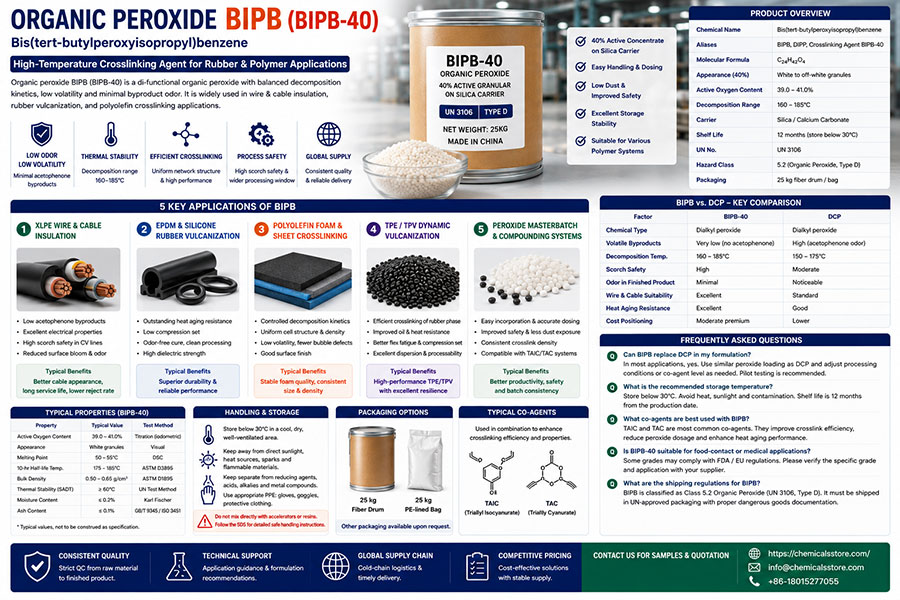
BIPB is commercially supplied as a 40% active concentrate on silica or calcium carbonate carrier (BIPB-40) or as a 96%+ technical-grade white powder. The 40% granular form is the most common for industrial use, offering improved handling safety and reduced dust exposure in compounding lines. Organic peroxide BIPB decomposes in the 160–185°C processing range, making it compatible with standard extruders and injection molding equipment used in rubber and polyolefin processing.
For composite material and rubber manufacturers evaluating crosslinking agents, organic peroxide BIPB is available through our organic peroxide sourcing platform alongside technical data sheets and COA documentation.
5 Key Applications of Organic Peroxide BIPB
1. XLPE Wire and Cable Insulation
Crosslinked polyethylene (XLPE) for medium- and high-voltage cable insulation is one of the largest end-use segments for organic peroxide BIPB. Compared to DCP, BIPB produces significantly lower levels of acetophenone — a volatile byproduct that causes surface blooming and odor issues in finished cable products. Manufacturers using continuous vulcanization (CV) lines benefit from BIPB’s higher processing safety margin (scorch safety), which reduces reject rates and equipment downtime.
2. EPDM and Silicone Rubber Vulcanization
In non-sulfur-compatible elastomers such as EPDM and silicone rubber, organic peroxide BIPB serves as an efficient vulcanizing agent. Vulcanizates produced with BIPB show superior compression set performance, heat aging resistance up to 200°C in silicone systems, and improved electrical insulation properties. These characteristics make BIPB-vulcanized rubber essential for automotive seals, industrial gaskets, and high-voltage insulating components.
3. Polyolefin Foam and Sheet Crosslinking
Crosslinked polyethylene (XPE) foam and sheet manufacturers rely on organic peroxide BIPB for its controlled decomposition kinetics, which allow precise management of foam cell structure, density, and surface finish. Applications include automotive interior acoustic panels, sports equipment padding, and construction insulation boards. BIPB’s lower volatility at processing temperature also reduces bubble defects in thin-wall foam sections.
4. Thermoplastic Elastomer (TPE and TPV) Dynamic Vulcanization
Dynamic vulcanization in thermoplastic vulcanizates (TPV) requires fast, uniform crosslinking of the rubber phase during melt mixing. Organic peroxide BIPB contributes to finely dispersed crosslink networks that improve oil resistance, compression set, and flex fatigue performance in TPE compounds. End-use applications include automotive weather seals, fluid-handling tubing, and consumer goods requiring rubber-like flexibility with thermoplastic processability.
5. Peroxide Masterbatch and Compounding Systems
Compounders frequently incorporate organic peroxide BIPB into pre-dispersed masterbatch systems with co-agents such as TAIC (triallyl isocyanurate) or TAC (triallyl cyanurate), antioxidants, and process aids. These masterbatch formats improve dosing accuracy in continuous extrusion or injection molding lines, reduce peroxide dust exposure, and enable consistent crosslink density across production batches.
Organic Peroxide BIPB vs. DCP: Essential Comparison for Buyers
The choice between organic peroxide BIPB and DCP (dicumyl peroxide) depends on your processing conditions, end-product requirements, and regulatory constraints. The table below summarizes the critical differences:
| Factor | BIPB-40 | DCP |
|---|---|---|
| Volatile byproducts | Low (no acetophenone) | Moderate (acetophenone odor) |
| Processing temp. range | 160–185°C | 150–175°C |
| Scorch safety | Higher | Moderate |
| Wire & cable suitability | Excellent | Standard |
| Odor in finished product | Minimal | Noticeable |
| Cost positioning | Moderate premium | Lower |
For manufacturers producing automotive interiors, cable insulation, or any product with strict odor or surface quality requirements, organic peroxide BIPB offers clear advantages over DCP despite its slightly higher material cost. Switching formulations should be preceded by pilot-scale trials to confirm equivalent crosslink density and mechanical properties under your specific processing conditions.
Sourcing Organic Peroxide BIPB: What Global Buyers Need to Evaluate
Purity and Grade Selection
The 40% granular form (BIPB-40) is standard for most industrial applications. Active oxygen content should be confirmed at ≥39.0–41.0% per COA titration data. Technical-grade powder (96%+) is available for specialty compounding where carrier dilution is undesirable.
Packaging, Handling, and Shelf Life
Organic peroxide BIPB is packaged in 25 kg UN-certified fiber drums or PE-lined paper bags. Storage conditions require temperatures below 30°C, away from heat sources, ignition risks, and reducing agents. Standard shelf life is 12 months from production date under proper storage. International sea freight typically applies UN3106 or UN3107 dangerous goods classification; air freight of organic peroxides is subject to IATA restrictions. Buyers should confirm transport classification with their supplier before arranging logistics.
For comprehensive safe handling standards for organic peroxides in industrial settings, refer to the ILO chemical safety guidelines.
Quality Documentation
Reliable organic peroxide BIPB suppliers provide batch-specific COA (with active oxygen content and melting point verification), GHS-compliant SDS, and UN-certified packaging documentation. For cable-grade or automotive-grade applications, requesting third-party lab verification of active content is a practical quality control step.
FAQ: Organic Peroxide BIPB
Can BIPB directly replace DCP in rubber formulations?
In most EPDM and polyolefin applications, organic peroxide BIPB can replace DCP on an approximately equimolar basis. Minor adjustments to cure temperature or co-agent levels may be necessary. Always conduct pilot trials before full production conversion to verify equivalent crosslink density and mechanical properties.
What is the recommended storage temperature for BIPB-40?
Organic peroxide BIPB-40 should be stored below 30°C in dry, well-ventilated conditions, away from flammable materials and heat sources. The self-accelerating decomposition temperature (SADT) must be confirmed per the SDS before selecting storage and transport conditions.
What co-agents improve BIPB crosslinking efficiency?
TAIC and TAC are the most widely used co-agents with organic peroxide BIPB. They increase crosslink efficiency, reduce the peroxide loading needed, improve heat aging performance, and minimize surface bloom in finished rubber and polyolefin products.
What is the typical minimum order quantity for BIPB?
For international B2B sourcing, minimum order quantities typically start from 500 kg to 1 MT for trial orders, with full container load (FCL) pricing available for established buyers. Lead times and packaging options vary by supplier and origin country.
Is organic peroxide BIPB approved for food-contact applications?
Certain grades may comply with specific food-contact regulations (FDA 21 CFR, EU 10/2011). Buyers must verify applicable approvals with their supplier and confirm that the specific grade and application meet local regulatory requirements.
Source Organic Peroxide BIPB for Your Production
For wire and cable manufacturers, rubber compounders, polyolefin foam producers, and TPE processors evaluating reliable supply chain partners, access to quality-certified organic peroxide BIPB with consistent active content and proper dangerous goods documentation is essential for production continuity.
Browse our organic peroxide product range or contact our team with your specification requirements, target application, and annual volume for a tailored sourcing proposal and sample request.