



Unsaturated polyester resin (UPR) remains the most widely used thermoset matrix material in fiber-reinforced plastic (FRP) manufacturing worldwide. From boat hulls and swimming pools to industrial pipes, storage tanks, and building panels, unsaturated polyester resin delivers a practical combination of mechanical strength, chemical resistance, and cost efficiency that composite fabricators depend on across multiple sectors. For overseas buyers managing procurement of FRP raw materials, understanding the key grades and application fit of unsaturated polyester resin is essential to making sound sourcing decisions.
What Is Unsaturated Polyester Resin?
Unsaturated polyester resin is a thermosetting polymer produced by the condensation of dicarboxylic acids — including maleic anhydride, fumaric acid, and isophthalic or orthophthalic acid — with diols such as propylene glycol, dissolved in reactive styrene monomer. When combined with a catalyst (typically methyl ethyl ketone peroxide, or MEKP) and a cobalt-based promoter, unsaturated polyester resin cross-links at room temperature to form a hard, durable solid.
The versatility of UPR comes from the range of raw materials and formulation strategies that producers use to tailor its performance for different process conditions and end-use environments. Buyers will encounter several distinct product families on the market.
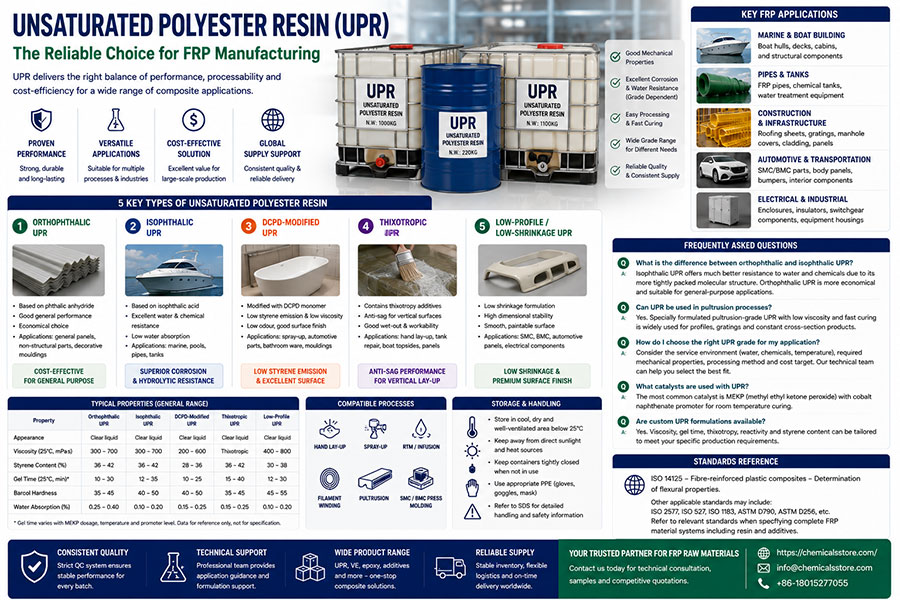
5 Key Types of Unsaturated Polyester Resin for FRP Manufacturing
1. Orthophthalic Unsaturated Polyester Resin
The standard entry-level grade, orthophthalic UPR is produced using phthalic anhydride as the primary diacid. It offers adequate mechanical properties and is typically the most cost-effective option for buyers. Common applications include general-purpose FRP panels, non-structural construction laminates, and low-cost decorative mouldings. While its water and chemical resistance is lower compared to premium grades, it remains widely specified for applications where service life requirements are moderate.
2. Isophthalic Unsaturated Polyester Resin
Produced with isophthalic acid as the primary diacid, isophthalic UPR provides significantly improved hydrolytic stability compared to orthophthalic grades. This makes it the preferred choice for marine hulls, swimming pools, and water-contact FRP structures. The tighter molecular structure reduces water absorption and osmotic blistering over time — a critical performance requirement for boat builders and pool manufacturers sourcing composite raw materials from overseas suppliers.
3. DCPD-Modified Unsaturated Polyester Resin
Dicyclopentadiene (DCPD)-modified grades are engineered for reduced styrene emission and lower viscosity, making them well-suited to spray-up and open-mould processes. The characteristic low odour and improved surface finish make DCPD-modified unsaturated polyester resin a practical choice for automotive parts, bathroom ware, and architectural mouldings where surface appearance and workplace environment compliance are priorities.
4. Thixotropic Unsaturated Polyester Resin
Thixotropic grades contain fumed silica or other rheology modifiers that give the resin a gel-like consistency at rest while allowing it to flow under shear. These formulations are designed for vertical-surface hand lay-up applications — boat topside laminates, tank repairs, and construction panels — where sagging control is critical. Buyers should confirm gel time and thixotropic index values in the technical data sheet when sourcing these grades.
5. Low-Profile / Low-Shrinkage Unsaturated Polyester Resin
Low-profile and low-shrinkage UPR grades incorporate thermoplastic additives or chain-extension chemistries to control volumetric shrinkage during cure. These formulations are widely used in SMC (sheet moulding compound) and BMC (bulk moulding compound) processes for automotive panels and electrical components, where dimensional consistency and smooth, paintable Class A surfaces are required.
Unsaturated Polyester Resin in Key FRP Application Industries
Marine and Boat Building
Isophthalic unsaturated polyester resin is the standard specification for hull laminates in recreational and commercial boats. Its combination of strength, blister resistance, and compatibility with woven roving and chopped strand mat makes it the baseline choice for most boatyards. According to ISO 12215 guidance on small craft hull construction, resin selection is a key factor in determining laminate durability in seawater service. Where longer service life in salt water is required, vinyl ester resin is often specified for barrier coats or structural laminates.
FRP Pipes and Chemical Storage Tanks
For industrial pipe and tank applications, isophthalic or bisphenol A-based UPR grades are common depending on the chemical environment. Buyers in water treatment, oil and gas, and petrochemical sectors should request chemical resistance tables from the resin supplier and confirm grade selection against the intended service fluid. Both hand lay-up and filament winding processes are used in this sector. Browse our resin product range to identify initial candidates for pipe and tank applications.
Construction and Infrastructure
In construction, orthophthalic and isophthalic UPR are used for corrugated roofing panels, gratings, manhole covers, and decorative cladding. Pultrusion and continuous lamination are common production methods. Cost efficiency, consistent reactivity, and reliable supply chain access are the primary sourcing criteria for construction composite producers operating at scale.
Automotive and Electrical Components
SMC and BMC applications require low-shrinkage unsaturated polyester resin combined with glass fibre and mineral fillers. The automotive sector demands tight viscosity and gel time specifications, consistent batch quality, and material traceability documentation. Electrical component manufacturers additionally require reliable dielectric properties and dimensional stability across production runs.
Key Sourcing Considerations When Buying Unsaturated Polyester Resin
When evaluating unsaturated polyester resin suppliers, composite buyers should address the following parameters:
- Resin grade and process fit: Confirm the grade matches your lamination process (hand lay-up, spray-up, RTM, filament winding) and end application environment.
- Gel time and reactivity: Gel time at ambient temperature is critical for controlling the lamination cycle. Request technical data sheets with gel time measured at standard test conditions.
- Viscosity: Viscosity determines how well the resin wets fiberglass reinforcement. Thixotropic grades behave differently from standard Newtonian flow resins — confirm the right type for your process.
- Styrene content and VOC compliance: Regulations on styrene emissions vary by country. Buyers in the EU, North America, and Australia face increasingly strict occupational exposure limits. Confirm whether the resin is standard- or low-styrene formulated.
- Packaging and storage: UPR is sensitive to heat and inhibitor depletion. Request shelf life data, recommended storage temperature ranges, and confirm cold-chain capability for tropical export markets. Typical shelf life is 3–6 months from production date under proper conditions.
Chemicalsstore.com provides sourcing support for a range of unsaturated polyester resin grades suitable for marine, construction, pipe and tank, and automotive FRP applications, including supply chain resource support for recommended international brand products. Contact our team to discuss your specific grade requirements and production process needs.
Frequently Asked Questions About Unsaturated Polyester Resin
What is the difference between orthophthalic and isophthalic UPR?
Orthophthalic unsaturated polyester resin uses phthalic anhydride and is the standard cost-effective grade for general-purpose applications. Isophthalic UPR uses isophthalic acid and offers superior water resistance and hydrolytic stability, making it the preferred specification for marine hulls and water-contact FRP structures.
Can unsaturated polyester resin be used with all types of fiberglass reinforcement?
Yes. UPR is compatible with chopped strand mat (CSM), woven roving, and biaxial fabrics. The key is to confirm that the fiberglass surface sizing (binder) is compatible with polyester chemistry. Most commercially available E-glass mats and rovings are designed to work with unsaturated polyester resin.
What catalyst is used with unsaturated polyester resin?
The standard catalyst for ambient-temperature cure is methyl ethyl ketone peroxide (MEKP), used at approximately 1–2% by weight with a cobalt-based accelerator. Selection of MEKP grade and dosage directly affects gel time, peak exotherm, and final cure quality. Browse our organic peroxide and MEKP sourcing options for available grades.
How does unsaturated polyester resin compare to vinyl ester resin for marine applications?
Isophthalic unsaturated polyester resin is a proven and cost-effective choice for recreational boat hulls. Vinyl ester resin offers higher elongation to break, superior chemical resistance, and better hydrolytic stability — making it the preferred option for high-performance marine structures, chemical-resistant tank laminates, or applications with more demanding service conditions.
What documentation should I request when sourcing unsaturated polyester resin?
Buyers should request the technical data sheet (TDS), safety data sheet (SDS), batch certificate (with production date and gel time confirmation), and chemical resistance table relevant to the intended service environment. For regulated markets, confirm styrene content and whether the product meets applicable occupational exposure thresholds in the destination country.
Ready to Source Unsaturated Polyester Resin?
Selecting the right unsaturated polyester resin grade for your FRP process requires matching formulation chemistry to application requirements, process method, and regulatory constraints. Our team supports overseas composite buyers with technical grade matching, sample coordination, and supply chain planning across multiple resin product families. Contact us today to discuss your unsaturated polyester resin requirements and receive a tailored material recommendation.