



When selecting an MEKP catalyst for fiberglass reinforced plastic (FRP) production, the wrong choice can cause undercuring, gel time inconsistencies, and surface defects that disrupt your entire production line. As the most widely used initiator for room-temperature curing of unsaturated polyester resin and vinyl ester resin systems, MEKP catalyst accounts for the majority of initiator consumption in hand lay-up, spray-up, and casting applications worldwide.
What Is MEKP Catalyst and How Does It Work in FRP?
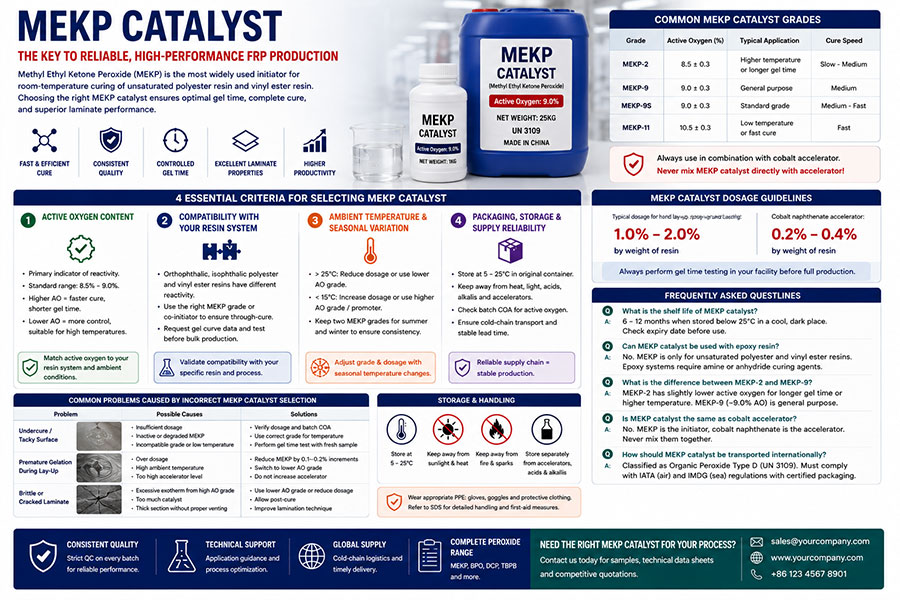
MEKP catalyst (methyl ethyl ketone peroxide) is an organic peroxide initiator that decomposes in the presence of a cobalt-based accelerator to generate free radicals that crosslink unsaturated polyester or vinyl ester resin. The reaction speed, gel time, and peak exotherm are all influenced by the type of MEKP catalyst you select. Common grades include MEKP-2, MEKP-9, and blended variants designed for specific ambient temperatures or processing speeds. Selecting the correct MEKP catalyst grade is a critical procurement decision for any FRP manufacturer.
4 Essential Criteria for Selecting MEKP Catalyst
1. Active Oxygen Content
Active oxygen content is the primary measure of MEKP catalyst reactivity. Standard grades typically range from 8.5% to 9.0% active oxygen. Higher active oxygen content delivers faster curing and shorter gel times, ideal for production environments where throughput is critical. Lower active oxygen grades offer greater process control at higher ambient temperatures, reducing the risk of premature gelation. When sourcing MEKP catalyst, always confirm the active oxygen specification in the technical data sheet and match it to your resin system and ambient conditions.
2. Compatibility with Your Resin System
Not all MEKP catalyst grades perform equally across resin types. Orthophthalic polyester resins, isophthalic polyester resins, and vinyl ester resins each have distinct reactivity profiles. Vinyl ester systems may require an MEKP catalyst with adjusted active oxygen content or a co-initiator to achieve adequate through-cure in thicker laminates. Always request gel curve data from your supplier to validate MEKP catalyst compatibility with your specific resin before committing to bulk quantities. Browse our unsaturated polyester resin range for compatible resin systems.
3. Ambient Temperature and Seasonal Variation
MEKP catalyst dosage and grade must be adjusted for ambient temperature. In warm climates above 25 degrees Celsius, reduced dosage or a lower-reactivity MEKP catalyst prevents premature gelation. In cooler conditions below 15 degrees Celsius, a higher active oxygen grade or additional promoter may be required to achieve complete cure. FRP manufacturers in regions with significant seasonal temperature swings should maintain two MEKP catalyst grades, one for summer and one for winter, to maintain consistent laminate quality year-round.
4. Packaging, Storage, and Supply Chain Reliability
MEKP catalyst is classified as a flammable organic peroxide requiring cold-chain storage (typically 5 to 25 degrees Celsius) and compliance with international transport regulations. When evaluating MEKP catalyst suppliers, confirm batch-to-batch active oxygen content through QC certificates, minimum order quantities compatible with your storage capacity, cold storage during transport, and consistent lead times to avoid production stoppages. A reliable MEKP catalyst supply chain is as important as the chemical specification itself.
MEKP Catalyst Dosage: General Guidelines for FRP Applications
Typical MEKP catalyst dosage for hand lay-up and spray-up ranges from 1.0% to 2.0% by weight of resin, combined with 0.2% to 0.4% cobalt naphthenate accelerator. These ratios should always be validated through gel time testing in your facility before full production runs.
For safety handling reference, the International Labour Organization chemical safety card for methyl ethyl ketone peroxide provides baseline handling recommendations for industrial manufacturing. Explore our full organic peroxide portfolio for MEKP catalyst grades and alternative initiator options.
Common Problems Caused by Incorrect MEKP Catalyst Selection
Undercure and Tacky Surface
A tacky, uncured surface after demolding is usually caused by insufficient MEKP catalyst dosage, inactive or degraded peroxide, or incompatibility between the MEKP catalyst grade and ambient temperature. Check batch QC certificates and perform gel time tests with fresh samples before troubleshooting other variables in your production process.
Premature Gelation During Lay-Up
If the resin gels before you complete your lay-up, the MEKP catalyst dosage is too high or the ambient temperature is elevated. Reduce dosage by 0.1 to 0.2 percent increments or switch to a lower active oxygen MEKP catalyst grade. Never increase the cobalt accelerator to compensate, as this creates additional risk without solving the root cause.
Frequently Asked Questions About MEKP Catalyst
What is the shelf life of MEKP catalyst?
MEKP catalyst typically has a shelf life of 6 to 12 months when stored in a cool, dark environment below 25 degrees Celsius. Always check the expiry date and store away from heat sources, sparks, and combustible materials. Degraded MEKP catalyst will show reduced active oxygen content and unreliable gel times.
Can MEKP catalyst be used with epoxy resin?
No. MEKP catalyst is not compatible with epoxy resin systems. Epoxy resins require amine-based or anhydride curing agents. Use MEKP catalyst exclusively with unsaturated polyester or vinyl ester resin systems. Mixing MEKP catalyst with epoxy resin will not initiate cure and may create hazardous conditions.
What is the difference between MEKP-2 and MEKP-9?
MEKP-2 and MEKP-9 refer to different MEKP catalyst formulations with varying active oxygen content and peroxide composition. MEKP-9 is a commonly referenced standard grade with approximately 9.0% active oxygen. MEKP-2 variants may have modified composition suited for specific ambient temperatures or resin systems. Always compare technical data sheet specifications before switching MEKP catalyst grades mid-production.
Is MEKP catalyst the same as cobalt accelerator?
No. MEKP catalyst is the initiator (free radical source), while cobalt naphthenate is the accelerator (promoter). Both are required for room-temperature curing of polyester and vinyl ester resins, but they must never be mixed directly with each other. Always add them separately to the resin to avoid a hazardous exothermic reaction.
How should MEKP catalyst be transported internationally?
MEKP catalyst is classified as an organic peroxide under UN regulations and requires compliance with IATA (air freight) and IMDG (sea freight) dangerous goods rules. Confirm that your supplier provides proper UN classification documentation, certified packaging, and current safety data sheets before importing MEKP catalyst across borders.
Partner with a Reliable MEKP Catalyst Supplier
Choosing the right MEKP catalyst supplier requires more than reviewing a technical data sheet. You need a supply chain partner who can deliver consistent active oxygen content across batches, provide cold-chain logistics for international shipments, and offer technical support for resin-peroxide system matching. Whether you operate a hand lay-up workshop, a spray-up line, or a filament winding facility, the correct MEKP catalyst grade makes a measurable difference in your production efficiency and laminate quality. Contact our technical team to discuss your resin system, production volume, and ambient conditions. We will help you identify the right MEKP catalyst specification and supply options that match your procurement requirements.