



What Is Gelcoat and Why It Matters in FRP Manufacturing
Gelcoat is a pigmented, resin-based surface coating applied to the mold face before lamination begins. In gelcoat for FRP (fiber-reinforced plastic) manufacturing, this first layer protects the structural laminate from UV degradation, moisture ingress, and chemical attack while providing the aesthetic surface finish that end users see and touch. Choosing the wrong gelcoat leads to surface cracking, osmotic blistering in marine applications, premature color fade, and costly rework — making material selection a critical procurement decision for FRP factories worldwide.
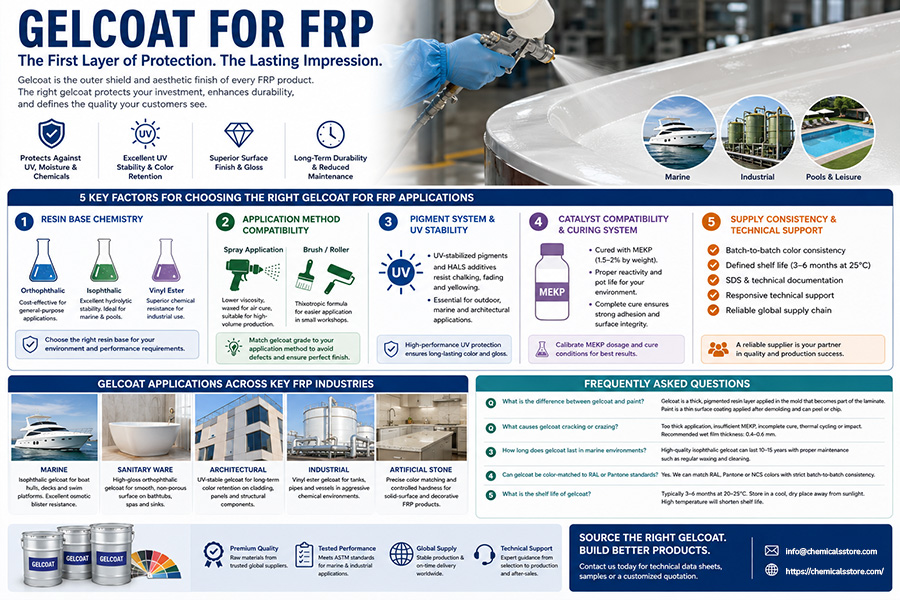
5 Key Factors for Choosing the Right Gelcoat for FRP Applications
1. Resin Base Chemistry
Gelcoats are formulated on orthophthalic, isophthalic, or vinyl ester resin bases. Standard orthophthalic gelcoat suits general-purpose applications such as sanitary ware and display parts where cost efficiency matters more than long-term water resistance. Isophthalic gelcoat for FRP delivers superior hydrolytic stability — the industry-recognized choice for marine hulls, swimming pools, and boat decks where osmotic blister resistance is non-negotiable. Vinyl ester gelcoat provides the highest chemical resistance for industrial tank linings and aggressive-environment FRP structures.
2. Application Method Compatibility
Gelcoat is applied by spray gun in volume production or by brush and roller in small workshops. Spray-grade formulations are optimized for lower viscosity and contain wax additives to achieve full surface cure when exposed to air. Tooling gelcoat — used to build or repair mold surfaces — requires a harder, more heat-resistant formulation. Always match the gelcoat grade to your application method and production environment. Mismatches cause pinholes, fish-eyes, or solvent entrapment that compromise the surface finish of every finished part.
3. Pigment System and UV Stability
For outdoor FRP structures, boat components, and architectural panels exposed to direct sunlight, UV resistance is a non-negotiable specification. High-performance gelcoat for FRP uses UV-stabilized pigment systems and may incorporate HALS (hindered amine light stabilizers) to resist chalking and color shift over years of exterior exposure. White and light-colored gelcoats are the most demanding — yellowing under UV is immediately visible to buyers and end users, and can undermine product reputation in just a few seasons.
4. Catalyst Compatibility and Curing System
Gelcoat for FRP is cured with methyl ethyl ketone peroxide (MEKP), the standard catalyst in open-mold manufacturing. The gelcoat formulation must be matched to your MEKP catalyst system in terms of reactivity, pot life, and ambient cure speed. Recommended international brand products widely used in the industry are available through established supply chain resource support. Standard MEKP dosage for gelcoat curing is 1.5–2% by weight; ambient temperature, humidity, and batch reactivity all require careful calibration. Undercured gelcoat remains tacky and will not bond reliably to the laminating resin, leading to adhesion failures in service.
5. Supply Consistency and Technical Support
For B2B buyers sourcing gelcoat for FRP at production scale, consistency matters as much as chemistry. Batch-to-batch color matching, defined shelf life (typically 3–6 months at 25°C), compliant SDS documentation, and responsive technical support are all factors in a reliable supply relationship. Working with a supplier who understands the complete FRP material system — including composite resins, catalysts, fibers, and additives — reduces complexity and quality risk compared to sourcing each component from a different vendor.
Gelcoat Applications Across Key FRP Industries
Gelcoat for FRP serves different functional roles depending on the end-use environment. In the marine industry, isophthalic gelcoat is the proven standard for boat hulls, yacht decks, and swimming platforms — chosen primarily for blister resistance over multi-year water immersion. In sanitary ware production, high-gloss orthophthalic gelcoat delivers the smooth, non-porous surface finish required for bathtubs and spa units. Architectural FRP cladding panels demand UV-stable pigment systems for long-term color retention on building facades. In artificial stone and solid-surface manufacturing, precise color matching and controlled surface hardness are the primary specifications.
Industrial FRP pipe, tank, and vessel applications increasingly specify vinyl ester-based gelcoat where chemical splash resistance on the outer surface is required alongside structural protection from the laminate. For structural resin selection guidance across manufacturing processes, see our full range of FRP composite resins. Industry performance standards for gelcoat in marine and structural applications are defined by ASTM testing protocols that buyers should reference when qualifying suppliers.
Frequently Asked Questions About Gelcoat for FRP
What is the difference between gelcoat and paint?
Gelcoat is a thick, pigmented resin system applied to the mold surface and chemically bonded to the FRP laminate during production. Applied at 0.4–0.6 mm wet film thickness, it becomes a structural part of the composite. Paint is a surface coating applied to a finished part and can peel or chip under mechanical or UV stress. Gelcoat for FRP typically provides 5–10 times the film build and durability of conventional topcoats.
What causes gelcoat cracking or crazing?
Common causes include excessive application thickness (above 0.6 mm), insufficient MEKP catalyst or incomplete cure, thermal cycling stress in outdoor structures, and impact damage. Correct application thickness (0.4–0.6 mm wet film) and calibrated catalyst dosage prevent the majority of gelcoat surface defects in production.
How long does gelcoat last in marine environments?
High-quality isophthalic gelcoat for FRP with UV-stabilized pigment systems can maintain surface gloss and color integrity for 10–15 years in marine or outdoor applications with standard maintenance. Regular waxing and polishing significantly extend the service life of the gelcoat surface.
Can gelcoat be color-matched to RAL or Pantone standards?
Yes. Gelcoat can be formulated to match RAL, Pantone, or NCS color standards for B2B production orders. Batch-to-batch color consistency is critical for architectural, automotive, and consumer product applications. Confirm color matching capability and batch tolerance specifications with your supplier before committing to production volumes.
What is the shelf life of gelcoat?
Most gelcoat products have a shelf life of 3–6 months when stored at 20–25°C, away from direct sunlight and heat sources. Storage above 30°C significantly accelerates premature gelation and shortens usable product life. Always verify the batch manufacture date and storage conditions when receiving a shipment.
Source the Right Gelcoat for Your FRP Project
Whether you are manufacturing marine hulls, industrial tanks, architectural panels, artificial stone components, or sanitary ware, matching gelcoat for FRP to your specific application requirements is the foundation of consistent product quality. Contact us to discuss your production requirements, request technical data sheets, or get a sourcing inquiry started. Our team provides technical support across the full FRP material system — from resin and catalyst selection to gelcoat and surface finish guidance.