



Marine resins are the structural backbone of fiber-reinforced polymer (FRP) boat building, providing the mechanical performance, water resistance, and durability that vessels demand in saltwater environments. For overseas FRP manufacturers, boat builders, and procurement managers sourcing composite materials, selecting the right marine resin goes far beyond comparing price sheets. The resin system you choose directly affects hydrolytic stability, blister resistance, fabrication efficiency, and the long-term service life of hulls, decks, and structural panels.
This guide covers the main resin types used in marine composite applications, the five criteria that should drive your selection decision, and practical sourcing considerations for B2B buyers.
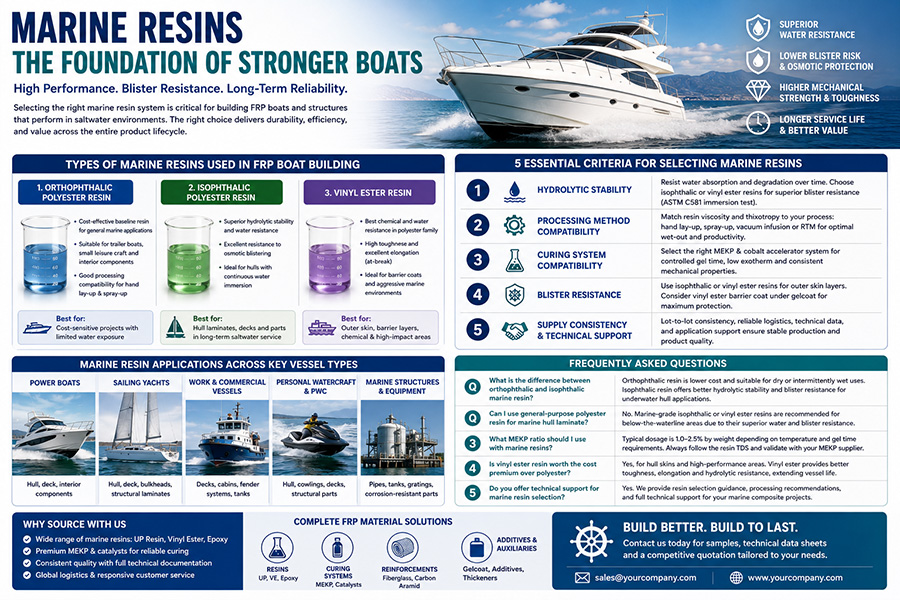
Types of Marine Resins Used in FRP Boat Building
The FRP marine industry relies on three main resin families. Each offers a different performance profile and cost structure suited to different vessel types and production methods.
Orthophthalic and Isophthalic Polyester Resins
Orthophthalic unsaturated polyester resin is the baseline choice for cost-sensitive marine applications: trailer boats, small leisure craft, and interior structural components where moisture exposure is moderate. Its lower cost and broad processing compatibility make it widely used in spray-up and hand lay-up production.
Isophthalic polyester resin offers significantly improved hydrolytic resistance, making it the preferred option for hulls with continuous water immersion. The isophthalic acid backbone reduces water permeability and helps prevent osmotic blistering — a common long-term failure mode in FRP marine hulls. For production facilities building hulls intended for extended saltwater service, isophthalic marine resins represent a meaningful upgrade at a modest cost premium.
Vinyl Ester Resin for Marine Composites
Vinyl ester resin delivers the best combination of mechanical toughness and chemical resistance among the thermosetting marine resins available for FRP laminate production. Its bisphenol A epoxy backbone provides elongation-at-break values significantly higher than polyester, making it better suited for impact-resistant structures, vacuum infusion laminates, and applications requiring a barrier coat against water penetration.
Shipbuilders using vinyl ester for the outer skin laminate — combined with isophthalic polyester for structural infill layers — achieve a cost-effective system that balances blister resistance and material cost. Vinyl ester marine resins are also the standard choice in FRP pipe and tank production where chemical resistance requirements overlap with marine specifications. Browse our unsaturated polyester and vinyl ester resin range for available grades and technical data.
Epoxy Resin in High-Performance Marine Applications
Epoxy resin is the standard for performance sailing craft, racing hulls, and structural reinforcements. Its near-zero water uptake, superior adhesion to glass and carbon fiber, and compatibility with amine or anhydride curing agents make it the benchmark for mechanical performance in marine composites. However, epoxy marine resins require UV protection and are typically used alongside a protective gelcoat system for exterior applications.
For high-volume production boats, epoxy systems are commonly used selectively — for structural joints, core bonding, and repair laminate — rather than as the primary hull resin, where cost and processing speed favor polyester or vinyl ester.
5 Essential Criteria for Selecting Marine Resins
1. Hydrolytic Stability
Marine resins in hull laminate must resist water absorption over the service life of the vessel. Isophthalic polyester and vinyl ester both outperform standard orthophthalic grades in immersion tests consistent with ASTM C581 chemical resistance evaluation methodology. For hulls rated for continuous saltwater immersion, confirm the resin supplier’s water absorption and blister resistance data before specification.
2. Processing Method Compatibility
Marine resins are processed by hand lay-up, spray-up, vacuum infusion, and resin transfer molding. Not all resin grades perform equivalently across methods. Infusion-grade marine resins require lower initial viscosity (typically 200–500 mPa·s at 25°C) and controlled gel time to ensure complete fiber wet-out in closed mold processes. Spray-up grades benefit from thixotropic properties to prevent sagging on vertical surfaces.
3. Curing System Compatibility
Most marine resins are cured with methyl ethyl ketone peroxide (MEKP) in the presence of a cobalt accelerator. MEKP type, concentration, and ambient temperature all affect gel time, exotherm, and final mechanical properties. For production environments running across different climates, having access to a matched organic peroxide curing system with technical dosage guidance is a practical procurement advantage that reduces processing variability.
4. Blister Resistance
Osmotic blistering is one of the most common quality complaints in FRP marine hulls. Selecting an isophthalic or vinyl ester resin for the outer skin layers, combined with proper laminate design and gelcoat application, is the established mitigation strategy. Some manufacturers also apply a dedicated vinyl ester barrier coat between the gelcoat and the main structural laminate for enhanced protection.
5. Supply Consistency and Technical Support
For production boat builders running weekly lamination schedules, consistent material quality is as important as initial resin performance. Lot-to-lot variation in gel time, reactivity, and viscosity can disrupt production timelines and affect laminate quality. Qualifying a supplier that provides technical data sheet support, application engineering guidance, and reliable logistics is a key part of sustainable marine resin procurement.
Frequently Asked Questions About Marine Resins
Q: What is the difference between orthophthalic and isophthalic marine resin?
Orthophthalic resin uses phthalic anhydride as the primary diacid and is lower cost with adequate performance for dry or intermittently wet applications. Isophthalic resin uses isophthalic acid, producing a less permeable matrix with better long-term resistance to osmotic blistering in underwater hull applications.
Q: Can I use general-purpose polyester resin for marine hull laminate?
Standard general-purpose polyester resin is not recommended for marine hull laminate below the waterline. Marine-grade isophthalic or vinyl ester resins are specified for these zones due to their improved hydrolytic performance and blister resistance profile.
Q: What MEKP ratio should I use with marine resins?
Typical MEKP dosage is 1.0–2.5% by weight depending on ambient temperature, desired gel time, and specific resin grade. Always follow the resin technical data sheet and validate with your MEKP supplier’s specification. Consistent use of a quality-controlled organic peroxide product reduces variability across production batches.
Q: Is vinyl ester resin worth the cost premium over polyester for marine applications?
For hull skins, underwater sections, and blister-prone zones, vinyl ester resin’s improved elongation and hydrolytic resistance typically justify the cost premium over the vessel’s service life. For interior structural members above the waterline, isophthalic polyester often provides sufficient performance at lower cost.
Q: Do you offer technical support for marine resin selection?
Yes. We supply unsaturated polyester resin, vinyl ester resin, epoxy resin, MEKP curing systems, and composite additives for marine fabricators. Our team can assist with resin grade selection, processing parameter guidance, and supply chain solutions for production requirements of any scale.
Source Marine Resins with Reliable Supply Chain Support
FRP boat builders and marine composite manufacturers operating at scale need more than competitive pricing — they need consistent material quality, responsive technical support, and a supplier that understands the application requirements behind every order.
Whether you are qualifying a new resin system for a production hull program, scaling up a marine composites operation, or looking for a stable supply of isophthalic or vinyl ester marine resins for your fabrication line, contact us with your specific technical requirements and volume details. We welcome inquiries for samples, technical documentation, and sourcing proposals matched to your production schedule.