



Blister resistance is an important consideration in fiberglass-reinforced plastic (FRP) boat hull manufacturing. When a hull is exposed to water for extended periods, moisture penetration, incomplete curing, material incompatibility, and manufacturing defects can contribute to blister formation and surface degradation.
For marine manufacturers, selecting the right combination of gelcoat, resin, and initiator is essential for producing durable hulls with reliable surface protection. However, no single material can guarantee blister resistance. Material compatibility, laminate quality, curing conditions, and application procedures must work together.
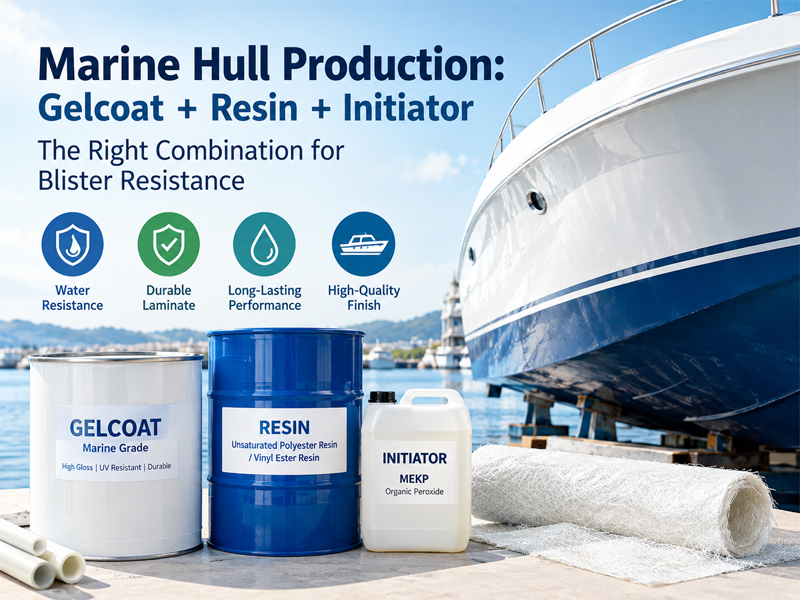
1. Marine Gelcoat: The First Line of Surface Protection
Marine gelcoat provides the outer surface finish of an FRP hull. It contributes to appearance, weathering resistance, and protection against water exposure.
When selecting a marine gelcoat, manufacturers should evaluate:
- Water resistance: Choose a grade designed for prolonged marine exposure.
- Surface quality: Ensure consistent application to minimize pinholes, porosity, and surface defects.
- Curing performance: Follow the recommended catalyst ratio, temperature, and film thickness.
- Application compatibility: Confirm that the gelcoat is suitable for the selected spray-up or hand lay-up process.
A properly applied and cured gelcoat helps reduce moisture ingress, but surface preparation and process control remain equally important.
2. Marine Resin: Building a Durable FRP Laminate
The resin system binds the fiberglass reinforcement and determines many of the laminate’s mechanical and chemical properties.
Unsaturated polyester resin is widely used in boatbuilding because of its balance of cost and processability. For applications requiring enhanced resistance to water and demanding marine conditions, suitable vinyl ester resin grades may also be considered.
When evaluating marine resin, manufacturers should consider:
- Water resistance and long-term marine exposure
- Adhesion between the gelcoat and underlying laminate
- Mechanical strength and toughness
- Compatibility with fiberglass reinforcement
- Cure behavior under actual production conditions
The appropriate resin depends on the hull design, service environment, and manufacturer’s performance requirements. Resin selection should be based on technical data and relevant marine-service testing rather than resin type alone.
3. Initiator Selection: Achieving Consistent Curing
Organic peroxide initiators, including methyl ethyl ketone peroxide (MEKP), are commonly used to cure unsaturated polyester and certain vinyl ester systems under appropriate conditions.
Incorrect initiator selection or dosage can lead to incomplete curing, excessive exotherm, surface defects, or inconsistent laminate properties.
To improve process consistency, manufacturers should:
- Use an initiator recommended for the specific resin or gelcoat.
- Follow the supplier’s specified dosage range.
- Control workshop and material temperatures.
- Verify gel time and cure performance before full-scale production.
- Follow the relevant safety data sheets and handling instructions.
The gelcoat and laminate resin may require different curing conditions. Their compatibility and cure schedules should be confirmed before production.
4. How Gelcoat, Resin, and Initiator Work Together
Blister resistance depends on the performance of the complete FRP system, not just one component.
| Material | Primary role | Key consideration |
|---|---|---|
| Marine gelcoat | Surface finish and moisture barrier | Water resistance, film thickness, and surface quality |
| Polyester or vinyl ester resin | Structural laminate and fiber bonding | Water resistance, adhesion, and cure performance |
| Organic peroxide initiator | Initiates resin curing | Compatibility, dosage, and curing conditions |
| Fiberglass reinforcement | Provides structural strength | Sizing compatibility, wet-out, and laminate consolidation |
Manufacturers should also control moisture contamination, resin-to-fiber wet-out, air entrapment, laminate thickness, and curing conditions. Poorly bonded layers, voids, and inadequately cured areas can undermine the performance of an otherwise suitable material combination.
5. Practical Checks Before Marine Hull Production
Before starting a new hull production run, manufacturers should confirm the following:
- Review technical data sheets: Verify the recommended gelcoat, resin, and initiator combination.
- Control application conditions: Maintain appropriate temperature, humidity, film thickness, and mixing procedures.
- Check laminate quality: Minimize voids, dry spots, and contamination between layers.
- Validate curing performance: Confirm that the system achieves the required cure under actual production conditions.
- Test for marine durability: Use appropriate water-resistance and blister-resistance evaluations for the intended service environment.
ASTM D714, for example, provides a method for evaluating the degree of blistering in coatings. For FRP marine structures, the test method and acceptance criteria should be selected according to the specific coating or laminate system being evaluated.
Sourcing Marine Gelcoat, Resin, and Initiators
Choosing compatible materials is an important step toward reducing blister-related risks in marine hull manufacturing. A suitable gelcoat, a resin matched to the service environment, and a compatible initiator system can help manufacturers achieve consistent processing and durable FRP structures when combined with proper application and quality control.
ChemicalsStore.com supports marine and composite manufacturers with sourcing options for:
- Marine gelcoat
- Unsaturated polyester resin
- Vinyl ester resin
- Organic peroxide initiators
- Fiberglass and auxiliary agents
Explore our Resin Product Range and Auxiliary Agent Catalog to compare available materials.
Need help selecting materials for your boat hull production line? Contact info@chemicalsstore.com with your molding process, resin requirements, and intended marine service conditions. Our team can help you review suitable product options and request a quotation.