


Breathers & Bleeders are auxiliary vacuum molding materials that allow trapped air to escape and excess resin to be absorbed during vacuum bagging, autoclave curing, and vacuum infusion of FRP and composite laminates. Choosing the right Breathers & Bleeders grade directly affects vacuum integrity, laminate consolidation, and final part quality, which makes grade selection an important sourcing decision for composite manufacturers and fabricators.
Breathers & Bleeders Product Range and Specifications
This product range covers eight grades engineered for different weight, permeability, and temperature requirements, from basic oven cure processes up to high-temperature autoclave cycles. Each grade is specified by weight, roll width and length, maximum use temperature, and base material type, as summarized below.
| Grade | Weight | Width x Length | Max Use Temperature | Material Type | Applicable Characteristics |
|---|---|---|---|---|---|
| ZN1 | 115g/m² (3.28oz/y²) | 59in (1.5m) x 1640ft (500m) | 302°F (150°C) | PET&TPU | Breathable, but not permeable to glue |
| ZN3 | 100g/m² (2.85oz/y²) | 59in (1.5m) x 1640ft (500m) | 392°F (200°C) | PET | Easy to conform over shaped parts |
| ZWN4 | 150g/m² (4.27oz/y²) | 59in (1.5m) x 328ft (100m) | 338°F (170°C) | RPET | Excellent cost performance, suitable for oven process |
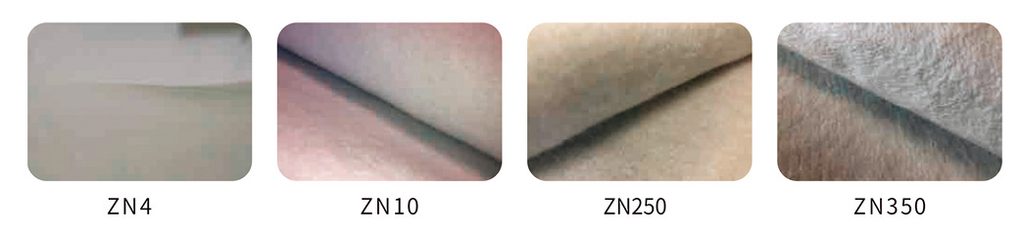
| ZN4 | 150g/m² (4.27oz/y²) | 59in (1.5m) x 328ft (100m) | 392°F (200°C) | PET | Suitable for oven process |
| ZN7 | 250g/m² (7.12oz/y²) | 59in (1.5m) x 164ft (50m) | 392°F (200°C) | PET | Suitable for autoclave process, below 0.5MPa |
| ZN10 | 340g/m² (9.68oz/y²) | 59in (1.5m) x 164ft (50m) | 392°F (200°C) | PET | Suitable for autoclave process, below 1MPa |
| ZN250 | 370g/m² (10.53oz/y²) | 59in (1.5m) x 164ft (50m) | 482°F (250°C) | PA66 | High permeability, high strength, suitable for autoclave process |
| ZN350 | 600g/m² (17.09oz/y²) | 39in (1m) x 98ft (30m) | 752°F (400°C) | Glass fibre | High temperature resistance, suitable for autoclave process |
All grades listed above carry a two-year storage life under normal storage conditions. Actual in-service operating temperature depends on mold shape, curing parameters, resin system, and laying method, so buyers are encouraged to validate performance under their own process conditions before committing to volume orders.
Choosing the Right Breathers & Bleeders Grade for Your Process
Lighter grades such as ZN1 and ZN3 are suited to parts that need a breathable path for air evacuation without letting resin bleed through the glue line, while ZN3 also conforms more easily over shaped or contoured tooling. ZWN4 offers a cost-efficient option for standard oven cure cycles, and ZN4 is the PET equivalent for oven processing where higher temperature resistance is preferred. For autoclave processing, ZN7 and ZN10 are rated for pressures below 0.5MPa and 1MPa respectively, giving fabricators a choice based on the pressure profile of their cure cycle. ZN250, made from PA66, combines high permeability with high strength for demanding autoclave work, while ZN350, built from glass fibre, is the highest temperature grade in this range, rated to 752°F (400°C) for the most thermally demanding autoclave cycles.
Applications of Breathers & Bleeders in FRP and Composite Layup
Breathers & Bleeders are placed over the laminate stack beneath the vacuum bag in hand lay-up, vacuum infusion, and autoclave molding of FRP parts for marine, pipe and tank, pultrusion, filament winding, and wind energy applications. By channeling air toward the vacuum port and, where applicable, absorbing excess resin, these auxiliary materials help maintain consistent vacuum pressure across the full area of the part, supporting more uniform laminate consolidation and reduced void content. Process guidance for vacuum-assisted composite manufacturing, including material conditioning and testing practices, is also addressed by standards bodies such as the ASTM D20 Committee on Plastics, which composite manufacturers can reference alongside their own qualification testing.
Because grade selection interacts with resin system, tooling geometry, and cure schedule, this material is commonly specified together with other auxiliary agent products such as release films, flow mesh, and vacuum bagging consumables used in the same layup.
Sourcing and Supply
Chemicalsstore.com supports overseas composite material buyers, FRP factories, boat builders, pipe and tank manufacturers, pultrusion factories, and filament winding manufacturers with supply chain resource support for vacuum molding auxiliary materials. Buyers evaluating a grade for a new process are encouraged to request the technical data sheet for detailed material performance indicators and conventional specification parameters before finalizing an order.
Frequently Asked Questions
What is the difference between a breather and a bleeder fabric?
Breather-type grades such as ZN1 are designed to be breathable without being permeable to glue, so they primarily provide an air evacuation path, while bleeder-oriented grades allow a controlled amount of excess resin to pass through during cure.
Which Breathers & Bleeders grade is suitable for autoclave processing?
ZN7 and ZN10 are rated for autoclave process below 0.5MPa and 1MPa respectively, ZN250 suits high-permeability autoclave applications, and ZN350 is rated to 752°F (400°C) for the highest temperature autoclave cycles.
What maximum temperature can Breathers & Bleeders withstand?
Maximum use temperature varies by grade, ranging from 302°F (150°C) for ZN1 up to 752°F (400°C) for the glass-fibre ZN350 grade, so grade selection should match the planned cure temperature.
What roll sizes are available for Breathers & Bleeders?
Roll widths range from 39 inches (1m) to 59 inches (1.5m), with lengths from 98 feet (30m) up to 1640 feet (500m) depending on the grade, allowing buyers to match roll size to project volume.
How should Breathers & Bleeders be stored?
All grades carry a two-year storage life under normal conditions; actual performance should be verified under the buyer’s own process conditions before large-volume use.
For technical data sheets, grade recommendations, or a quotation on Breathers & Bleeders for your next FRP or composite production run, contact our team through the inquiry form on this page.