



Selecting the right organic peroxide initiator is one of the most critical decisions in high-temperature FRP processing. Whether you are operating a pultrusion line or a filament winding facility, the initiator you choose directly affects cure speed, product quality, production efficiency, and operational safety. With multiple peroxide types available across varying half-life temperatures, understanding the selection criteria helps sourcing managers and composite engineers make better purchasing decisions.
This guide is intended for FRP manufacturers sourcing organic peroxide initiators for continuous production processes, and covers the key parameters, practical considerations, and common challenges encountered in real-world composite manufacturing.
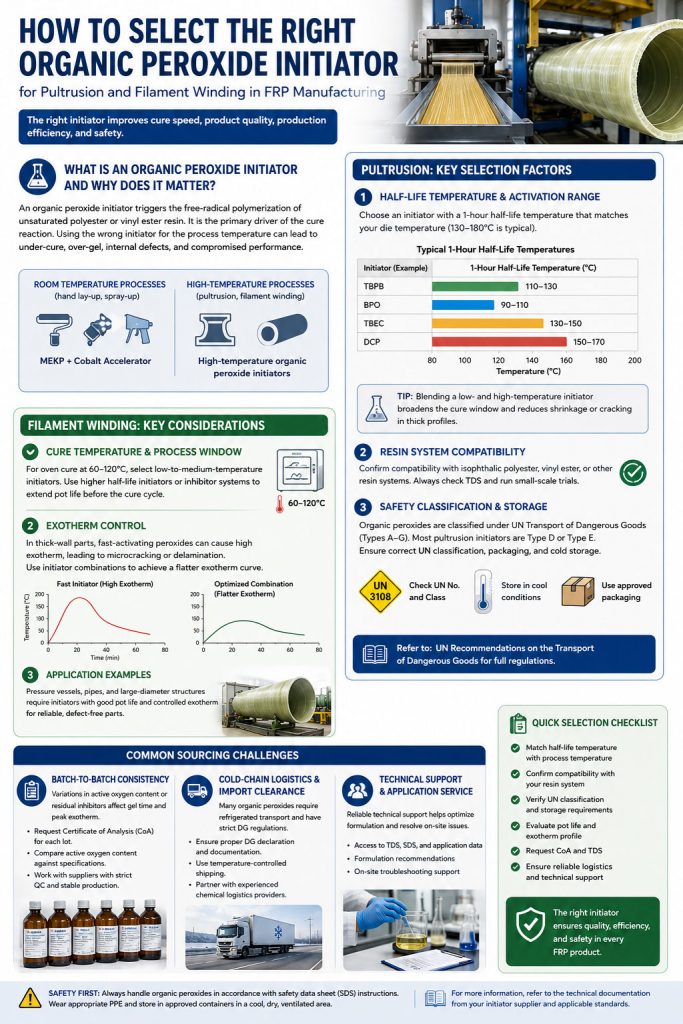
What Is an Organic Peroxide Initiator and Why Does It Matter?
An organic peroxide initiator is a chemical compound used to trigger the free-radical polymerization of unsaturated polyester resin or vinyl ester resin. In FRP manufacturing, it is the primary driver of the cure reaction — without the right initiator matched to the right processing temperature, the resin may under-cure, over-gel, or produce internal defects that compromise structural integrity.
In room-temperature processes such as hand lay-up and spray-up, MEKP (methyl ethyl ketone peroxide) is the standard initiator, typically paired with a cobalt accelerator. However, in high-temperature continuous processes like pultrusion and filament winding with heated die systems, a different class of organic peroxide initiator is required — one with the appropriate half-life temperature to release free radicals within the specific thermal window of the production process.
How to Select the Right Organic Peroxide Initiator for Pultrusion
Pultrusion is a continuous manufacturing process where reinforced fibers are pulled through a resin bath and a heated die, where cure takes place under controlled temperature. The selection of an organic peroxide initiator for pultrusion depends on several interrelated factors.
1. Half-Life Temperature and Activation Range
The most important parameter when selecting an organic peroxide initiator is its half-life temperature — the temperature at which 50% of the peroxide decomposes within a defined time period (typically one hour or ten hours). For pultrusion dies operating between 130°C and 180°C, initiators with one-hour half-life temperatures in the 110–150°C range are commonly used.
Recommended international brand products such as tert-butyl peroxybenzoate (TBPB) and dicumyl peroxide (DCP) are frequently specified for mid-to-high-temperature pultrusion applications. Blending two organic peroxide initiators — one that activates at lower temperature and one at higher temperature — can help achieve a broader cure window and reduce shrinkage or cracking in thick profiles.
2. Resin System Compatibility
Not all organic peroxide initiators are compatible with all resin systems. Isophthalic unsaturated polyester resins and vinyl ester resins may respond differently to the same initiator. Before finalizing sourcing decisions, always request a technical data sheet and confirm compatibility through resin supplier documentation or small-scale trial runs.
3. Safety Classification and Storage Requirements
Organic peroxides are classified by the UN Transportation of Dangerous Goods regulations into Types A through G, based on their explosive potential. For international procurement, sourcing managers must confirm the correct UN classification, packaging requirements, and storage temperature for each initiator grade. Most high-temperature organic peroxide initiators used in pultrusion fall into Type D or Type E classifications, which impose specific packaging and cold-chain requirements depending on formulation.
For more information on regulatory classifications, refer to the UN Recommendations on the Transport of Dangerous Goods.
Organic Peroxide Initiator Selection for Filament Winding
Filament winding is used to produce pressure vessels, pipes, and cylindrical composite structures. Unlike pultrusion, filament winding typically involves an oven or infrared cure cycle rather than a contact die, which affects the thermal profile experienced by the resin.
For ambient wind with oven cure at 60–120°C, low-to-medium-temperature organic peroxide initiators are preferred. Processes that require longer pot life before the cure cycle begins should use initiators with higher half-life temperatures or inhibitor systems to extend working time without premature gelation.
Filament winding manufacturers sourcing organic peroxide initiators should also consider the resin’s exotherm profile. In thick-wall structures, excessive exotherm from fast-activating peroxides can cause internal temperature spikes, leading to microcracking or delamination. Selecting an initiator with a flatter exotherm curve — often achieved by using a combination of peroxide types — is common practice for large-diameter pipe manufacturing.
Common Sourcing Challenges for FRP Manufacturers
Batch-to-Batch Consistency
One of the most frequently raised concerns by FRP production managers is batch-to-batch consistency. Variation in active oxygen content, peroxide concentration, or residual inhibitor levels can shift gel times and peak exotherm, requiring constant line-speed adjustments. When evaluating suppliers, request a certificate of analysis (CoA) for each production lot and compare active oxygen content against published specifications.
Cold-Chain Logistics and Import Clearance
Many organic peroxide initiators require refrigerated storage and temperature-controlled transport. For overseas buyers, this creates additional complexity around import clearance, Dangerous Goods declarations, and port handling. Working with an experienced chemical trading partner that understands cross-border organic peroxide logistics can significantly reduce lead times and compliance risk.
Minimum Order Quantities and Supply Continuity
Some high-temperature organic peroxide initiator grades carry minimum order quantities (MOQ) that may be difficult for smaller FRP factories to manage per order cycle. Supply chain resource support — including consolidated shipping from multiple product lines — can help smaller buyers maintain production continuity without tying up excessive working capital. Browse our organic peroxide product range to explore available grades and specifications.
Frequently Asked Questions
What is the difference between MEKP and high-temperature organic peroxide initiators?
MEKP (methyl ethyl ketone peroxide) is designed for room-temperature curing with a cobalt accelerator. High-temperature organic peroxide initiators such as TBPB or DCP do not require accelerators and are activated by the heat of the processing die or oven, making them suitable for pultrusion and filament winding applications.
Can I use a single organic peroxide initiator for both pultrusion and filament winding?
It depends on the cure temperatures of each process. If both processes operate within a similar temperature window, a single initiator may be applicable. More commonly, different grades are selected to precisely match each process’s thermal profile and pot-life requirements.
How do I verify compatibility between an organic peroxide initiator and my resin system?
Start with the technical data sheet provided by the peroxide supplier, which typically lists recommended resin types and processing temperatures. Small-scale trials using the actual resin and glass reinforcement are strongly recommended before committing to full production use.
What documentation is required to import organic peroxide initiators internationally?
You will typically need a Safety Data Sheet (SDS), Certificate of Analysis (CoA), UN Classification documentation, and a Dangerous Goods declaration. Import requirements vary by country, so consulting with a freight forwarder experienced in hazardous chemical imports is advisable.
How should organic peroxide initiators be stored on-site?
Most grades require cool, dry, and well-ventilated storage away from heat sources, oxidizers, and reducing agents. Refrigerated storage at 5–20°C is required for many liquid peroxide formulations. Always follow the storage temperature limits specified on the product label and SDS to maintain product performance and safety.
Get Sourcing Support for Your FRP Curing Application
Choosing the right organic peroxide initiator for your pultrusion or filament winding process requires matching chemical reactivity to your thermal process window, resin system, and production throughput requirements. Our team works with FRP manufacturers across the marine, pipe and tank, and industrial composite sectors to identify suitable grade options and supply chain solutions.
Browse our composite resin product range or contact us directly to discuss your application, required grade, quantity, and shipping destination. We provide technical documentation and sourcing coordination to support your procurement process from selection through delivery.