



Selecting the right marine resins is one of the most consequential decisions in FRP boat building and marine composite manufacturing. The resin matrix determines a vessel’s structural integrity, resistance to water absorption, and long-term durability in harsh saltwater environments. Whether you are manufacturing fiberglass hulls, decks, bulkheads, or mast components, understanding the performance trade-offs between resin types will directly affect your product quality and procurement costs.
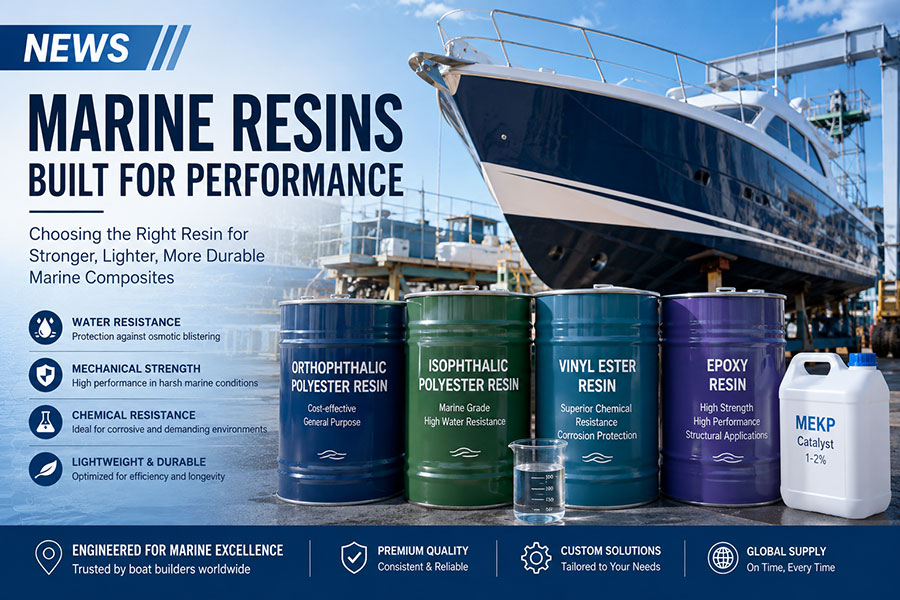
Types of Marine Resins Used in FRP Boat Construction
The four primary resin families used in marine composites each offer a distinct balance of cost, performance, and processability. Choosing between them requires a clear understanding of the application demands, service environment, and production process.
Orthophthalic Polyester Resin
Orthophthalic polyester resin is the most economical option and remains in common use for non-structural marine parts, interior fittings, and low-demand applications. It offers good processability with hand lay-up and spray-up methods and is compatible with standard MEKP catalysts. However, its moisture absorption rate limits its suitability for underwater hull structures, where osmotic blistering is a key long-term concern.
Isophthalic Polyester Resin
Isophthalic polyester resin delivers significantly improved water resistance compared to orthophthalic grades, making it the preferred choice for marine laminates and hull gelcoat backing layers. Its tighter molecular structure reduces osmotic permeability, which is why it is widely specified in classification society guidelines for boat hull construction. Isophthalic resin strikes a practical balance between cost and performance for most production boat manufacturers.
Vinyl Ester Resin
Vinyl ester resin offers superior chemical resistance and mechanical toughness thanks to its epoxy-based backbone. This makes it the standard choice for underwater hull skins, fuel tanks, bilge areas, and chemical-resistant marine structures. Vinyl ester is commonly applied as the outer skin layers over an isophthalic or orthophthalic polyester structural core — a hybrid laminate approach that balances cost with performance. For high-specification workboats, patrol vessels, or commercial marine structures, vinyl ester is often specified throughout the laminate stack. You can review our range of polyester and vinyl ester resins for marine applications.
Epoxy Resin
Marine epoxy resin delivers the highest mechanical properties — tensile strength, flexural modulus, and adhesion — and is preferred for racing sailboats, high-performance powerboats, and structural repairs. Epoxy is compatible with vacuum infusion and prepreg processing, enabling the lightweight, high-strength laminates demanded by competitive marine construction. Its higher cost and longer cure cycle relative to polyester systems mean it is typically reserved for premium applications where weight and performance are the primary drivers.
Key Performance Parameters for Marine Resin Selection
When evaluating marine resins for procurement, the following technical parameters should guide your specification process. Testing against recognized standards such as ASTM D570 for water absorption provides a consistent basis for comparing resin grades across suppliers.
- Water absorption (ASTM D570): Lower values indicate better resistance to osmotic blistering. Isophthalic polyester and vinyl ester significantly outperform orthophthalic grades.
- Flexural strength and modulus: Critical for hull stiffness and structural performance under wave-loading conditions.
- HDT (Heat Deflection Temperature): Important for deck structures and above-waterline areas exposed to direct sun in tropical climates.
- Gel time and pot life: Affects production throughput in open-mold processes such as hand lay-up and spray-up.
- Styrene content: Environmental and occupational health regulations in many markets impose styrene emission limits. Low-styrene and styrene-free formulations are increasingly specified for indoor marine production environments.
Processing and Catalyst Compatibility in Marine Applications
Marine resins must be matched to the appropriate catalyst and accelerator system for the intended cure conditions. MEKP (methyl ethyl ketone peroxide) at 1–2% by weight is the standard initiator for unsaturated polyester and vinyl ester systems in ambient-cure marine production. Cure speed is adjusted via cobalt naphthenate accelerator concentration and inhibitor levels to suit shop temperature and laminate thickness requirements.
For epoxy marine systems, amine hardeners — including cycloaliphatic amines and polyamide types — are selected based on pot life, application method, and final mechanical targets. Suppliers offering supply chain resource support for both resin and matched curing agent systems can simplify procurement and reduce formulation risk for buyers sourcing multiple product lines.
Mold release agents are a complementary consideration in any marine production workflow. Semi-permanent release systems and carnauba wax products are widely used to ensure clean part release and consistent surface finish quality. Our composite release agent range supports both hand lay-up and closed-mold marine processes.
Marine Resin Procurement: What Overseas Buyers Should Evaluate
For composite manufacturers and chemical traders sourcing marine resins internationally, consistent batch-to-batch quality is as important as unit price. Key supplier evaluation criteria include:
- Full TDS and SDS documentation availability in English
- Shelf life and storage requirements, particularly for peroxide initiators
- Flexible packaging options: 200 kg drum, IBC tote, or bulk tanker
- Lead time, minimum order quantities, and export compliance documentation
- COA with batch-level traceability and test data aligned to ASTM or ISO test methods
Buyers sourcing across multiple product categories — resin, catalyst, gelcoat, and reinforcement fiber — benefit from consolidated procurement through a specialist supplier to reduce logistics complexity and qualification time.
Frequently Asked Questions About Marine Resins
What is the difference between marine resin and standard FRP resin?
“Marine resin” typically refers to isophthalic or vinyl ester grades engineered specifically for low water absorption and blister resistance. Standard orthophthalic polyester resins are widely used in general FRP applications but are not recommended for structural underwater marine laminates due to higher osmotic permeability.
Is vinyl ester resin worth the higher cost for boat hulls?
For hulls with a design life exceeding 10 years, the reduced osmotic blister risk and improved mechanical performance of vinyl ester typically justify the cost premium. Many production boat builders use vinyl ester for the inner skin laminate and isophthalic polyester for the structural core layers to optimize the cost-performance ratio.
Can epoxy resin be applied over existing polyester laminate in marine repairs?
Epoxy adheres well to cured polyester laminates and is a standard choice for structural marine repairs. However, the reverse is not reliable: polyester resin does not bond adequately to cured epoxy surfaces. For new construction using epoxy systems, specify epoxy-compatible primers and gelcoats from the outset.
What catalyst is standard for marine vinyl ester resins?
MEKP (methyl ethyl ketone peroxide) at 1–2% by weight is the standard catalyst for ambient-cure vinyl ester marine systems. Catalyst loading should be adjusted based on ambient shop temperature, pot life requirements, and laminate thickness to avoid exothermic cracking in thick sections.
How do I ensure consistent resin quality across production batches?
Request a COA with gel time, viscosity, and acid value data for each production batch. Establish incoming QC testing against agreed specification limits, and work with a supplier who provides batch traceability documentation and responsive technical support for production troubleshooting.
Ready to Source Marine Resins for Your Production?
Whether you are building fiberglass hulls, patrol vessels, or marine structural components, selecting the right resin system is essential to long-term product performance. We offer a range of isophthalic polyester, vinyl ester, and epoxy resin options supported by full technical documentation, sourced from internationally recognized supply chain partners.
Contact us to discuss your application requirements, production volume, and preferred processing method — our technical team will help match the right marine resin system to your specification and procurement needs.