



Selecting the right MEKP catalyst is one of the most critical decisions in FRP composite manufacturing. Methyl ethyl ketone peroxide initiates the free-radical curing reaction in unsaturated polyester and vinyl ester resin systems, and small variations in grade, dosage, or storage temperature can significantly affect gel time, cure quality, and final laminate performance. For factories running hand lay-up, spray-up, filament winding, or pultrusion lines, understanding how to source and apply this initiator correctly reduces scrap rates, supports consistent cycle times, and contributes to long-term production reliability.
What Is MEKP Catalyst and How Does It Cure FRP Composites?
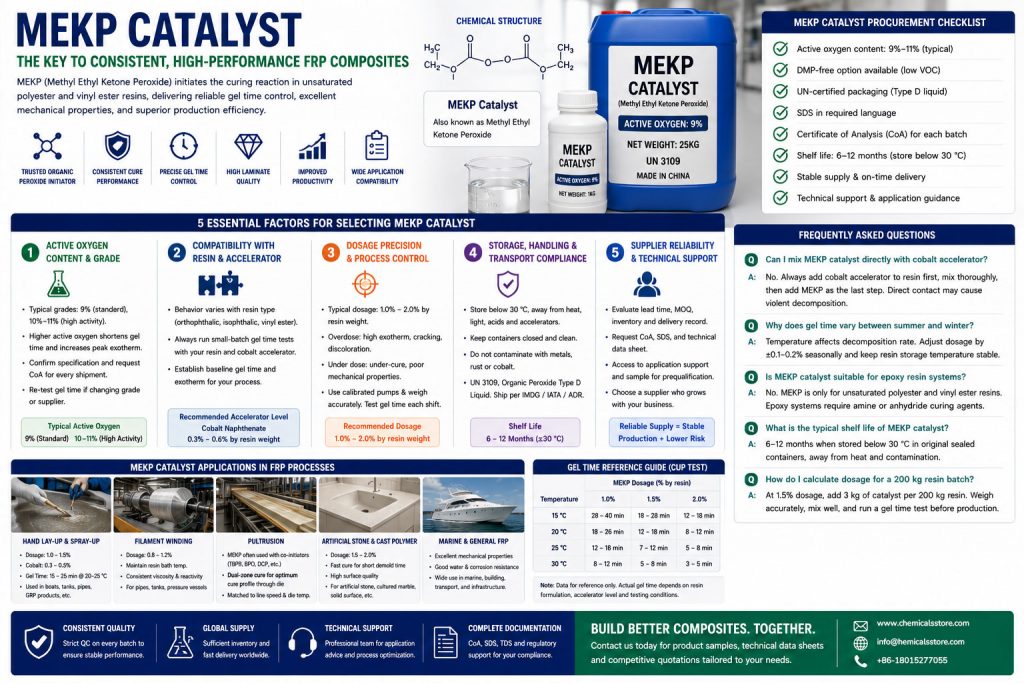
MEKP catalyst belongs to the organic peroxide family. When added to an unsaturated polyester or vinyl ester resin at 1-2% by weight, it decomposes in the presence of a cobalt naphthenate accelerator to generate free radicals. These radicals initiate crosslinking between the styrene monomer and the polymer backbone, converting the liquid resin matrix into a rigid thermoset composite. The decomposition rate, and therefore the gel time and peak exotherm, depends on the catalyst grade (expressed as active oxygen content), ambient temperature, resin formulation, and accelerator level. Most commercial grades used in FRP manufacturing contain 9-11% active oxygen.
5 Essential Factors for Selecting MEKP Catalyst in FRP Production
1. Active Oxygen Content and Grade
Active oxygen content is the primary performance indicator for any initiator grade. Standard grades typically deliver around 9% active oxygen, while higher-performance variants reach 10-11%. Higher active oxygen shortens gel time and raises peak exotherm, which is useful for manufacturers working in low-temperature environments or producing thick-section components. Buyers should confirm the specification with their supplier and request a Certificate of Analysis for every delivery batch. Avoid accepting grade substitutions without re-running gel-time trials, as even minor differences affect cure consistency across production batches.
2. Compatibility With Your Resin and Accelerator System
An MEKP catalyst formulated for one resin system may behave unpredictably in another. Orthophthalic polyester, isophthalic polyester, and vinyl ester resins have distinct reactivity profiles and different accelerator demand. Before committing to a supply source, request a technical data sheet and conduct small-scale gel trials using your own resin, cobalt accelerator, and production temperature. Document gel time and exotherm to establish a repeatable baseline. This step is particularly important when switching suppliers or introducing a new resin grade, as the MEKP catalyst performance profile that worked with a previous formulation may not transfer directly.
3. Dosage Precision and Process Control
Accurate dosing of MEKP catalyst at 1-2% by weight is essential for consistent output. Overdosing beyond 2% does not proportionally accelerate cure; instead, it raises peak exotherm, which can cause cracking in thick laminates and discoloration in light-colored gelcoat. Underdosing leads to under-cure and reduced mechanical strength in the finished laminate. Use calibrated peristaltic pumps on automated spray-up lines and measured dispensers on manual operations. Run a gel-time cup test at the start of each shift to confirm cure profile before full production begins.
4. Storage, Handling, and Transport Compliance
MEKP catalyst is classified as an oxidizing liquid under GHS and must be stored separately from heat sources, direct sunlight, strong acids, and cobalt accelerators. Recommended storage temperature is below 30 degrees C. Even trace contamination from rust, iron particles, or cobalt can trigger decomposition in the container. Dedicated, labeled storage separate from accelerator supplies is industry standard. For international procurement, verify that the supplier ships in UN-certified packaging and complies with IMDG or IATA regulations for organic peroxide Type D liquid. ASTM composite industry guidelines provide supplementary reference for safe handling and testing protocols in FRP facilities.
5. Supplier Reliability and Technical Support
For continuous production schedules, supply continuity matters as much as product specification. Gaps in catalyst availability cause line stoppages whose cost quickly exceeds any savings from a lower unit price. When evaluating suppliers, assess lead times, minimum order quantities, documentation quality, and responsiveness to technical queries. Suppliers who can provide supply chain resource support aligned with recommended international brand products add significant value beyond the product itself. Ask whether application guidance, safety documentation in your language, and sample batches for pre-qualification trials are available before placing a volume commitment.
MEKP Catalyst Applications Across FRP Manufacturing Processes
MEKP catalyst is widely used across the major open and closed composite molding processes used in FRP production:
- Hand lay-up and spray-up: Standard grade at 1.0-1.5% by weight with cobalt accelerator at 0.3-0.5%. Gel time of 15-25 minutes at 20-25 degrees C is typical. Adjust dosage by 0.1-0.2% increments seasonally to compensate for ambient temperature changes.
- Filament winding: Lower catalyst levels of 0.8-1.2% help prevent premature gelation in the resin bath. Resin bath temperature is monitored continuously to maintain consistent viscosity and reactivity throughout the winding cycle.
- Pultrusion: Often blended with a co-initiator such as a peroxy ester or dialkyl peroxide to achieve staged dual-zone cure through the heated die, matched to the pull speed and die temperature profile.
- Artificial stone and cast polymer: Higher-activity grades at 1.5-2.0% support faster mold turnover, which is critical for high-volume production environments with short demold cycles.
Sourcing Checklist for MEKP Catalyst Procurement
When issuing an RFQ, include these specification points to align supplier proposals with your production requirements:
- Active oxygen content minimum and maximum range
- DMP-free or standard formulation (DMP-free preferred for low-VOC applications)
- Packaging options: 25 kg or 200 kg UN-certified drums
- Shelf life and storage temperature requirements
- Safety data sheet (SDS) availability in your required language
- Batch test report or CoA included with every shipment
Request a sample for gel-time verification before placing a full order. A supplier willing to support pre-qualification trials demonstrates confidence in their product quality and technical commitment to your process requirements.
Frequently Asked Questions
Can I mix MEKP catalyst directly with cobalt accelerator?
No. Direct contact between MEKP catalyst and cobalt accelerator can cause violent decomposition. The cobalt accelerator must be pre-mixed into the resin first; the catalyst is added as the final step immediately before laminating or casting begins.
Why does my gel time vary between summer and winter?
Temperature directly affects MEKP decomposition rate. Reduce catalyst dosage by 0.1-0.2% in warm months and increase it in cold months. Maintaining consistent resin storage temperature also reduces batch-to-batch variability during seasonal transitions.
Is MEKP catalyst suitable for epoxy resin systems?
No. MEKP catalyst is only compatible with unsaturated polyester and vinyl ester resin systems. Epoxy resins cure via an addition mechanism and require amine, polyamide, or anhydride curing agents, not peroxide initiators.
What is the typical shelf life of MEKP catalyst?
Most commercial grades carry a shelf life of 6-12 months when stored below 30 degrees C in sealed original containers, away from heat, light, and contamination sources. Always verify the stated expiration date on the supplier’s CoA before use in production.
How do I calculate dosage for a 200 kg resin batch?
At 1.5% dosage, add 3 kg of catalyst per 200 kg of resin. Weigh accurately, stir thoroughly, and run a gel-time cup test before committing to full production. Confirm the ratio at the start of every production shift for consistent process traceability.
Ready to Source MEKP Catalyst for Your Production Line?
Contact our technical team to request a product sample, confirm active oxygen specifications, or discuss a supply arrangement tailored to your composite manufacturing process. We support FRP factories, pultrusion operations, filament winding facilities, and boat builders with application-matched initiator selection and reliable supply chain solutions.