



Selecting the right BPO curing agent is one of the most critical decisions in polyester resin and vinyl ester resin processing for FRP composite manufacturing. BPO (benzoyl peroxide), also known as dibenzoyl peroxide, is a widely used organic peroxide initiator for room-temperature and elevated-temperature curing systems, particularly in applications where MEKP-based curing is not preferred. Understanding how a BPO curing agent behaves across different resin systems, temperatures, and fabrication methods directly affects your laminate quality, processing efficiency, and overall manufacturing cost.
What Is a BPO Curing Agent and How Does It Work?
Benzoyl peroxide belongs to the diacyl peroxide family of organic peroxides. When used as a BPO curing agent in unsaturated polyester resin or vinyl ester resin, it decomposes under heat or in the presence of a tertiary amine accelerator (such as DMA or DEA) to generate free radicals that initiate cross-linking.
Unlike MEKP (methyl ethyl ketone peroxide), which is activated by cobalt naphthenate, a BPO curing agent is primarily activated by amine accelerators. This makes BPO systems the preferred choice when cobalt-free curing or specific color requirements are needed, particularly in artificial stone, cultured marble, and light-colored FRP products.
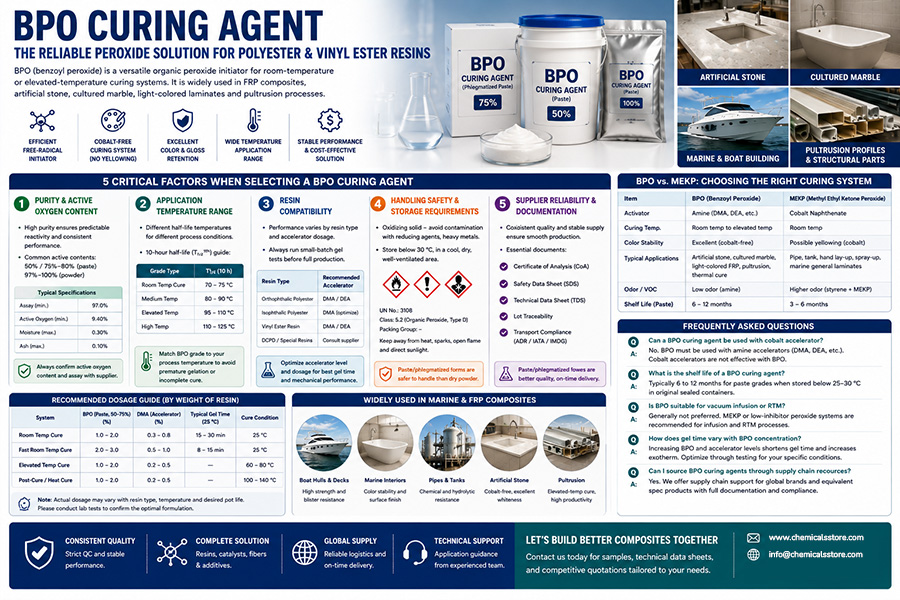
5 Critical Factors When Selecting a BPO Curing Agent
1. Purity and Active Oxygen Content
The purity of your BPO curing agent directly affects reactivity and batch-to-batch consistency. High-purity BPO (typically 97-100% assay) provides more predictable gel times and peak exotherm profiles. Phlegmatized (wetted) or paste forms, commonly 50% or 75-80% active, are safer to handle and easier to disperse in resin. Always confirm the active oxygen content with your supplier before incorporating a new BPO grade into your production line.
2. Application Temperature Range
BPO curing agents are available in different half-life temperature profiles. For room-temperature curing with amine activation, choose grades with a 10-hour half-life temperature in the 70-75 degrees C range. For elevated-temperature processing such as filament winding mandrel cure or heated press operations, higher decomposition temperature grades are required. Mismatching a BPO curing agent to your process temperature is one of the most common causes of premature gelation or incomplete cure.
3. Resin Compatibility
Not all BPO curing agents perform equally across different resin types. In orthophthalic polyester resins, BPO reacts effectively with standard DMA accelerators. In isophthalic or DCPD-based resins, the accelerator concentration may need adjustment. For vinyl ester resins, BPO-amine systems support room-temperature cure but require careful gel time optimization. Always conduct small-batch gel time tests before committing to full production with a new resin-peroxide combination. Our resin product range covers the most common grades for FRP applications and can serve as a reference for compatibility planning.
4. Handling Safety and Storage Requirements
BPO is classified as an oxidizing solid with potential flammability and sensitivity to contamination. Paste and phlegmatized grades offer significantly safer handling compared to dry powder forms. Storage temperature must be maintained below 30 degrees C, away from reducing agents, heavy metal compounds, and direct heat sources. For reference safety data, the ILO International Chemical Safety Card for Dibenzoyl Peroxide provides recognized occupational exposure and handling guidance. Consult your supplier SDS for transportation classifications including ADR and IATA requirements.
5. Supplier Reliability and Documentation
For FRP manufacturers with export customers or quality certification requirements, sourcing a BPO curing agent from suppliers who provide consistent lot documentation, including certificate of analysis, SDS, and TDS, is essential. Supply chain disruption in organic peroxide supply directly affects production scheduling. Suppliers with multi-source procurement capabilities and established logistics for temperature-controlled shipment reduce this risk significantly.
BPO vs. MEKP: Choosing the Right Curing System for Your Process
While MEKP is the dominant organic peroxide initiator in hand lay-up and spray-up applications for FRP pipe, tank, and marine manufacturing, BPO curing agents serve distinct process requirements. BPO is typically preferred for:
- Artificial stone and cultured marble applications using cobalt-free, amine-activated systems
- Light-colored or white FRP laminates where cobalt accelerators can cause yellowing
- Pultrusion processes with amine-terminated cure profiles and elevated die temperatures
- Room-temperature cure in applications requiring reduced styrene emission or specific colorant compatibility
For a broader overview of organic peroxide selection across FRP processes, our organic peroxide product range covers MEKP, BPO, and other initiator systems for composite manufacturing.
Frequently Asked Questions About BPO Curing Agents
Can a BPO curing agent be used with cobalt accelerator?
BPO is not compatible with cobalt naphthenate as an activator. The correct activator system for a BPO curing agent is a tertiary amine such as DMA (N,N-dimethylaniline) or DEA (N,N-diethylaniline). Using cobalt with BPO will not produce the expected free radical generation and may result in incomplete cure or processing inconsistency.
What is the shelf life of a BPO curing agent?
Most phlegmatized BPO paste grades have a shelf life of 6 to 12 months when stored properly at or below 25 degrees C in original sealed containers. Always verify the expiry date provided on the certificate of analysis supplied by your manufacturer or distributor.
Is BPO suitable for vacuum infusion or RTM?
BPO-amine systems are generally not preferred for liquid composite molding methods such as vacuum infusion or RTM due to limited open time control associated with paste grades. For infusion and RTM applications, MEKP or specific low-inhibitor peroxide systems are typically recommended for better process control.
How does gel time vary with BPO concentration?
Gel time is sensitive to both BPO concentration and amine accelerator level. Increasing BPO concentration shortens gel time and raises peak exotherm temperature. Work with your resin supplier and peroxide supplier to establish a recommended dosage matrix for your specific production conditions, resin type, and ambient temperature range.
Can I source BPO curing agents through established supply chain resources?
Yes. Supply chain resource support for recommended international brand products and equivalent-specification formulations is available through qualified industrial chemical distributors. When evaluating suppliers, confirm product assay, active oxygen content, packaging form, and full lot documentation to ensure consistent production quality.
Matching Your BPO Curing Agent to Your FRP Production Requirements
For FRP manufacturers and composite material buyers evaluating BPO curing agents, the key sourcing criteria include confirmed active oxygen content, paste or phlegmatized form availability, SDS compliance with your import regulations, and stable supply with documented lot traceability. Getting these factors right before scaling up production prevents costly rework and quality failures in the field.
Contact our technical team with your resin system, fabrication method, production volume, and target gel time parameters. We will identify the most suitable BPO curing agent grade and accelerator ratio for your process, and provide full product documentation to support your sourcing and compliance requirements.