



Improving Efficiency, Surface Quality, and Production Consistency
In composite manufacturing, mold release agents play a critical role in ensuring efficient demolding, high-quality surface finish, and stable production cycles. Selecting the right release agent is essential for optimizing productivity and reducing defects, especially in processes such as vacuum infusion, RTM, and compression molding.
With a wide range of release systems available, understanding how to choose the appropriate solution can significantly improve both operational efficiency and final product quality.
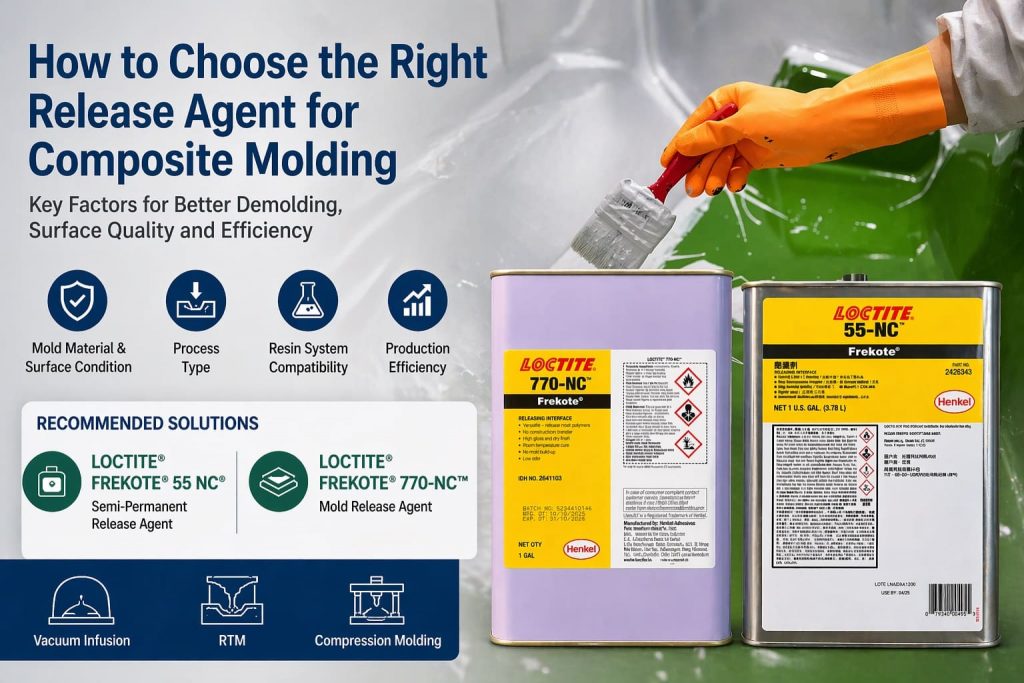
Why Release Agents Matter
During composite molding, materials such as resin systems and reinforcements are cured against mold surfaces. Without a proper release system, components may:
- Stick to the mold surface
- Suffer surface defects or damage
- Require excessive cleaning and downtime
A suitable release agent creates a controlled interface between the mold and the composite part, enabling clean separation and repeatable production cycles.
Key Factors in Selecting a Release Agent
Mold Material and Surface Condition
Different mold materials require different release systems:
- Metal molds (steel, aluminum)
- Composite molds (FRP, epoxy tooling)
Surface finish, porosity, and condition also affect release performance and durability.
Process Type
The molding process determines the performance requirements of the release agent:
- Vacuum Infusion
- Resin Transfer Molding (RTM)
- Compression Molding
Each process involves different pressures, temperatures, and resin flow behavior, which influence release agent selection.
Resin System Compatibility
Release agents must be compatible with the resin system used, such as:
- Unsaturated polyester resins
- Vinyl ester resins
- Epoxy systems
Proper compatibility ensures stable release performance without affecting curing or surface quality.
Production Efficiency Requirements
In industrial production, efficiency is a key factor:
- Number of release cycles per application
- Ease of application
- Reduction in mold cleaning frequency
High-performance release systems can significantly reduce downtime and labor costs.
Semi-Permanent Release Agents: A Preferred Solution
Among various options, semi-permanent release agents are widely used in modern composite manufacturing due to their efficiency and consistency.
Representative products include:
These systems offer several advantages:
- Multiple release cycles from a single application
- Minimal transfer to molded parts
- Improved surface finish quality
- Reduced mold contamination and maintenance
They are particularly suitable for high-volume production and high-quality surface requirements.
Common Issues and How to Avoid Them
Incorrect selection or application of release agents can lead to:
- Part sticking or difficult demolding
- Surface defects such as pinholes or contamination
- Increased mold cleaning frequency
To avoid these issues, it is important to:
- Select a release agent compatible with the process and resin
- Follow proper mold preparation and application procedures
- Maintain consistent process control
Supporting Composite Manufacturing
Release agents are widely used across industries including:
- Automotive components
- Marine and boat manufacturing
- Wind energy parts
- Industrial composite structures
Their role is essential in achieving repeatability, quality, and production efficiency.
Supply by Thousands Technology
As a professional supplier of composite materials and industrial solutions, Thousands Technology provides high-performance release agents, including Loctite® Frekote systems, to support composite manufacturing worldwide.
We offer:
- Reliable product supply
- Technical guidance for material selection
- Support for various composite processes
For more information on release agent solutions and product selection, customers are welcome to contact the Thousands Technology team.