



When planning an FRP (fiberglass-reinforced plastic) project, one of the most common questions engineers and procurement teams face is: should I use fiberglass resin (polyester resin) or epoxy resin? Both materials can work with fiberglass reinforcements, but they perform very differently depending on the application, process, and performance requirements.
This guide from Thousands Technology breaks down the key differences, so you can make an informed decision for your next project.
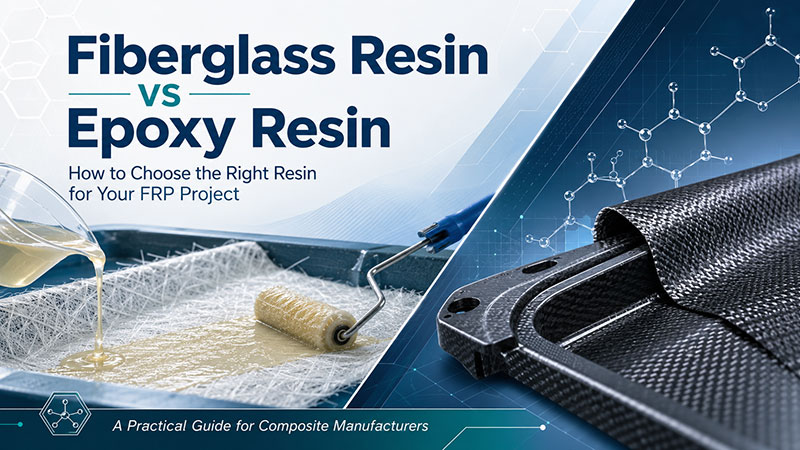
What Is Fiberglass Resin (Unsaturated Polyester Resin)?
Fiberglass resin — commonly referred to as unsaturated polyester resin (UPR) — is the most widely used matrix resin in the composites industry. It is produced by the condensation reaction of unsaturated dibasic acids and glycols, dissolved in styrene monomer as a reactive diluent.
Key characteristics of polyester resin include:
- Low cost and easy availability
- Good processability for hand lay-up, spray-up, and RTM
- Requires MEKP catalyst (methyl ethyl ketone peroxide) for cure initiation
- Moderate mechanical properties
- Slightly higher styrene content (odor and VOC considerations)
- Moderate chemical resistance
Polyester resin is used in a wide range of applications: FRP boats, bathroom fixtures, automotive body panels, and general-purpose fiberglass parts. It is the default choice when cost efficiency is the primary driver.
What Is Epoxy Resin?
Epoxy resin is a thermosetting polymer formed by the reaction of epoxide groups with hardeners (curing agents) such as amines or anhydrides. Unlike polyester resin, epoxy does not require styrene and offers significantly superior adhesion, mechanical performance, and chemical resistance.
Key characteristics of epoxy resin include:
- High mechanical strength and stiffness
- Excellent adhesion to a wide range of substrates
- Superior chemical and moisture resistance
- Low shrinkage during cure
- Higher cost compared to polyester resin
- Longer cure time (typically requires heat post-cure for maximum performance)
- Used with specific curing agents (amine, anhydride, or latent hardeners)
Epoxy resins are preferred in high-performance applications such as aerospace structures, wind turbine blades, carbon fiber composites, and advanced marine construction.
Key Differences: Fiberglass Resin vs Epoxy Resin
The table below summarizes the five most important dimensions for comparison:
| Property | Polyester Resin (Fiberglass Resin) | Epoxy Resin |
|---|---|---|
| Mechanical Strength | Moderate tensile and flexural strength | High tensile strength, superior interlaminar shear |
| Chemical Resistance | Moderate — suitable for mild environments | Excellent — suitable for aggressive chemicals |
| Adhesion | Good to fiberglass; weaker to metals | Outstanding — bonds well to most substrates |
| Cost | Lower cost (USD 1.2–2.5/kg typical) | Higher cost (USD 4–12/kg depending on grade) |
| Processing / Cure | Fast cure with MEKP; room temperature | Slower cure; often requires heat post-cure |
| Shrinkage | Higher shrinkage (6–8%) | Low shrinkage (<2%) |
| Styrene Content | Contains styrene (VOC concern) | Styrene-free |
When to Use Fiberglass (Polyester) Resin
Polyester resin is the right choice when:
- Cost is a primary concern — Polyester resin offers a significantly lower material cost, making it ideal for high-volume, cost-sensitive production.
- The application does not require extreme chemical resistance — For example, general-purpose FRP panels, decorative parts, or structures exposed only to water and mild weathering.
- Fast production cycles are needed — Polyester cures quickly at room temperature with MEKP catalyst, enabling rapid demoulding.
- Standard boat building and repair — Most production boats use polyester or orthophthalic resin for the hull laminate.
- Hand lay-up and spray-up processes — Polyester is formulated specifically for open-mold processes and is easy to handle.
When to Use Epoxy Resin for FRP
Epoxy resin is the preferred choice when:
- High structural performance is required — Aerospace parts, racing boats, wind turbine blade skins, and structural civil engineering applications.
- Excellent chemical resistance is critical — Chemical processing vessels, storage tanks for aggressive media, and pipe systems handling acids or solvents.
- Carbon fiber reinforcement is used — Epoxy is the standard matrix for carbon fiber composites due to its superior adhesion to carbon fibers.
- Low shrinkage is important — Precision tooling, molds, and components with tight dimensional tolerances.
- Infusion or prepreg processes — Vacuum infusion and prepreg manufacturing often use epoxy systems for their processing characteristics.
What About Vinyl Ester Resin? The Middle Ground Option
When neither standard polyester nor full epoxy meets the requirements, vinyl ester resin (VER) is often the best solution. Vinyl ester resin is chemically positioned between polyester and epoxy: it is produced by reacting an epoxy backbone with acrylic or methacrylic acid, then dissolved in styrene.
Vinyl ester resin offers:
- Better chemical resistance than standard polyester resin
- Higher mechanical performance than orthophthalic polyester
- Lower cost than most epoxy systems
- Compatible with MEKP catalyst (similar processing to polyester)
- Widely used in FRP pipes, chemical storage tanks, marine structural components, and pultrusion profiles
If your application involves chemical resistance above what polyester can offer, but the full cost of epoxy is not justified, vinyl ester resin is the answer. It is the industry standard for corrosion-resistant FRP piping systems and chemical-grade storage tanks.
Summary: Which Resin Is Right for Your Project?
- Choose polyester resin for cost-effective, general-purpose FRP fabrication: boats, panels, sanitary ware, and standard structures.
- Choose vinyl ester resin for FRP pipes, tanks, and components requiring improved chemical resistance and structural performance at a reasonable cost.
- Choose epoxy resin for high-performance structural composites, advanced marine, aerospace, wind energy, and applications demanding maximum strength and chemical durability.
Resin Solutions Available from Thousands Technology
As a composite materials supplier and material solution provider, Evergreen Chemicals offers a range of resin systems to support FRP manufacturers across different industries:
- Unsaturated Polyester Resin — General purpose, marine grade, isophthalic, and low-styrene options
- Vinyl Ester Resin — Corrosion-resistant grades for FRP pipes, tanks, and pultrusion
- Epoxy Resin — Standard and high-performance grades for structural composites
- MEKP Catalyst — For curing polyester and vinyl ester resin systems
Not sure which resin system is best for your application? Contact Thousands Technology with your project details — our team provides product recommendations and sourcing support for composite manufacturers worldwide.