



Selecting the right mold release agent for FRP (fiber-reinforced plastic) production is one of the most overlooked factors affecting part quality, surface finish, and production efficiency. Whether you manufacture FRP pipes, marine vessels, automotive panels, or electrical enclosures, the mold release agent you choose determines how cleanly parts demold, how many release cycles you achieve per application, and how the final surface looks. This guide covers 5 essential factors that FRP manufacturers and composite sourcing teams should evaluate before specifying a mold release agent for FRP operations.
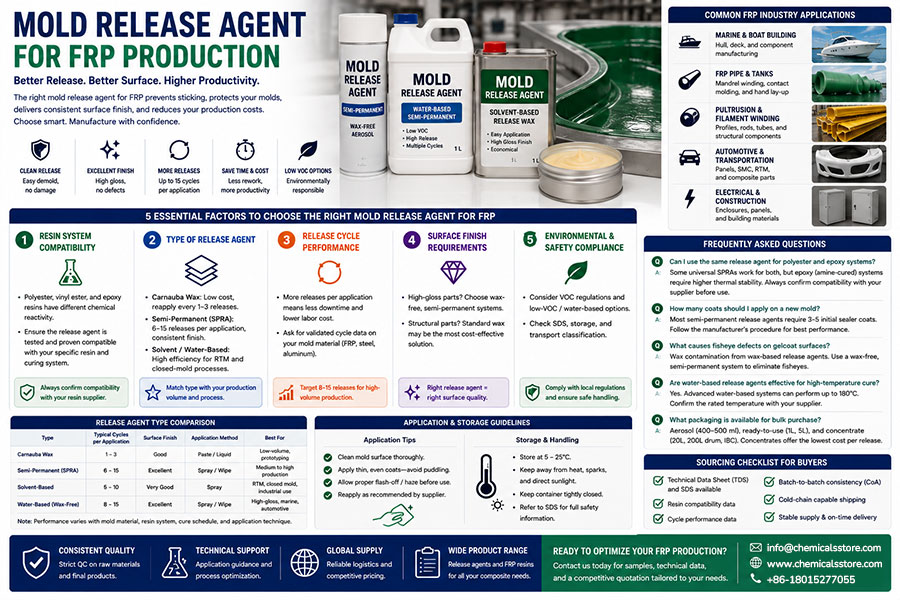
What Is a Mold Release Agent and Why It Matters in FRP Production
A mold release agent for FRP is a chemical barrier applied to the mold surface before layup or infusion, preventing the cured laminate from bonding to the mold. Without proper release agent application, parts can stick to the mold, causing surface tearing, cosmetic defects, increased labor costs, and even mold damage.
In FRP manufacturing processes such as hand lay-up, spray-up, resin transfer molding (RTM), and filament winding, the mold release agent must withstand the heat and chemical environment of curing resins. This includes unsaturated polyester resin, vinyl ester resin, and epoxy resin systems — each with different chemical reactivity and cure temperatures that affect release agent selection.
5 Essential Factors to Choose the Right Mold Release Agent for FRP
1. Resin System Compatibility
Different resin systems interact differently with release agents. Polyester and vinyl ester resins — which use organic peroxides such as MEKP as initiators — require release agents that are chemically resistant to styrene and peroxide environments. Epoxy resin systems, especially those using amine curing agents, demand release agents with high thermal stability and strong barrier properties. Always confirm that the mold release agent for FRP you are sourcing has been tested against your specific resin chemistry and processing conditions.
2. Type of Release Agent: Wax, Semi-Permanent, or Solvent-Based
The three main categories of mold release agents used in FRP composite manufacturing are:
- Carnauba wax-based release agents: Traditional and cost-effective, suitable for low-volume or prototype production. Requires re-application every 1–3 demolding cycles.
- Semi-permanent release agents (SPRA): Applied less frequently — typically allowing 6–15 releases per application — and provide more consistent surface finish. Recommended for medium-to-high production volumes.
- Solvent-based and water-based systems: Used in industrial RTM and closed-mold processes where cycle efficiency and surface quality are critical requirements.
Selecting the right category of mold release agent for FRP directly affects your production cycle time, labor cost per part, and mold maintenance frequency.
3. Release Cycle Performance
High-volume FRP producers need mold release agents that deliver multiple releases per application without recoating. A semi-permanent mold release agent that allows 8–15 releases per application significantly reduces downtime compared to wax-based systems. When evaluating suppliers, request validated cycle count data specific to your mold material — fiberglass molds, steel molds, and aluminum tools each interact differently with release agents. Ask for technical data sheets and trial samples before committing to volume orders.
4. Surface Finish Requirements
For high-gloss marine parts, gelcoat-finished boat hulls, or visible automotive panels, the mold release agent must leave no haze, wax residue, or fisheye defects on the cured surface. In these cases, wax-free semi-permanent systems — particularly water-based formulations — are preferred over solvent wax products. For structural FRP applications where surface appearance is secondary to strength, a standard wax-based mold release agent for FRP may offer the best cost-performance ratio. Matching release agent type to surface finish requirements prevents costly rework and rejection.
5. Environmental and Safety Compliance
With tightening VOC regulations in key export markets — particularly in the EU, North America, and Southeast Asia — sourcing teams increasingly specify low-VOC or water-based mold release agents for FRP production lines. Additionally, consider storage and transportation classification: solvent-based release agents may be classified as flammable liquids, which affects shipping costs and warehouse safety requirements. Request Safety Data Sheets (SDS) from suppliers and verify that products comply with the regulations applicable to your operating region.
Common FRP Industry Applications for Mold Release Agents
The most common industry segments sourcing mold release agents for FRP composites include boat and marine hull manufacturing (large open-mold hand lay-up), FRP pipe and tank production using mandrel-wound or contact-molded processes, pultrusion and filament winding operations requiring consistent low-drag release, automotive and transportation component manufacturing using closed-mold SMC and RTM processes, and electrical enclosure and construction panel production with medium-volume hand lay-up requirements. Each of these industries places different demands on the release agent in terms of cycle count, surface finish, and chemical compatibility.
Procurement and Supply Chain Considerations
When sourcing mold release agents for FRP through B2B channels, composite material buyers should evaluate minimum order quantities, packaging formats (aerosol can versus bulk concentrate versus ready-to-use spray), shelf life, and batch consistency. For high-volume operations, working with a supply partner that provides both release agents and compatible resin systems from a single source reduces procurement complexity and simplifies technical support. Learn more about our FRP resin product range, which includes resins designed for compatibility with semi-permanent release systems.
For composite manufacturing standards reference, ISO 14125 covers mechanical testing of fiber-reinforced plastic composites. Buyers sourcing materials for regulated industries should reference applicable ISO standards when specifying complete material systems including mold release agent selection.
Frequently Asked Questions: Mold Release Agent for FRP
Can I use the same mold release agent for both polyester and epoxy resin systems?
Some universal semi-permanent release agents are compatible with both polyester and epoxy resin systems, but this is not always the case. Epoxy systems — especially amine-cured formulations — require release agents with higher thermal resistance and specific chemical inertness. Always confirm compatibility with your supplier and request technical data sheets for your specific resin chemistry before production use.
How many coats should I apply on a new mold before production?
For new or freshly polished molds, most semi-permanent mold release agents for FRP require 3–5 initial sealer coats before full production releases are attempted. Skipping the sealing steps is a common cause of adhesion failure and part sticking in the first production cycles. Follow the manufacturer’s recommended sealing procedure carefully.
What causes fisheye defects on gelcoat surfaces?
Fisheye defects on gelcoat-finished FRP surfaces are typically caused by wax contamination transferred from wax-based mold release agents. Switching to a wax-free, semi-permanent mold release agent for FRP eliminates this contamination source and is strongly recommended for high-gloss marine and decorative applications.
Are water-based mold release agents effective for elevated-temperature curing?
Advanced water-based semi-permanent release agents are formulated for molds operating up to 180°C and are compatible with ambient-cure and oven-cure FRP systems. Confirm the rated temperature range with your supplier before use in heated tools or post-cure ovens.
What packaging formats are available for bulk procurement?
For high-volume FRP production, bulk concentrate formats — diluted with water or solvent on-site — offer the lowest cost per release. Ready-to-use aerosol cans are suitable for low-volume or prototype work. When procuring in bulk, confirm shelf life, storage requirements, and dilution ratios with your supplier before finalizing the supply agreement.
Ready to Source Mold Release Agents for Your FRP Operation?
Choosing the right mold release agent for FRP production directly impacts your surface quality, production cycle time, and cost per part. Our team provides technical consultation and supply chain support for FRP release agent selection and compatible composite resin systems. Contact us to discuss your production requirements and request a product recommendation tailored to your specific application and volume.