



When it comes to marine FRP construction, vinyl ester resin is the material of choice for builders who need long-term performance in hydrolytic, mechanical, and UV-stressed environments. Boat hulls, marine decks, underwater fittings, and offshore structural components each present different exposure conditions — and selecting the right resin system is a procurement and engineering decision with direct impact on service life and warranty risk.
For FRP fabricators and sourcing managers in the marine sector, the challenge is not only finding competitive supply, but matching the correct resin formulation to the process method and structural requirements. This guide covers five critical selection factors that experienced boat builders evaluate before committing to a resin system.
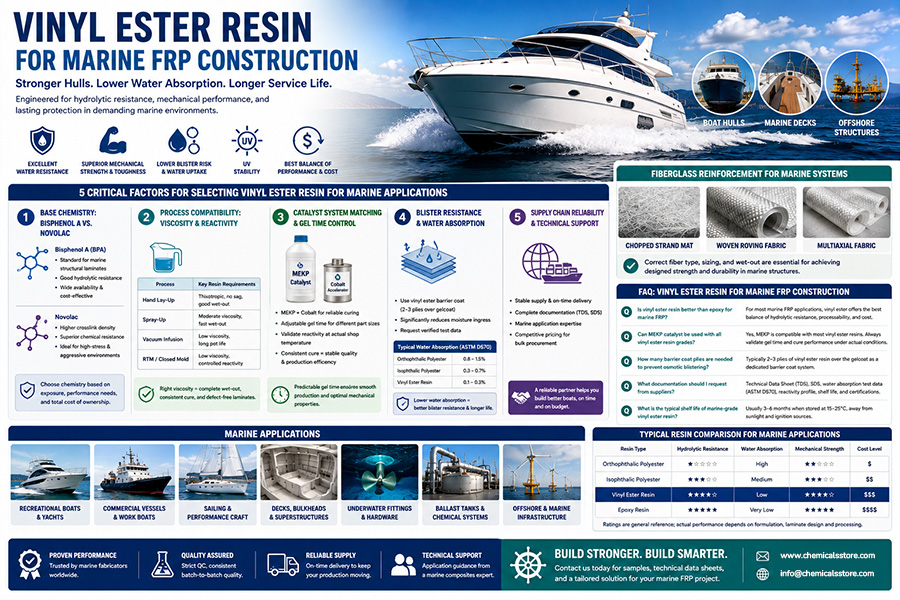
Why Vinyl Ester Resin Dominates Marine Composite Fabrication
Compared to orthophthalic and isophthalic polyester grades, vinyl ester resin provides significantly better hydrolytic resistance, lower water absorption, and higher elongation at break — properties that directly determine blister resistance and structural fatigue life in marine applications. The ester linkages in this chemistry are positioned at the molecular chain ends, reducing the number of hydrolysis-prone sites and improving long-term performance in immersed or splash-zone conditions.
Epoxy systems deliver higher mechanical performance but at greater cost and with more demanding processing requirements, including humidity sensitivity and extended cure cycles. For the majority of commercial and recreational marine FRP production, vinyl ester resin represents the optimal balance of performance, processability, and supply cost. For marine-specific formulations, options such as AME 5500 C marine resin are engineered specifically for boat building and marine laminate applications.
5 Critical Factors for Selecting Vinyl Ester Resin for Marine Applications
1. Base Chemistry: Bisphenol A vs. Novolac Formulations
Bisphenol A-based vinyl ester resin is the standard for marine structural lamination, offering reliable mechanical properties, hydrolysis resistance, and broad compatibility with MEKP catalyst systems. Novolac-based grades provide higher crosslink density and elevated chemical resistance, making them suitable for ballast tank linings, underwater hardware encapsulation, and areas exposed to fuel or aggressive media.
Clearly define the structural zone and exposure condition before specifying resin chemistry. For general hull lamination, bisphenol A grades are typically sufficient and easier to source at scale. Reserve novolac grades for targeted high-stress applications where the performance premium is justified.
2. Process Compatibility: Viscosity and Reactivity Requirements
Marine FRP structures are produced using hand lay-up, spray-up, vacuum infusion, and resin transfer molding. Each process demands different rheological and reactivity characteristics. Hand lay-up grades require higher thixotropy to prevent runoff on vertical surfaces. Vacuum infusion processes require low-viscosity formulations with extended pot life to ensure complete wet-out across large hull panels before gelation begins.
A viscosity mismatch between resin grade and process method leads to dry reinforcement zones, incomplete cure, or delamination — structural defects that are difficult to detect and costly to repair. Always confirm process compatibility with your resin supplier before bulk procurement.
3. Catalyst System Matching and Gel Time Control
Vinyl ester resin is cured using MEKP catalyst combined with a cobalt naphthenate accelerator. For production marine fabrication, gel time predictability is a critical operational parameter. Large infused panels require accurate gel time management to avoid premature gelation, while smaller structural parts may need faster cure cycles to maintain throughput.
Sourcing resin and catalyst from compatible supply channels — with reactivity data validated at your facility’s ambient temperature — reduces batch-to-batch variability and prevents quality incidents caused by unexpected cure rate changes.
4. Blister Resistance and Water Absorption Performance Data
Osmotic blistering below the gelcoat surface is one of the most prevalent and commercially damaging defects in marine FRP construction. Water migrates through the laminate, accumulates at interlaminar interfaces, and generates localized pressure that produces visible blisters — often appearing within 3 to 7 years in service.
Using vinyl ester resin as a barrier coat system — typically 2 to 3 laminate plies applied directly over the gelcoat — provides a hydrolysis-resistant zone that substantially reduces moisture ingress. When sourcing resin for barrier coat applications, request water absorption test data per ASTM D570 or equivalent, and verify that the data reflects marine immersion conditions rather than short-term laboratory exposure.
5. Supply Chain Reliability and Technical Support Capability
For marine fabricators operating on production schedules, resin supply interruptions directly affect vessel delivery commitments. Evaluating vinyl ester resin suppliers on supply reliability, documentation quality, and technical support capability is as important as price benchmarking.
Suppliers with marine composites experience understand classification society requirements, seasonal production volume needs, and application-specific guidance for barrier coat, structural laminate, and secondary bond systems. Access to supply chain resource support for recommended international brand products — combined with competitive pricing for direct procurement — is a practical advantage when scaling marine FRP capacity.
Fiberglass Reinforcement for Marine Composite Systems
Resin performance in marine structures depends significantly on fiberglass reinforcement selection — whether chopped strand mat, woven roving, or multiaxial fabrics. Resin-fiber compatibility, correct sizing chemistry, and proper wet-out during lamination are prerequisites for achieving designed mechanical properties. Coordinate resin and reinforcement procurement to complete system-level compatibility testing before production launch.
FAQ: Vinyl Ester Resin for Marine FRP Construction
Is vinyl ester resin better than epoxy for marine FRP applications?
For most commercial marine FRP applications, vinyl ester resin provides a more practical combination of hydrolytic performance, cure compatibility, and procurement cost than epoxy. Epoxy delivers higher mechanical performance in high-load structural applications but requires controlled humidity, longer cure cycles, and typically costs more per kilogram. For boat hulls, decks, and structural marine laminates, this resin system is the industry standard.
Can MEKP catalyst be used with all vinyl ester resin grades?
MEKP catalyst is compatible with most commercial vinyl ester resin grades, but reactivity profiles vary by formulation. Always validate the catalyst ratio, accelerator level, and resulting gel time against your specific resin batch under actual shop temperature conditions before beginning production lamination.
How many barrier coat plies are needed to prevent osmotic blistering?
Standard practice specifies 2 to 3 plies of vinyl ester resin laminate applied over the gelcoat as a dedicated barrier coat system. The exact layup schedule depends on hull design, water exposure duration, and classification requirements. Consult your resin supplier’s application guidelines for your specific construction method.
What documentation should marine fabricators request from resin suppliers?
Request the current technical data sheet, SDS, water absorption test data (ASTM D570 or equivalent), reactivity profile with your catalyst system, shelf life and storage requirements, and any marine or classification society certifications relevant to your build specification.
What is the typical shelf life for marine-grade vinyl ester resin?
Most commercial grades carry a shelf life of 3 to 6 months when stored at recommended temperatures (typically 15–25°C) away from direct sunlight and ignition sources. Monitor inhibitor levels and viscosity on aged stock before committing to production use.
Discuss Your Marine Resin Requirements
Contact our technical team to review your vessel construction specifications, fabrication process, and sourcing requirements. We provide application-matched resin selection, compatible catalyst system guidance, and stable supply for commercial marine FRP producers.