



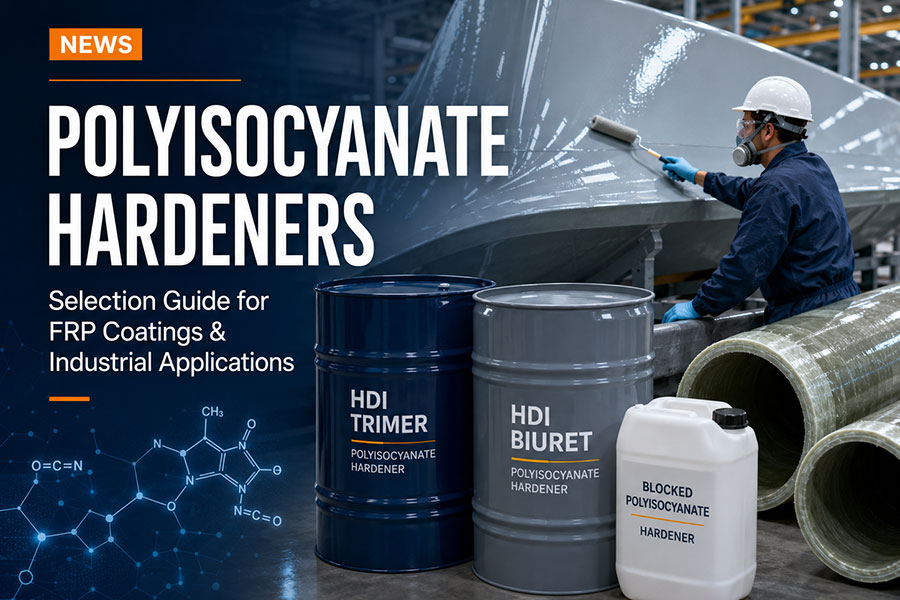
Polyisocyanate hardeners are a critical component in high-performance coating and adhesive systems used across FRP (fiber-reinforced plastic) manufacturing, marine vessels, industrial infrastructure, and protective coating applications. Choosing the right type — whether an HDI trimer, biuret, or blocked variant — has a direct impact on film durability, pot life, yellowing resistance, and overall system compatibility. This guide walks procurement engineers and sourcing managers through the key product types, selection criteria, and supply considerations for polyisocyanate hardeners in B2B composite and industrial coating contexts.
What Are Polyisocyanate Hardeners and Why Do They Matter in FRP?
Polyisocyanate hardeners are multi-functional isocyanate compounds used as crosslinkers in two-component (2K) polyurethane coatings, adhesives, and sealants. When combined with a hydroxyl-functional resin (polyol), they react to form a dense polyurethane network with excellent chemical resistance, mechanical toughness, and weathering stability.
In FRP and composite manufacturing, polyisocyanate hardeners are most commonly used in:
- Topcoats and finish coats applied over composite molded parts
- Adhesive bonding of FRP panels in automotive, marine, and construction assemblies
- Primer and barrier coat systems for corrosion-resistant FRP pipes and tanks
- Industrial maintenance coatings applied to composite infrastructure components
The global polyisocyanate market covers a wide range of chemistries — HDI (hexamethylene diisocyanate), MDI, TDI, and IPDI-based variants — each offering distinct performance trade-offs. For composite and FRP applications where exterior appearance and weathering resistance matter, aliphatic HDI-based polyisocyanate hardeners are the industry standard. According to ISO standards for polyurethane raw materials, the NCO content and viscosity of the hardener must be carefully matched to the polyol system and application method.
Key Types of HDI Polyisocyanate Hardeners
Understanding the structural differences between HDI-based product families is essential before specifying a hardener for a particular process line.
HDI Trimer (Isocyanurate)
HDI trimer polyisocyanates — such as recommended international brand products in the HDI trimer category — offer a rigid isocyanurate ring structure that delivers excellent hardness, chemical resistance, and weatherability. They are widely specified for automotive OEM coatings, marine topcoats, and exterior architectural coatings where non-yellowing performance is non-negotiable. Typical NCO content ranges from 21–23%, with viscosities suited to spray application at room temperature or slightly elevated temperatures. Products in this category, including supply chain resource support options like HDI trimer polyisocyanate hardeners, are stocked by specialty chemical distributors serving the Asia-Pacific composite market.
HDI Biuret
HDI biuret polyisocyanates offer a more flexible network structure compared to trimers, resulting in coatings with better elongation and impact resistance. They are commonly used in flexible composite assemblies, PVC coatings, and elastomeric systems. NCO content is typically in the 22–23% range. The biuret structure tends to produce slightly lower chemical resistance than the trimer at equivalent crosslink density, making application selection important.
Blocked Polyisocyanates (1K Stoving Systems)
For coil coating, powder coating precursors, or high-volume automotive painting lines where two-component mixing logistics are impractical, blocked aliphatic polyisocyanates are used. The isocyanate groups are masked with a blocking agent and only react with the polyol upon application of heat (typically 140–180°C). These are not commonly used in open-mold FRP processes but are relevant in SMC (sheet molding compound) and BMC (bulk molding compound) production where compression molding provides the required cure temperature. Supply chain resource support for blocked HDI-based systems is available from multiple Asian and European specialty chemical distributors.
How to Select Polyisocyanate Hardeners for FRP Coating Applications
Several technical parameters should guide your hardener specification decision:
NCO Content and Stoichiometry
The NCO (isocyanate) content of the hardener, expressed as a percentage by weight, determines how much hardener is needed to achieve the correct NCO:OH ratio (typically 1.0:1.0 to 1.2:1.0). Over-indexing on isocyanate produces brittle coatings; under-indexing leads to softness and poor chemical resistance. Confirm the NCO value with each batch from your supplier — this is especially important when sourcing from multiple distributors across a global supply chain.
Viscosity and Solvent Compatibility
HDI trimer polyisocyanates are typically supplied in solvent-free or solvent-reduced grades (e.g., in butyl acetate or xylene blends) to achieve spray-applicable viscosities. For waterborne 2K PU systems — increasingly required in low-VOC FRP shop environments — hydrophilic polyisocyanate hardeners with emulsifying functionality are available. Verify solvent compatibility with your polyol system before finalizing the formulation.
Pot Life and Cure Speed
Standard HDI trimer hardeners with conventional polyols typically offer pot lives of 4–8 hours at room temperature. For production environments requiring faster throughput, tertiary amine or organotin-catalyzed systems can reduce cure time significantly. However, catalyst type also affects yellowing tendency, so UV-stable catalyst selection matters for exterior-facing composites.
Intended End-Use Environment
FRP pipes and tanks used in chemical processing or wastewater treatment demand coating systems with strong acid and alkali resistance. In these environments, vinyl ester resin-based FRP structures (see our resin product range) are often paired with HDI isocyanurate topcoats to extend service life. Marine FRP structures require non-yellowing, salt-spray resistant topcoats. Automotive FRP exterior panels follow OEM-specified 2K PU systems with IPDI or HDI-based hardeners for Class A surface quality.
Polyisocyanate Hardeners in Industrial FRP Topcoat Systems
The role of the polyisocyanate hardener goes beyond simple crosslinking chemistry. In a typical FRP topcoat formulation applied by spray over a gelcoat or primer layer, the hardener determines the final film’s:
- Gloss retention after prolonged UV exposure
- Flexibility under thermal cycling or impact loads
- Chemical barrier performance against acids, alkalis, or solvents
- Adhesion to the underlying composite substrate
For hand lay-up and spray-up FRP manufacturers, polyisocyanate hardeners supplied in 5–20 kg pails or 200 kg drums are the most common packaging formats. Consistent batch quality is essential: variations in NCO content between batches can shift pot life and film hardness unpredictably, leading to rework or warranty issues on finished composite parts.
Industrial buyers sourcing for large-scale FRP pipe winding or pultrusion operations typically require supply chain resource support that includes technical data sheets, SDS documentation, and batch COA (Certificate of Analysis) for each delivery. Distributors with established relationships with leading international brand manufacturers can provide this documentation as a standard part of the supply agreement.
Supply and Sourcing Considerations for B2B Buyers
Procurement teams sourcing polyisocyanate hardeners for composite operations face several practical challenges:
MOQ and Lead Time
HDI-based polyisocyanate hardeners are specialty chemicals with longer lead times than commodity resins. Buyers in Southeast Asia, South Asia, and the Middle East often face 4–8 week lead times when sourcing direct from European manufacturers. Working with a regional chemical distributor that maintains local inventory can reduce lead time to 1–2 weeks and lower effective MOQ from 1,000 kg to 200–500 kg for smaller composite shops.
Regulatory and Hazmat Compliance
Free isocyanates are classified as hazardous materials under international transport regulations. Polyisocyanate hardeners must be shipped as Class 6.1 or Class 9 goods depending on NCO content and flash point. Importers should verify that their logistics partner holds the appropriate hazmat certifications. Distributors specializing in composite raw materials typically have established dangerous goods shipping capability and can advise on the correct packaging and labeling requirements for your destination country.
Storage and Handling
Polyisocyanate hardeners are moisture-sensitive. Exposure to atmospheric humidity causes the NCO groups to react with water, forming carbon dioxide and urea byproducts that impair crosslink density and cause film defects. Unopened drums should be stored in a dry, temperature-controlled warehouse (10–30°C), and partial containers should be purged with dry nitrogen before resealing. Buyers should factor in shelf life — typically 12 months from manufacture in sealed original packaging — when planning inventory.
Frequently Asked Questions
What is the difference between HDI trimer and HDI biuret polyisocyanate hardeners?
HDI trimer (isocyanurate) hardeners form a rigid ring structure that offers superior hardness, UV resistance, and chemical barrier performance. HDI biuret hardeners provide greater film flexibility and impact resistance at equivalent NCO content. For exterior FRP topcoats and marine applications, the trimer is typically preferred. For flexible composite assemblies or elastomeric coatings, biuret is the better choice.
Can polyisocyanate hardeners be used with unsaturated polyester or vinyl ester resins?
Not directly as a reactive crosslinker — polyisocyanates react with hydroxyl (–OH) groups, not with the unsaturated double bonds in polyester or vinyl ester resins. However, they are widely used in 2K polyurethane topcoat systems applied over cured polyester or vinyl ester FRP substrates. In some specialty formulations, hydroxyl-modified vinyl ester resins are co-reacted with polyisocyanates to improve coating adhesion.
What NCO content should I specify for a marine FRP topcoat?
For most marine topcoat applications, HDI trimer polyisocyanates with NCO content between 21–23% are standard. The formulator will calculate the exact mixing ratio with the polyol component to achieve the target NCO:OH index. Always request the technical data sheet and confirm the equivalent weight (EW) of the hardener for precise stoichiometry calculations.
How should I store polyisocyanate hardeners in a tropical climate?
In high-humidity tropical environments, moisture management is critical. Store sealed drums in an air-conditioned warehouse below 30°C and above 10°C. For opened containers, purge with dry nitrogen immediately after each use and reseal tightly. Inspect batch COAs for water content — most high-quality HDI polyisocyanate hardeners specify less than 0.05% water content at point of manufacture.
Are waterborne polyisocyanate hardeners available for low-VOC FRP coating systems?
Yes. Hydrophilic HDI polyisocyanate hardeners with built-in emulsifying functionality are available for waterborne 2K PU coating systems. These are increasingly specified in regions with strict VOC regulations (EU, California) and in enclosed FRP production environments where solvent exposure limits apply. They require specialized mixing equipment to achieve stable emulsion in water, and pot life is shorter compared to solvent-borne systems.
Inquire About Polyisocyanate Hardener Supply
Thousands Technology supplies polyisocyanate hardeners and related composite coating raw materials to FRP manufacturers, coating formulators, and chemical traders across Asia, the Middle East, and beyond. Whether you are specifying an HDI trimer for a marine topcoat, sourcing a blocked polyisocyanate for an SMC production line, or evaluating waterborne alternatives for VOC compliance, our technical team can assist with product matching, sample arrangement, and competitive supply chain resource support.
Contact us with your application requirements, annual volume, and destination port to receive a customized sourcing proposal. We also provide full documentation packages including TDS, SDS, and batch COA for quality-controlled procurement.