



Choosing the right MEKP catalyst directly affects cure speed, surface quality, and worker safety on the shop floor. Methyl Ethyl Ketone Peroxide (MEKP) remains one of the most widely used catalysts for curing unsaturated polyester resins (UPR) and vinyl ester resins in FRP manufacturing, pultrusion, coatings, and composite production. However, due to its strong oxidizing properties and high sensitivity to temperature and contamination, selecting the correct grade—and handling it safely—is critical for every factory.
As global safety regulations tighten and resin systems evolve, manufacturers are reevaluating how they choose, store, and transport MEKP in order to protect workers, ensure consistent curing performance, and comply with international standards.
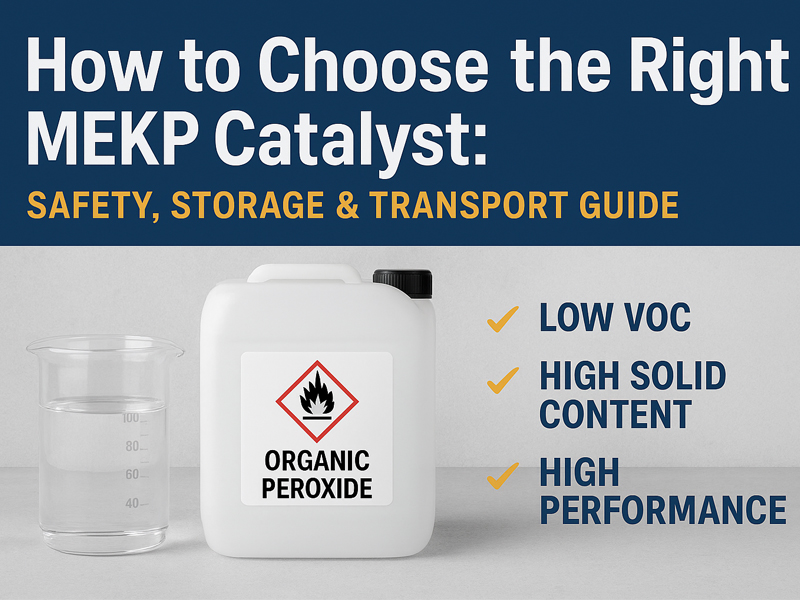
Understanding MEKP Catalyst Grades: Why the Right Choice Matters
Different manufacturing processes require different MEKP specifications. Common variations include:
- Low-active oxygen (low AO) MEKP for general FRP molding
- High-active oxygen MEKP for faster gel and shorter curing time
- Low-odor or low-hazard formulations
- Stabilized MEKP for improved storage safety
- Gelcoat-grade MEKP designed for consistent surface curing
Choosing the wrong grade can lead to issues such as slow curing, surface tack, excessive exotherm, or even product defects.
Experts emphasize that factories should always match MEKP selection to:
- Resin type (UPR, VER, special formulations)
- Production environment temperature
- Required gel time & curing speed
- Safety requirements and plant regulations
Safety: The First Priority in MEKP Handling
Every MEKP catalyst is classified as a Class 5.2 Organic Peroxide, meaning it can decompose violently if exposed to excessive heat, contaminants, or incompatible materials.
Factories are urged to follow strict safety measures:
- Use HDPE, PP, or glass containers only
- Avoid contact with metal contaminants like iron, copper, or cobalt
- Ensure good ventilation in MEKP handling areas
- Train workers in emergency response procedures
- Provide PPE: goggles, gloves, chemical-resistant clothing
Even a small amount of contamination can cause the peroxide to self-accelerate, increasing risk of fire or explosion.
Storage Guidelines: Preventing Decomposition and Hazards
Proper storage extends its shelf life and protects factory personnel.
Key recommendations include:
✔ Temperature Control
- Ideal storage: 10–25°C (50–77°F)
- Avoid sunlight and heat sources
- Use insulated storage in hot climates
✔ Approved Storage Rooms
- Fire-resistant construction
- Explosion-proof ventilation
- No smoking or ignition sources
- Segregation from other chemicals
✔ Container Requirements
- Keep MEKP in original UN-approved containers
- Do not store near reducing agents, accelerators, or metal powders
- Ensure containers are tightly closed to avoid contamination
Common MEKP Selection Mistakes to Avoid
Even experienced production teams can run into avoidable problems when choosing one. Some of the most frequent mistakes include:
- Using the same grade year-round without adjusting for seasonal temperature swings, which can cause gel times to run too fast in summer or too slow in winter
- Ignoring resin manufacturer recommendations for peroxide dosage, which affects cure profile, exotherm, and final laminate properties
- Buying it in bulk without adequate turnover, leading to aged stock that no longer performs to specification
- Overlooking compatibility with accelerators such as cobalt octoate, which must be added separately and never premixed directly with the catalyst
- Underestimating packaging and labeling requirements for cross-border shipments, which can delay customs clearance
Working with a supplier that understands both the chemistry and the logistics involved helps factories avoid these pitfalls before they affect production schedules.
Transportation: Complying With Global Hazardous Goods Regulations
As an organic peroxide, MEKP catalyst is regulated under:
- UN 3105, Organic Peroxide Type D, Liquid
- IMDG Code for sea transport
- ICAO/IATA for air transport
- ADR/RID for road and rail transport
Compliance includes:
- Proper UN-certified packaging
- Type D hazard labels
- Temperature-controlled transport (in hot climates)
- Trained dangerous goods handlers
Factories should only work with logistics partners experienced in organic peroxide handling, and should confirm current classification requirements directly with the IMO Dangerous Goods, Cargoes and Containers work programme, which maintains the IMDG Code referenced above.
Thousands Technology Co., Ltd Provides Reliable MEKP Solutions
As global composite and resin industries expand, Thousands Technology Co., Ltd supports manufacturers with:
- High-purity MEKP catalysts for UPR/VER
- Low-odor and stabilized grades
- Gelcoat-grade MEKP for premium surface finishing
- UN-approved safe packaging
- Technical guidance for curing optimization
With strict QC systems, safe logistics partners, and professional support, Thousands Technology ensures every shipment is delivered safely and performs reliably in customers’ factories. Buyers comparing options can review the full range of organic peroxide curing agents available for UPR and VER systems before placing an order.
Frequently Asked Questions About MEKP Catalyst Selection
What is the difference between low and high active oxygen MEKP catalyst grades?
Low active oxygen grades release peroxide more gradually, giving a longer working time that suits general FRP molding. High active oxygen grades accelerate gel and cure faster, which is useful for production lines that need shorter cycle times but requires closer control of exotherm to avoid surface defects.
How long can MEKP catalyst be stored before it loses effectiveness?
Shelf life depends heavily on storage temperature and container integrity. Keeping it within the recommended 10–25°C range, away from sunlight and contamination, helps preserve activity for longer. Factories should always rotate stock and avoid holding large volumes beyond the supplier’s recommended storage period.
Can this catalyst be shipped by air freight?
It is regulated as a Class 5.2 organic peroxide, and air shipment is subject to ICAO/IATA dangerous goods rules, which are stricter than sea or road transport for this hazard class. Buyers should confirm with their logistics partner whether a specific grade and package size is approved for air transport before ordering.
What causes MEKP catalyst to decompose prematurely?
Premature decomposition is usually triggered by heat exposure, contamination with metals such as iron, copper, or cobalt, or contact with incompatible chemicals. Using approved HDPE, PP, or glass containers and keeping storage areas cool and contaminant-free are the most effective ways to protect it from unwanted decomposition.
Which MEKP catalyst grade is best for gelcoat applications?
This gelcoat-grade product is formulated for consistent surface curing and a smoother finish compared to standard grades. Selecting the correct gelcoat-grade product helps reduce surface tack and improve gloss retention, which matters for visible laminate surfaces in marine and architectural applications.
Choosing the right MEKP catalyst is no longer just a technical decision—it’s a crucial step in ensuring factory safety, product quality, and compliance with international standards. With proper selection, safe storage, and regulated transportation, manufacturers can significantly reduce risk and improve curing efficiency.