



For manufacturers and procurement managers in the fiberglass reinforced plastics (FRP) industry, selecting the right resin system is one of the most consequential decisions in any project. Whether you are sourcing materials for FRP pipes and tanks, marine vessels, construction panels, or electrical enclosures, understanding the key differences between polyester resin and epoxy resin will help you optimize cost, performance, and supply chain reliability.
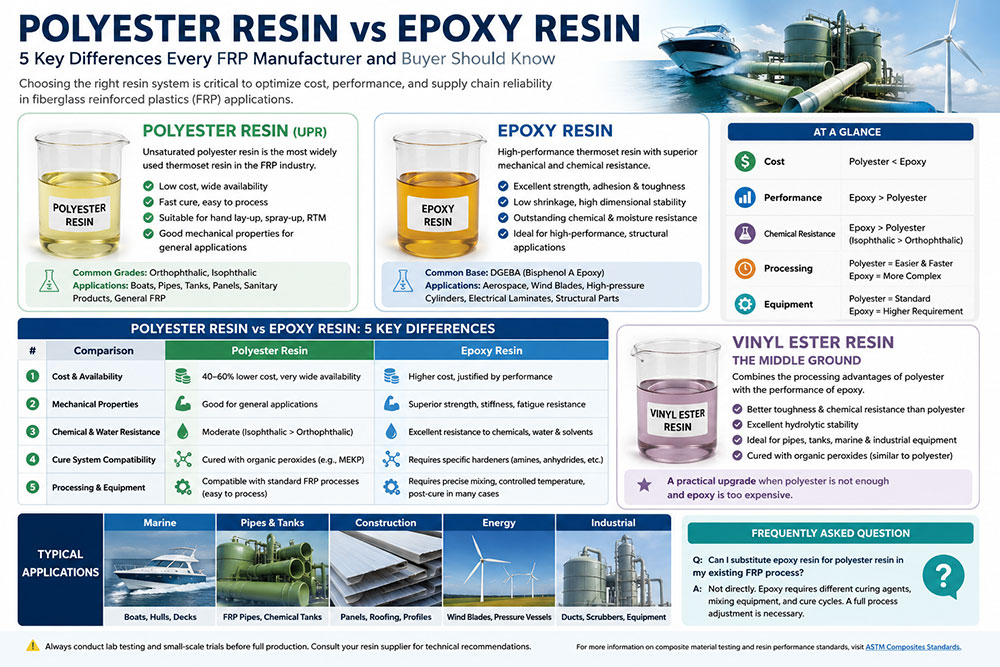
What Is Polyester Resin in FRP Composites?
Unsaturated polyester resin (UPR) is the most widely used thermoset resin in the fiberglass composites industry. It is produced by reacting diols with dicarboxylic acids—typically maleic anhydride and phthalic anhydride—to form a viscous liquid pre-polymer dissolved in styrene monomer. When combined with a catalyst system such as MEKP (methyl ethyl ketone peroxide), polyester resin undergoes free-radical polymerization to produce a rigid, cross-linked thermoset.
Polyester resin is well suited for hand lay-up, spray-up, and resin transfer molding (RTM) processes. Its advantages include low cost, ease of processing, fast cure cycles, and wide availability. It is the standard choice for many marine, construction, and general industrial FRP applications where moderate mechanical performance and chemical resistance are sufficient.
For B2B buyers, polyester resin is available in orthophthalic and isophthalic grades. Isophthalic polyester offers improved water and chemical resistance, making it appropriate for marine hulls, sanitary products, and corrosion-resistant tanks. Detailed grade specifications are available in our resin product category.
What Is Epoxy Resin and When Is It Used?
Epoxy resin is a high-performance thermoset polymer characterized by epoxide functional groups. The most common industrial grade is based on bisphenol A diglycidyl ether (DGEBA), cured with amine, anhydride, or polyamide hardeners. Epoxy resin systems offer superior adhesion, mechanical strength, low shrinkage, and excellent chemical and moisture resistance compared to polyester resin.
Epoxy is the preferred matrix resin for aerospace components, wind turbine blades, filament winding of high-pressure cylinders, and structural automotive parts. It is also widely used in electrical laminates (PCB substrates) and structural repair compounds. The trade-off is significantly higher material cost, more complex mixing ratios, and longer cure or post-cure cycles required to achieve full mechanical properties.
For authoritative guidance on composite material testing and resin performance standards, refer to the ASTM Composites Standards resource.
Polyester Resin vs Epoxy Resin: 5 Key Differences for FRP Buyers
1. Cost and Availability
Polyester resin is significantly lower in cost than epoxy resin—typically 40–60% less per kilogram at industrial volumes. For high-volume FRP applications such as pipes, tanks, boat hulls, and panels, polyester resin provides clear cost advantages. Epoxy resin is preferred when mechanical performance requirements cannot be met by polyester and the additional cost is justified by the application.
2. Mechanical Properties
Epoxy resin laminates consistently outperform polyester in tensile strength, flexural modulus, interlaminar shear strength, and fatigue resistance. For structurally critical applications such as wind turbine blades or aerospace brackets, this performance gap is decisive. For general-purpose FRP panels, boats, and sanitary products, polyester resin delivers adequate performance at lower cost.
3. Chemical and Water Resistance
Both resins offer resistance to a range of chemicals, but the level varies. Standard orthophthalic polyester resin has limited chemical resistance; isophthalic polyester performs better. For applications involving continuous exposure to acids, alkalis, or solvents—such as chemical storage tanks and wastewater pipes—vinyl ester resin or high-performance epoxy resin systems are strongly recommended.
4. Cure System Compatibility
Polyester resin is cured with organic peroxide initiators (typically MEKP or similar). Epoxy resin requires stoichiometrically matched curing agents—amines, anhydrides, or other hardeners. The cure system selection affects pot life, peak exotherm, and final mechanical properties. Composite fabricators switching between resin types need to adapt their entire cure system, not just the resin. You can find a full range of compatible organic peroxide initiators for polyester and vinyl ester resin systems in our catalog.
5. Processing and Equipment
Polyester resin is compatible with spray-up, hand lay-up, pultrusion, and filament winding using standard equipment. Epoxy systems tend to require more precise mixing equipment, controlled temperature environments, and sometimes autoclave or oven post-curing. For FRP factories already operating with polyester infrastructure, upgrading to epoxy involves capital investment and operator retraining.
Vinyl Ester Resin: The Middle Ground Between Polyester Resin and Epoxy
For buyers looking for performance between standard polyester and epoxy, vinyl ester resin is a compelling option. Vinyl ester combines a polyester-like processing profile with an epoxy-derived backbone, resulting in superior toughness, chemical resistance, and hydrolytic stability. It is widely used in FRP pipes, chemical storage tanks, marine structures, and industrial equipment where polyester resin falls short but epoxy resin is cost-prohibitive. Vinyl ester resin is processed similarly to polyester using organic peroxide cure systems, making it a practical upgrade for existing production lines.
Frequently Asked Questions
Can I substitute epoxy resin for polyester resin in my existing FRP process?
A direct substitution is not straightforward. Epoxy resin requires different curing agents, mixing equipment, and cure cycles. If you are evaluating an upgrade, consult with your resin supplier for a full process compatibility review before committing to a material change.
Is polyester resin suitable for chemical storage tanks?
Standard orthophthalic polyester resin is not recommended for corrosive chemical service. Isophthalic polyester or vinyl ester resin should be considered for corrosion-resistant tanks, depending on the specific chemical exposure and operating temperature.
What fiberglass reinforcement works best with epoxy resin?
Epoxy resin is compatible with woven roving, chopped strand mat, and multiaxial fabrics. For high-performance applications, unidirectional carbon fiber or glass fiber fabrics are typically used to maximize laminate mechanical properties.
How do I evaluate resin quality when sourcing from overseas suppliers?
Request a COA (certificate of analysis), technical data sheets, and samples for in-house testing. Key parameters for polyester resin include acid value, viscosity, gel time, and hardness after cure. For epoxy resin, check epoxy equivalent weight (EEW), viscosity, and purity levels.
Does resin selection affect shipping and handling requirements?
Yes. Both polyester resin and epoxy resin are classified as hazardous materials for transport. Organic peroxide initiators used with polyester and vinyl ester systems require temperature-controlled storage and transport. Your supplier should provide SDS documentation and shipping compliance guidance.
Source Your Composite Resins with Confidence
Choosing between polyester resin and epoxy resin is not a binary decision—it depends on your application requirements, process capabilities, budget, and supply chain constraints. Whether you are scaling up FRP pipe production, sourcing materials for marine vessel manufacturing, or selecting a resin system for an industrial tank project, our technical team can help you match the right resin and cure system to your needs.
Contact us today to discuss your material requirements, request samples, or get a sourcing quotation for polyester resin, vinyl ester resin, epoxy resin, and associated processing chemicals. Our team supports composite manufacturers and chemical traders across multiple industries with reliable supply, technical documentation, and application guidance.