



Organic peroxide BIPB is one of the more specialized products in the organic peroxide family, and it is also one of the easiest to get wrong when buyers source it purely on price. Unlike the ketone peroxides such as MEKP that composite fabricators use for room-temperature curing of unsaturated polyester and vinyl ester resins, BIPB is a dialkyl peroxide most often selected as a crosslinking agent for rubber compounds, wire and cable insulation, foam, and other polymer systems that are cured at elevated temperatures. Because it behaves differently from the peroxides used in typical hand lay-up or spray-up FRP work, wholesale buyers evaluating this product need a sourcing checklist that goes beyond a basic price comparison.
What Is Organic Peroxide BIPB and Where Is It Used?
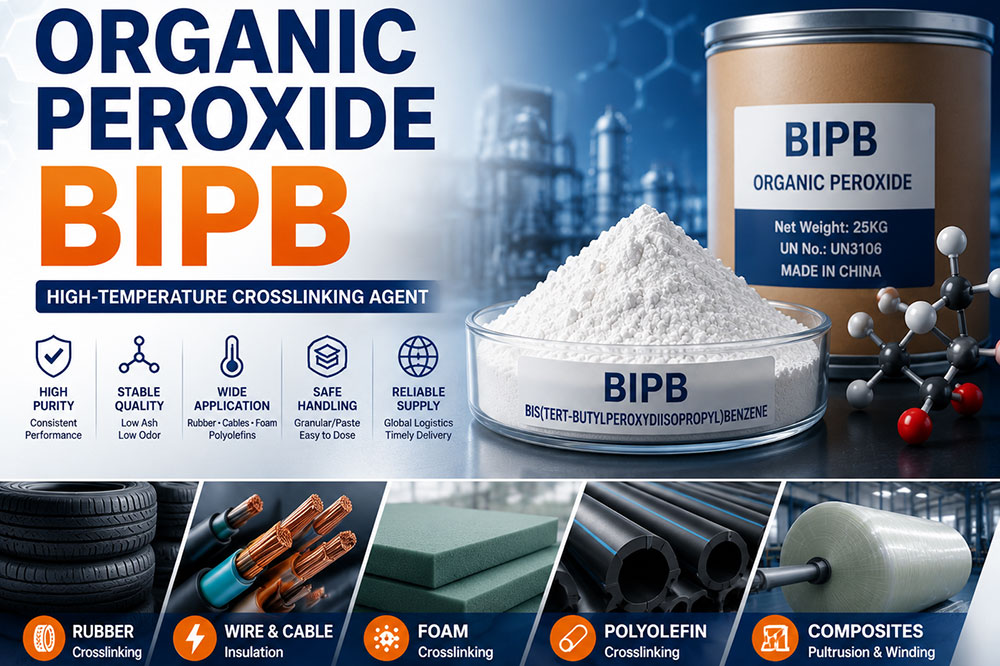
Chemically, BIPB (bis-tert-butylperoxy-diisopropylbenzene) belongs to the dialkyl peroxide family. It is typically supplied as a powder or paste carried on an inert filler, which affects handling, dosing, and storage compared to liquid peroxides. Buyers sourcing this crosslinking agent are usually compounders or processors working in rubber crosslinking, polyolefin foam production, wire and cable insulation, or specialty polymer manufacturing rather than the room-temperature FRP resin systems that dominate marine, pultrusion, and filament winding applications. Recognizing this distinction early prevents a common sourcing mistake: assuming that a supplier experienced in MEKP or BPO for polyester resin curing has the same depth of technical support for a high-temperature dialkyl peroxide like this one.
5 Essential Factors for Wholesale Buyers Sourcing Organic Peroxide BIPB
1. Batch-to-Batch Purity and Assay Consistency
Crosslinking performance depends on consistent active peroxide content from batch to batch. Wholesale buyers should ask suppliers for certificates of analysis on every shipment, not just the first sample lot, and should confirm how assay variation is tracked over time. Inconsistent purity in this material can translate directly into inconsistent cure profiles downstream, which is a costly problem to trace back to raw material once it shows up in finished parts.
2. Supply Chain Reliability and Lead Time
Organic peroxides are classified as dangerous goods for transport, which means shipping lead times can be longer and less predictable than for standard industrial chemicals. Buyers sourcing organic peroxide BIPB on a wholesale basis should ask about typical lead times, minimum order quantities, and whether the supplier can support recurring orders without last-minute allocation issues. A sourcing partner who can offer supply chain resource support across multiple peroxide grades reduces the risk of a single-point-of-failure supplier relationship.
3. Safety Documentation and Regulatory Compliance
Because organic peroxide BIPB falls under UN Class 5.2 dangerous goods regulations, buyers need current Safety Data Sheets, UN packing group classification, and transport documentation before the first shipment, not after. Skipping this step is one of the most common and most expensive wholesale sourcing mistakes, since customs delays or rejected shipments at the border can halt a production line entirely.
4. Packaging, Storage, and Temperature Control
Dialkyl peroxides including BIPB generally require controlled storage temperatures to remain stable and safe over their shelf life. Wholesale buyers should confirm what packaging format is used, what storage temperature range the supplier recommends, and how the product is protected during transit, particularly for shipments crossing warm climates or long transit routes. Getting this wrong does not just risk product quality, it raises real safety considerations.
5. Technical Support for Formulation and Processing
Because this peroxide grade is used across a range of elevated-temperature crosslinking applications, buyers benefit from a supplier that can offer application-level technical support rather than a pure commodity transaction. This includes guidance on dosing ranges relative to the base polymer, compatibility with co-agents, and processing temperature considerations specific to the buyer’s equipment and cycle time.
Avoiding Common Wholesale Sourcing Mistakes with Organic Peroxide BIPB
The most frequent mistake buyers make is treating organic peroxide BIPB as interchangeable with other organic peroxides simply because they share the same general hazard class. In practice, cure chemistry, recommended processing temperature, and handling requirements differ significantly between a dialkyl peroxide like BIPB and the ketone or diacyl peroxides used in cold-cure FRP resin systems. A second common mistake is qualifying only one supplier for a specialty grade like this, which leaves buyers exposed if that supplier faces a production interruption. Diversifying sourcing across recommended international brand products, while maintaining consistent specification requirements, is a more resilient approach for buyers who depend on continuous supply.
Why Buyers Are Turning to Diversified Peroxide Sourcing
As composite, rubber, and polymer manufacturers manage tighter production schedules, many buyers are moving away from single-source purchasing for specialty organic peroxides. A wholesale sourcing partner that can supply this dialkyl peroxide alongside related crosslinking and curing agents gives buyers a single point of contact for technical questions, documentation, and logistics planning, which shortens the qualification process for new formulations and reduces administrative overhead across multiple vendor relationships.
Frequently Asked Questions
Is organic peroxide BIPB the same as MEKP used in FRP resin curing?
No. Organic peroxide BIPB is a dialkyl peroxide typically used for elevated-temperature crosslinking in rubber, foam, and wire and cable insulation, while MEKP is a ketone peroxide used for room-temperature curing of unsaturated polyester and vinyl ester resins in FRP fabrication.
What documentation should I request before placing a wholesale order?
At minimum, request a current Safety Data Sheet, certificate of analysis for the specific batch, and UN transport classification documentation. This is standard practice for any organic peroxide shipment and should be available before your first order ships.
Does organic peroxide BIPB require special storage conditions?
Yes. Like most dialkyl peroxides, BIPB is temperature sensitive and suppliers typically specify a recommended storage temperature range to maintain stability and safety over its shelf life. Confirm this range with your supplier and verify it against your own warehouse conditions.
How can I reduce supply chain risk when sourcing this product?
Qualifying more than one supplier, confirming lead times in advance, and working with a sourcing partner that offers supply chain resource support across multiple peroxide grades all help reduce the risk of production interruptions tied to a single vendor.
Who typically buys organic peroxide BIPB in bulk?
Typical wholesale buyers include rubber compounders, wire and cable insulation manufacturers, foam producers, and specialty polymer processors who require elevated-temperature crosslinking agents as part of their production process.
For manufacturers relying on a stable supply of organic peroxide BIPB or related crosslinking agents, selecting the right supplier is as important as selecting the right product. Beyond pricing, factors such as product consistency, safety documentation, logistics support, and technical communication all play an important role in long-term sourcing decisions.
At ChemicalsStore.com, we help global industrial buyers source organic peroxides and specialty chemical materials with reliable supply support, complete technical documentation, and application-focused assistance. Whether you are qualifying a new supplier or optimizing your existing supply chain, our team can provide suitable sourcing solutions based on your product requirements and production needs.
👉 Contact us at info@chemicalsstore.com to discuss your organic peroxide BIPB sourcing requirements and request a quotation.