



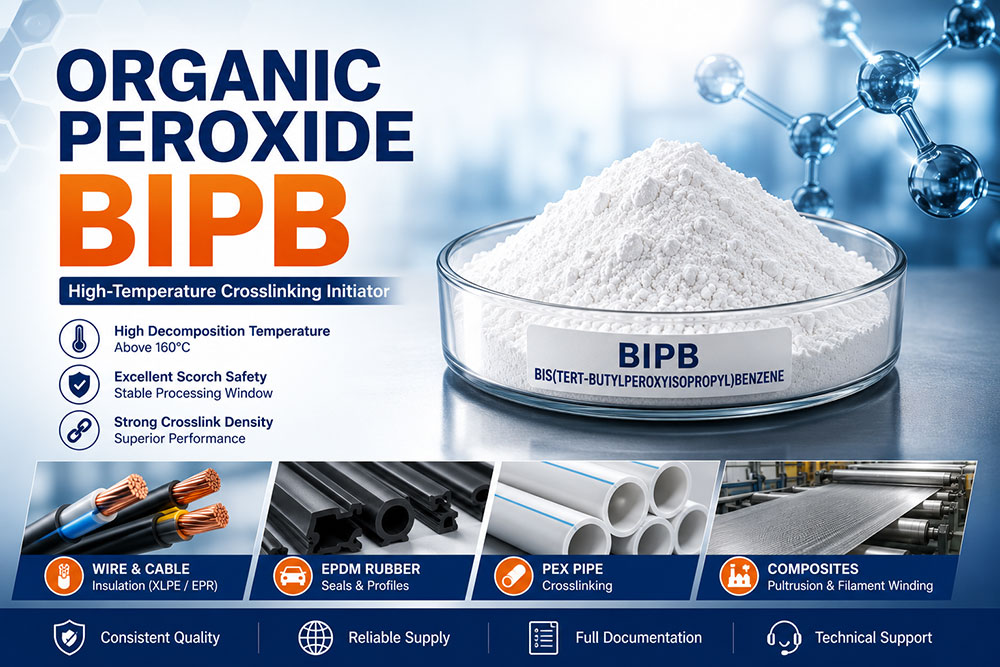
Organic peroxide BIPB — chemically known as bis(tert-butylperoxyisopropyl)benzene (CAS No. 25155-25-3) — is one of the most widely used high-temperature crosslinking initiators in rubber and polymer manufacturing. With a decomposition temperature above 160°C and excellent scorch safety, organic peroxide BIPB is the preferred choice for EPDM rubber compounds, silicone rubber, wire and cable insulation, and crosslinked polyethylene pipe applications. As global demand for crosslinked polymer materials continues to grow, sourcing reliable organic peroxide BIPB has become a critical decision point for manufacturers seeking to maintain consistent production quality and output efficiency.
What Is Organic Peroxide BIPB and How Does It Work?
BIPB belongs to the dialkyl peroxide family of crosslinking agents and is commonly supplied as a white crystalline powder, granule, or polymer-carrier masterbatch in active concentrations of 40% or higher. When exposed to processing temperatures above 160°C, organic peroxide BIPB undergoes homolytic cleavage to generate highly reactive free radicals. These radicals abstract hydrogen atoms from polymer backbones, creating carbon-carbon (C–C) crosslink bonds between adjacent polymer chains.
Unlike sulfur-based vulcanization systems, peroxide crosslinking with organic peroxide BIPB produces a clean, low-odor network structure with outstanding heat resistance, excellent electrical insulation properties, and minimal byproduct volatility. This makes BIPB an indispensable crosslinking agent for premium wire and cable products, automotive seals and profiles, and high-performance EPDM roofing membranes.
Key Industrial Applications of Organic Peroxide BIPB
EPDM and Specialty Rubber Crosslinking
Organic peroxide BIPB is extensively used for crosslinking EPDM rubber in automotive weather strips, roofing membranes, industrial hoses, and vibration dampers. Compared to sulfur vulcanization, BIPB-crosslinked EPDM retains superior compression set resistance and resists thermal degradation at sustained temperatures above 150°C — a critical requirement in automotive and construction-grade sealing applications.
Wire and Cable Insulation (XLPE and EPR)
In wire and cable manufacturing, organic peroxide BIPB serves as the primary initiator for crosslinking polyethylene (XLPE) and ethylene-propylene rubber (EPR) insulation compounds. BIPB-based formulations are widely specified for medium and high-voltage cable applications, where long-term dielectric performance, thermal stability, and moisture resistance are essential. Its low volatility and minimal decomposition byproducts make it especially suitable for demanding cable grades.
Crosslinked Polyethylene (PEX) Pipe Manufacturing
For PEX pipe production, organic peroxide BIPB enables the peroxide crosslinking method (used in PEX-a and PEX-b systems), producing pipes with shape memory properties and elevated pressure-temperature ratings for hot water distribution and radiant underfloor heating installations. Consistent active oxygen content in BIPB is directly linked to uniform crosslink density and long-term pipe performance under pressure.
Organic Peroxide BIPB: 5 Essential Factors to Evaluate Before Sourcing
1. Purity and Active Oxygen Content Specification
When sourcing organic peroxide BIPB, always request a batch-specific Certificate of Analysis (COA) confirming active oxygen content, BIPB purity, and decomposition temperature. Substandard formulations with inconsistent active content directly impact crosslink density, resulting in under-cured rubber with poor mechanical properties or inconsistent cable insulation performance. Verified COA documentation is the baseline for any credible supply relationship.
2. Formulation Type: Powder, Granule, or Masterbatch
Organic peroxide BIPB is available in multiple formulation types, each suited to different processing environments. Pure powder or granule forms offer maximum peroxide loading at lower carrier cost and are common in open-mill rubber mixing. Masterbatch formulations — where BIPB is pre-dispersed in a polymer carrier — improve handling safety, eliminate dust exposure risk, and ensure more uniform dispersion in continuous extrusion and injection molding processes. Selecting the right formulation for your mixing and curing equipment is essential to avoid processing problems.
3. Cold Chain Storage and Transport Compliance
As a Division 5.2 organic peroxide under international transport regulations, organic peroxide BIPB must be stored below 30°C in a dry environment away from heat sources, direct sunlight, and incompatible chemicals. When evaluating potential suppliers, confirm their cold-chain logistics capability, warehouse conditions, and shelf-life guarantees. BIPB that has been improperly stored or transported may exhibit premature partial decomposition, causing scorching problems during processing and reducing the effective crosslink yield in your final product.
4. Supplier Lead Time and Supply Chain Reliability
Production interruptions caused by organic peroxide BIPB shortages can be extremely costly in continuous extrusion and wire production environments. Before committing to a supplier, evaluate their inventory management, minimum order quantities, and documented ability to fulfill repeat orders within agreed lead times. Suppliers with established supply chain resource support and regional warehousing presence offer significantly lower supply disruption risk — a factor that should weigh heavily alongside unit price in your sourcing decision.
5. Regulatory Documentation: SDS, REACH, and UN Classification
Ensure your supplier provides complete and current Safety Data Sheets (SDS), UN classification records for organic peroxide transport, and compliant GHS-labeled packaging. For importers supplying the European market, REACH registration status is a mandatory compliance requirement. Responsible suppliers of organic peroxide BIPB maintain up-to-date regulatory documentation and can provide it promptly upon request — any hesitation here should be treated as a supply risk indicator.
Frequently Asked Questions About Organic Peroxide BIPB
What is the difference between BIPB 40 and BIPB 95?
BIPB 40 refers to a 40% active formulation diluted with an inert carrier for improved handling safety and easier weighing in production. BIPB 95 is a high-purity concentrate used in applications that require precise, high-loading crosslink dosing. The 40% granule or powder form is the most widely used in commercial rubber compounding and cable insulation manufacturing.
How does organic peroxide BIPB compare to DCP (dicumyl peroxide)?
Both BIPB and DCP are dialkyl peroxides used for polymer crosslinking. BIPB offers slightly higher thermal stability, lower decomposition byproduct volatility, and reduced odor compared to DCP, making it the preferred choice for automotive interior applications, food-contact tubing, and cable grades with strict outgassing specifications. DCP remains widely used due to its lower cost and established formulation base.
Can organic peroxide BIPB be used in silicone rubber compounds?
Yes. Organic peroxide BIPB is compatible with high-consistency silicone rubber (HCR) and is used as a secondary crosslinking agent in silicone formulations requiring specific cure kinetics. Consult the silicone compound manufacturer’s processing guide for recommended BIPB loading levels and cure temperature profiles.
What is the typical shelf life of BIPB?
Under proper cold storage conditions (below 30°C, dry and well-ventilated environment), organic peroxide BIPB typically has a shelf life of 12 months from the manufacture date. Always verify the remaining shelf life on the COA before accepting delivery and manage inventory on a first-in, first-out basis to avoid performance losses from aged stock.
Is organic peroxide BIPB available for trial order and technical evaluation?
Yes. Many suppliers offer sample quantities of organic peroxide BIPB for formulation testing and process validation. When submitting a sample request, specify the required formulation type (powder, granule, or masterbatch), active content percentage, and any packaging or documentation requirements needed for your incoming material inspection process.
For a broader overview of crosslinking initiator selection principles, refer to the ISO standards for rubber and polymer testing as a baseline for quality verification protocols.
Source Organic Peroxide BIPB With Confidence
Sourcing organic peroxide BIPB is not purely a price decision — it is a supply chain integrity decision that directly affects your production consistency, product compliance, and customer satisfaction. At Chemicalsstore, we supply organic peroxide BIPB and a comprehensive range of crosslinking initiators for rubber processing, wire and cable manufacturing, and polymer crosslinking applications, with full technical documentation, competitive lead times, and responsive export support.
Submit your inquiry today and receive a detailed product specification and quotation within 24 business hours. Our technical team is available to assist with formulation questions, sample arrangements, and regulatory documentation requirements.