



For composite manufacturers working in pultrusion, filament winding, or high-temperature lay-up, selecting the right initiator is critical to production efficiency and part quality. Organic peroxide BIPB (1,3-Bis(tert-butylperoxyisopropyl)benzene) has emerged as a preferred choice for FRP applications that demand reliable curing at elevated temperatures. Yet many procurement teams face challenges sourcing consistent-grade material or understanding how organic peroxide BIPB differs from conventional liquid peroxides like MEKP. This guide outlines five essential criteria to help FRP manufacturers select and source organic peroxide BIPB with confidence.
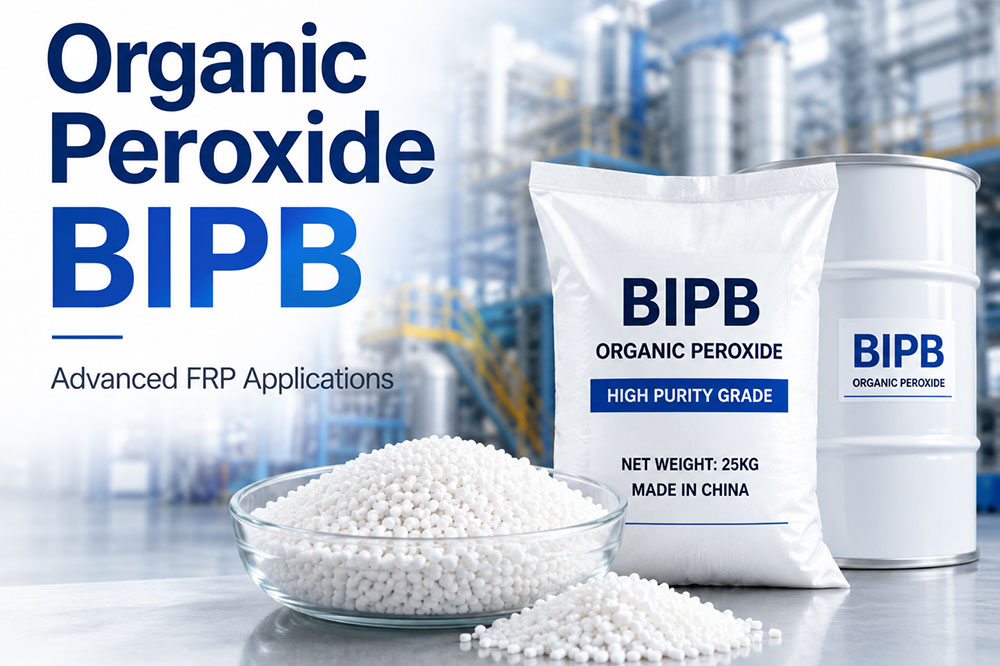
What Is Organic Peroxide BIPB and Why It Matters for FRP?
BIPB, sometimes referred to by trade nomenclature as diisopropylbenzene dihydroperoxide or bis-peroxide, is a solid bifunctional organic peroxide. Unlike MEKP or BPO, which are commonly used for room-temperature or low-temperature cure systems, organic peroxide BIPB activates at higher temperatures — typically in the 155–175°C processing range. This makes it especially suitable for:
- Pultrusion processes where a consistent heat profile is critical across the die
- Filament winding cured at elevated mandrel temperatures
- SMC and BMC compression molding with heated press tooling
- Continuous lamination lines using heated rollers or industrial ovens
Its bifunctional structure generates two radicals per molecule, improving crosslink density and contributing to stronger, more thermally resistant composite parts. For procurement teams, this translates into better-performing finished goods with fewer post-cure defect issues.
5 Essential Selection Criteria for Organic Peroxide BIPB
1. Active Oxygen Content and Purity Grade
The active oxygen content (AOC) of organic peroxide BIPB typically ranges between 9.0–9.5% for commercial-grade material. Higher purity translates to more predictable cure behavior and tighter batch-to-batch consistency — two factors that matter greatly in automated pultrusion lines. When evaluating suppliers, always request a Certificate of Analysis (CoA) that specifies AOC, assay percentage, and peroxide content per ASTM or equivalent standard.
Low-purity batches can cause under-cure, increased void content, and mechanical property variation. For mission-critical applications such as structural FRP profiles or pressure-rated pipe, specification-grade BIPB is non-negotiable.
2. Physical Form: Powder, Granule, or Masterbatch
Organic peroxide BIPB is available in several physical forms, each with handling implications that affect your production setup:
- Powder form: Highest surface area and fastest dispersion, but requires careful dust control and personal protective equipment per ILO guidelines on organic peroxide handling.
- Granule form: Easier to weigh and handle, lower dust risk, compatible with most automated dosing systems.
- Masterbatch (pre-blended in carrier resin): Ideal for SMC and BMC lines; eliminates manual weighing error but limits flexibility in resin-to-initiator ratio.
For pultrusion and filament winding operations, granule-grade organic peroxide BIPB is most commonly specified because it balances ease of handling with consistent dispersion performance.
3. Half-Life Temperature and Cure Window Compatibility
Every organic peroxide has a characteristic half-life temperature — the temperature at which half the peroxide decomposes within a defined time period. For organic peroxide BIPB, the 10-hour half-life temperature is approximately 100°C, and the 1-minute half-life falls around 175°C. These values directly inform your cure schedule design.
Before sourcing, verify that your resin system’s peak exotherm and your mold or die temperature align with BIPB’s activation range. If your process temperature is below 140°C, you may need a different peroxide or a co-initiator blend. Working with a technical support team that understands both resin chemistry and initiator behavior will help you avoid costly trial-and-error in production.
4. Supply Stability and Cold Chain Requirements
Unlike liquid peroxides such as MEKP, organic peroxide BIPB is a solid at ambient temperature, which simplifies storage conditions — but it still requires temperature control below 30°C and must be kept away from direct heat sources or ignition risks. When vetting suppliers, confirm the following:
- Warehouse storage temperature records and cold chain documentation
- Minimum order quantities and shelf life specifications (typically 12 months from production date)
- Export compliance documentation for your import country, particularly for markets with strict organic peroxide import controls such as the EU, USA, and South Korea
Supply chain reliability is a critical factor for composite manufacturers running continuous production lines. A single delayed shipment of BIPB can stall an entire pultrusion operation. Confirm your supplier’s track record on on-time delivery before committing to a long-term supply arrangement.
5. Regulatory Compliance and Safety Documentation
Organic peroxide BIPB is classified as a Class 5.2 dangerous good for transportation purposes. Before placing an order with a new supplier, ensure the following are in order:
- SDS (Safety Data Sheet) complies with GHS standards applicable in your target market
- UN number and packaging group are correctly stated (UN3106 or UN3110 depending on formulation and concentration)
- Export and import documentation complies with IATA DGR (for air freight) or IMDG Code (for sea freight)
The International Labour Organization’s Chemical Safety guidelines provide a reference framework for managing organic peroxide hazards in manufacturing environments. Always align internal handling procedures with local regulatory requirements before introducing a new peroxide grade into your facility.
How Organic Peroxide BIPB Compares to Other FRP Initiators
Procurement managers often ask how BIPB compares to TBPB, TBPEH, or MEKP in FRP applications. The key differentiator is temperature activation range:
- MEKP is ideal for room-temperature cure of hand lay-up and spray-up processes using cobalt-based promoters.
- BPO is suited for moderate temperatures in closed mold processes and SMC formulations.
- TBPB and TBPEH work well in mid-range temperature pultrusion applications (130–150°C processing range).
- Organic peroxide BIPB is the preferred choice when your process temperature exceeds 155°C and you need high crosslink density and superior thermal performance in the cured part.
For composite part designers targeting heat deflection temperatures above 120°C, BIPB is often the correct initiator, paired with a compatible unsaturated polyester or vinyl ester resin formulation. You can explore our organic peroxide product range for supply options tailored to different process temperature requirements, including BIPB and alternative high-temperature initiators.
Practical Sourcing Tips for FRP Manufacturers
Sourcing organic peroxide BIPB from China-based suppliers can offer significant cost advantages, but requires careful vetting before committing to a supply arrangement. Key checkpoints include requesting third-party lab test reports for active oxygen content rather than relying solely on internal CoA documentation, confirming the supplier’s dangerous goods export qualification (China customs requires specific DG export registration), and clarifying lead times — particularly around Chinese public holidays such as Golden Week and Chinese New Year.
BIPB is typically sold in 25 kg carton or drum packaging. For buyers looking to establish a stable supply chain, working with a distributor that can consolidate organic peroxide BIPB with your other composite raw materials — including resins, fiberglass reinforcements, and cobalt accelerators — into a single consolidated shipment often reduces logistics cost and simplifies dangerous goods documentation handling.
Frequently Asked Questions About Organic Peroxide BIPB
What does BIPB stand for?
BIPB stands for 1,3-Bis(tert-butylperoxyisopropyl)benzene. It is also referred to by alternative chemical nomenclature or under trade names used by recommended international brand products in the peroxide supply chain. When sourcing, confirm the CAS number (25155-25-3) with the supplier to ensure you are receiving the correct compound.
Is organic peroxide BIPB compatible with all FRP resin systems?
BIPB is primarily used with unsaturated polyester and vinyl ester resin systems at elevated processing temperatures. It is not typically used with room-temperature cure systems or epoxy resin systems. Always confirm resin-initiator compatibility with your resin supplier or technical support team before finalizing your process specification.
What is the typical loading level of organic peroxide BIPB in a pultrusion formulation?
Loading levels generally range from 0.5 to 2.0 phr (parts per hundred resin), depending on the resin reactivity, pull speed, die temperature profile, and part cross-section geometry. Your resin or peroxide supplier’s technical team can recommend a starting formulation based on your specific production parameters.
Can BIPB be used in combination with other organic peroxides?
Yes. In some pultrusion applications, organic peroxide BIPB is used in combination with lower-activation-temperature peroxides such as TBPB to create a staged cure profile. This approach ensures proper gelation at the die entrance and full through-cure at the die exit, which is particularly important for thick-section profiles or fast pull-speed operations.
How should organic peroxide BIPB be stored in a manufacturing facility?
Store below 30°C in a dry, ventilated area away from heat sources, combustible materials, and all accelerators or promoters. Keep containers sealed and clearly labeled. Observe the stated shelf life — typically 12 months from the manufacture date. Conduct regular inventory rotation to ensure older stock is consumed first.
Get Reliable Supply of Organic Peroxide BIPB for Your Production
Our team supports composite manufacturers worldwide with technical selection guidance and stable supply chain solutions for organic peroxide BIPB and a complete range of FRP raw materials. Whether you need a product specification sheet, a trial sample, or a competitive supply quote tailored to your production volumes and process requirements, we are ready to assist.
Contact us today to submit an inquiry and get a response from our technical team within one business day.