



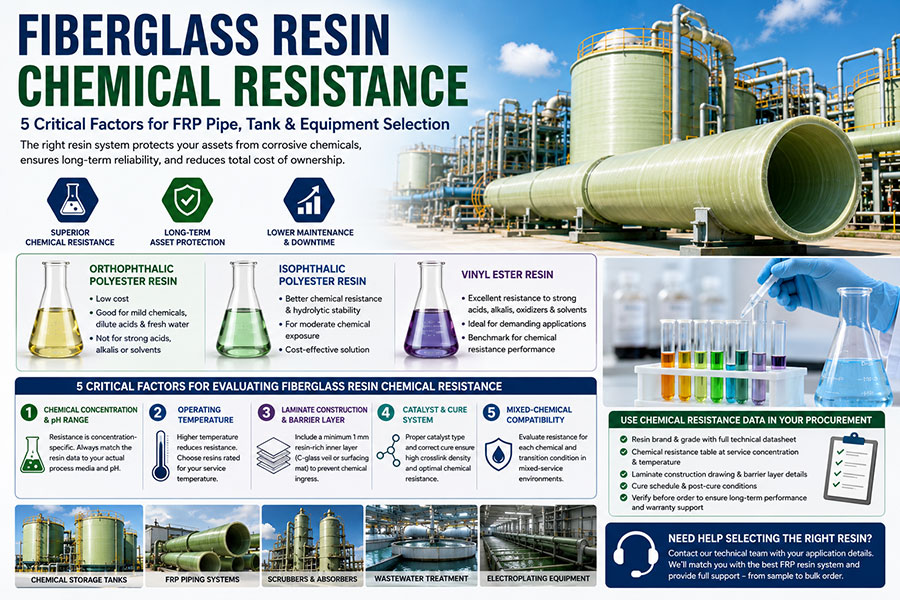
For FRP pipe manufacturers, tank builders, and industrial procurement teams, fiberglass resin chemical resistance is one of the most decisive factors in material selection. Choosing a resin without understanding its chemical resistance profile can lead to premature laminate failure, costly maintenance, and unplanned production downtime. This guide covers five critical factors every sourcing manager should evaluate when specifying an FRP resin system.
Why Fiberglass Resin Chemical Resistance Determines Long-Term Asset Performance
In corrosive service environments — chemical storage tanks, industrial piping, scrubbers, and process vessels — the resin matrix is the primary barrier between the fiberglass reinforcement and the contained media. Unlike metals, FRP composites do not corrode conventionally, but the resin can absorb, swell, or chemically degrade when exposed to incompatible fluids at elevated temperatures.
Fiberglass resin chemical resistance is not a single fixed property. It depends on resin type, glass content, laminate construction, operating temperature, chemical concentration, and whether the system operates under static or dynamic stress. Procurement teams that evaluate only the resin type often encounter unexpected service failures.
Core FRP Resin Types and Their Chemical Resistance Profiles
Orthophthalic Polyester Resin
Orthophthalic polyester is the lowest-cost option, offering adequate resistance to mild chemicals, dilute acids, and fresh water. It is not recommended for prolonged exposure to strong acids, alkalis, or aromatic solvents. For most industrial corrosion-resistant applications, orthophthalic systems are considered a baseline rather than a specification choice.
Isophthalic Polyester Resin
Isophthalic polyester delivers improved fiberglass resin chemical resistance compared to orthophthalic grades, with better hydrolytic stability and resistance to dilute acids. It is commonly specified for water treatment equipment, boat hulls, and general-purpose industrial tanks where moderate chemical exposure is expected. Its cost-to-performance ratio makes it a practical choice for buyers managing tight capital budgets.
Vinyl Ester Resin
Vinyl ester resin is the benchmark for demanding chemical resistance applications. Its epoxy backbone and reduced ester linkage density give it significantly superior resistance to strong acids, alkalis, oxidizing chemicals, and solvents compared to polyester systems. Bisphenol A vinyl ester is widely specified for FRP pipes, chemical storage tanks, scrubbers, and electroplating equipment. For applications involving hypochlorite solutions, sulfuric acid, or sodium hydroxide, vinyl ester is typically the resin of choice.
Supply chain resource support from recommended international brand products is available through our platform. Explore our full range of FRP resin products to compare grades by chemical resistance rating.
5 Critical Factors for Evaluating Fiberglass Resin Chemical Resistance
1. Chemical Concentration and pH Range
Resin chemical resistance data is concentration-specific. A resin rated for 10% sulfuric acid may not perform at 30% concentration. Always cross-reference the chemical resistance table against the actual service concentration and pH of your process media. ASTM C581 provides a standardized immersion test protocol used by resin manufacturers to generate chemical resistance data.
2. Operating Temperature
Chemical resistance ratings are typically published at 20–25°C. Elevated service temperatures significantly reduce effective fiberglass resin chemical resistance across all resin types. As a general guideline, each 10°C increase in temperature can roughly halve the effective resistance of a polyester system. Vinyl ester systems offer a higher heat deflection temperature and retain barrier properties better at elevated temperatures, making them preferable for hot chemical service.
3. Laminate Construction and Resin-Rich Barrier Layer
Even the best resin specification will underperform if the laminate construction does not include an adequate resin-rich corrosion barrier. Industry best practice for FRP chemical equipment calls for a minimum 1 mm resin-rich inner surface layer — typically using C-glass veil or synthetic surfacing mat — followed by structural plies. Omitting this layer is a common cause of early chemical ingress regardless of the resin grade selected.
4. Catalyst and Cure System Selection
The curing system directly affects crosslink density and the final chemical resistance of the laminate. Under-cured laminates — caused by incorrect MEKP ratio, low ambient temperature during fabrication, or insufficient post-cure — will show lower chemical resistance than the datasheet implies. Our organic peroxide and MEKP catalyst range includes grades formulated to ensure complete cure across varying fabrication conditions.
5. Compatibility with Mixed-Chemical Environments
Some industrial vessels must handle mixed chemical streams or undergo regular cleaning with aggressive solvents. In these cases, fiberglass resin chemical resistance must be evaluated for each fluid and each transition condition — not just steady-state operation. Vinyl ester resin systems generally offer the broadest compatibility envelope for mixed-service applications.
How to Use Chemical Resistance Data in Your Procurement Process
When requesting quotations for FRP pipe or tank projects, ask suppliers to provide the following:
- Resin brand and grade with full technical datasheet
- Chemical resistance table covering your specific media at service concentration and temperature
- Laminate construction drawing showing the resin-rich barrier layer specification
- Cure schedule and post-cure conditions used during fabrication
Verifying these details before order placement protects your project from costly field failures and supports stronger warranty coverage from the fabricator.
Frequently Asked Questions
Is vinyl ester resin always better than polyester for chemical resistance?
Vinyl ester offers superior fiberglass resin chemical resistance for strong acids, alkalis, and oxidizing media. For mild service conditions and cost-sensitive projects, isophthalic polyester remains a practical specification choice.
Can the same resin be used for both acidic and alkaline service?
Some vinyl ester grades show broad compatibility across pH ranges, but acid and alkaline resistance profiles differ by resin chemistry. Always verify against the chemical resistance table provided by your resin supplier for your specific service media.
What ASTM standard covers FRP chemical resistance testing?
ASTM C581 covers standard practice for determining chemical resistance of thermosetting resins used in glass-fiber-reinforced structures intended for liquid service. It is the primary test protocol referenced in FRP resin technical documentation.
How does operating temperature affect resin selection?
Higher service temperatures reduce effective fiberglass resin chemical resistance. Consult elevated-temperature resistance data from your resin supplier and consider post-cured vinyl ester systems for service above 60°C.
Where can I source FRP resins with verified chemical resistance documentation?
Our platform provides access to unsaturated polyester resin, vinyl ester resin, and epoxy resin grades with full technical datasheets and chemical resistance tables. Submit an inquiry with your application details for a matched recommendation.
Ready to specify the right resin for your corrosive service application? Contact our technical team with your chemical media, operating conditions, and project specifications — we will match you with the right fiberglass resin system and provide full technical support from sample to bulk order.