



Wind turbine blade resin selection is one of the most important decisions in wind blade manufacturing. As global wind energy capacity continues to grow, manufacturers need resin systems that support structural reliability, processing efficiency, and long-term cost control.
For wind turbine blades, epoxy resin and vinyl ester resin are two commonly discussed options. Each resin system offers different advantages in fatigue resistance, moisture performance, cure behavior, and total material cost. This guide explains how to evaluate wind turbine blade resin for procurement and composite manufacturing applications.
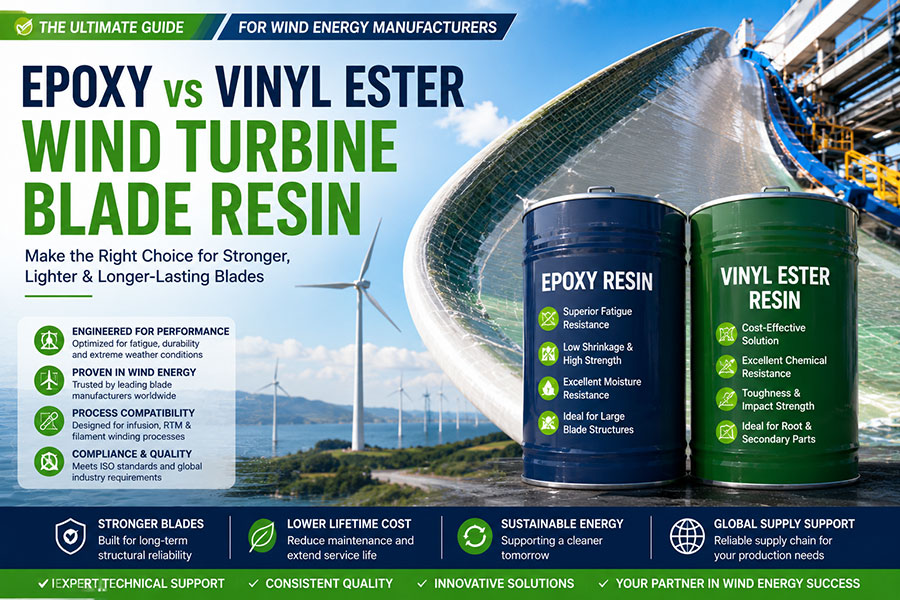
Why Resin Choice Defines Blade Performance
Wind turbine blades operate under continuous dynamic loading, UV exposure, and fluctuating humidity for 20–25 years. The structural matrix resin must deliver high fatigue resistance under cyclic stress, low moisture absorption to prevent microcracking, good fiber-matrix adhesion with fiberglass and carbon fiber reinforcements, process compatibility with infusion or filament winding processes, and consistent cure behavior across large, variable-temperature mold environments. No single resin type meets every requirement optimally. Epoxy and vinyl ester resins represent two different engineering trade-offs that matter significantly at production scale.
Epoxy Resin for Wind Turbine Blade Manufacturing
Epoxy resin is the industry benchmark for large wind turbine blades, particularly those over 60 meters. Fatigue Strength: Epoxy-based composites exhibit superior fatigue endurance compared to polyester or vinyl ester alternatives, making them the default choice for high-cycle structural loading. Low Shrinkage: Epoxy resins cure with minimal volumetric shrinkage, reducing internal stress and improving dimensional accuracy during infusion molding. Moisture Resistance: Properly cured epoxy laminates absorb significantly less water than general-purpose polyester, extending service life in offshore and high-humidity environments. Resin Infusion Compatibility: Low-viscosity epoxy formulations are well-suited to vacuum-assisted resin infusion (VARI), the dominant process in modern blade production.
Trade-offs include higher raw material cost, longer cure cycles, and the need for amine or anhydride curing agents that require careful handling and storage. Procurement teams should evaluate total system cost — resin plus curing agent plus processing parameters — not resin price alone. Supply chain resource support for infusion-grade epoxy and curing agent systems is available through established composite material distributors serving wind OEM supply chains.
Vinyl Ester Resin in Wind Energy Composite Applications
Vinyl ester resin occupies an important niche in wind energy composites, particularly for blade root sections and hardware interfaces where chemical resistance and toughness are prioritized, secondary structures and nacelle components where cost reduction offsets lower fatigue performance, and hybrid laminates that combine vinyl ester barrier layers with structural epoxy layers to improve osmotic resistance.
Vinyl ester resin offers a cost-effective alternative to epoxy in applications where extreme fatigue loading is not the primary design driver. Its inherent toughness and chemical resistance make it a practical choice for components exposed to moisture or processing chemicals. Procurement teams sourcing vinyl ester resin for wind applications should confirm resin viscosity at processing temperature, gel time consistency across production batches, and compatibility with the MEKP catalyst or organic peroxide system specified by the design authority.
5 Key Criteria for Wind Turbine Blade Resin Procurement
1. Batch Consistency: Large blade production demands tight lot-to-lot viscosity and reactivity tolerances. Request batch test reports (BTR) covering gel time, peak exotherm, and viscosity for each incoming shipment.
2. Infusion Window: For VARI or resin transfer molding (RTM), confirm pot life and infusion time at your shop temperature. Seasonal temperature variation can significantly affect processing windows.
3. Mechanical Data Compatibility: Request neat resin castings data (tensile, flexural, HDT) and laminate-level fatigue data. ISO 13003 provides standardized methodology for fatigue testing of fiber-reinforced plastics — the most relevant benchmark for blade-grade material qualification.
4. Regulatory and Safety Compliance: Verify SDS documentation, transport classification (especially for organic peroxide initiators used with vinyl ester systems), and any regional chemical regulations applicable to your manufacturing site.
5. Supply Continuity: Wind blade projects run on long production schedules. Confirm that your resin supplier can commit to multi-year availability with stable formulation and no unannounced raw material substitutions.
Matching Fiberglass Reinforcements to Your Resin System
Resin selection does not occur in isolation. Wind turbine blade laminates pair structural resins with fiberglass woven rovings, multiaxial fabrics, or unidirectional tapes. The resin must be compatible with the sizing chemistry on the fiber surface — epoxy-compatible sizing and polyester/vinyl ester-compatible sizing differ in chemistry. Using mismatched combinations reduces interfacial adhesion and can significantly degrade laminate interlaminar shear strength. Always specify the intended matrix resin when ordering fiberglass materials and request compatibility confirmation from your reinforcement supplier. Explore fiberglass reinforcement options suited to composite infusion and filament winding applications.
Catalyst Selection for Vinyl Ester Wind Applications
For vinyl ester resin systems used in wind component production, the choice of organic peroxide initiator directly controls gel time, exotherm profile, and post-cure degree. Room-temperature curing typically uses MEKP catalysts, while elevated-temperature cure cycles may require higher-activation peroxide systems. Batch-to-batch consistency in the catalyst is as important as in the resin itself. View organic peroxide catalyst options compatible with vinyl ester and polyester resin systems for composite applications.
Frequently Asked Questions
Q1: Can vinyl ester resin replace epoxy in large wind turbine blades?
For blades above 60–70 meters under high fatigue loading, epoxy remains the engineering standard. Vinyl ester can be used in specific zones or smaller blade platforms where cost optimization is prioritized and fatigue demands are lower. Always validate against the blade design authority’s material specification before substitution.
Q2: What curing agents are used with epoxy resin in blade manufacturing?
Blade production typically uses cycloaliphatic amine or anhydride curing agents, depending on process temperature and cure schedule. Some systems use reactive diluents to lower viscosity for infusion. Hardener selection affects pot life, cure shrinkage, and post-cure glass transition temperature (Tg) — all critical to long-term blade performance.
Q3: What is the shelf life of epoxy resin for wind applications?
Most infusion-grade epoxy resins have a shelf life of 12–24 months when stored in sealed containers at 15–25°C. Curing agents may have different storage requirements. Follow FIFO inventory practices on production lines to avoid out-of-date material reaching fabrication.
Q4: Is fiberglass resin chemically resistant enough for wind blade root hardware interfaces?
Standard orthophthalic polyester resin has limited chemical resistance and is not recommended for hardware interface zones exposed to lubricants, hydraulic fluids, or salt spray. Vinyl ester resin or epoxy provides substantially better chemical resistance for such applications.
Q5: How do I compare resin bids from multiple suppliers?
Request equivalent test data: neat resin mechanicals, pot life at your target processing temperature, and laminate ILSS with your specified fiber type. Price per kilogram is a starting point — not the decision criterion. Factor in logistics, lead time, and documentation support when evaluating total supplier value.
Inquire About Wind Blade Resin Supply
Whether you are evaluating epoxy resin systems for infusion manufacturing or sourcing vinyl ester resin for FRP wind energy components, getting the material specification right before ordering prevents costly rework downstream. Our technical team supports composite material sourcing managers with application-matched resin recommendations, SDS documentation, and supply chain coordination for wind energy projects. Contact us to discuss your project requirements — batch size, process type, cure schedule, and performance targets — and receive a tailored material proposal.
Contact us to discuss your wind blade resin sourcing requirements →