



Organic peroxides are indispensable processing agents in rubber vulcanization, polymer crosslinking, and wire and cable insulation manufacturing. Among the most widely used is BIPB — bis(tert-butylperoxyisopropyl)benzene — a high-temperature dialkyl peroxide valued for its clean decomposition profile and versatile crosslinking performance. For procurement managers and material engineers at rubber factories, cable plants, and polymer compounders, sourcing BIPB on a wholesale basis means carefully evaluating purity, active oxygen content, packaging compliance, and supplier reliability. This guide outlines the key technical and procurement factors that matter most to B2B buyers.
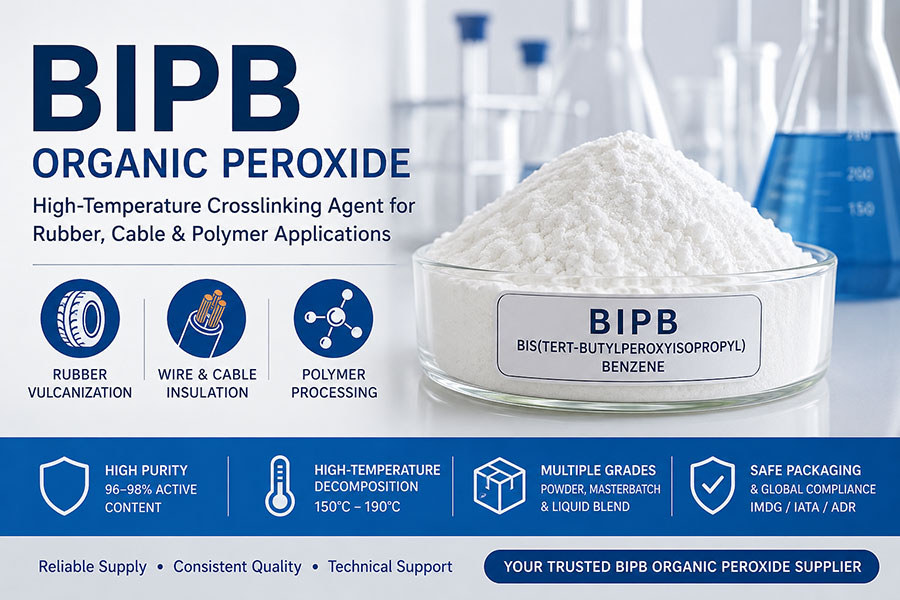
What Is BIPB and Why Is It Used in Industrial Processing?
BIPB (CAS 25155-25-3 for the 1,3-isomer; 2212-81-9 for the 1,4-isomer) belongs to the dialkyl peroxide class of organic peroxides. It is commercially available under various trade names from leading international brand products in the organic peroxide segment, and is used in a range of supply chain resource support arrangements by processors across Asia, Europe, and the Americas.
The compound decomposes at temperatures typically between 150°C and 190°C, releasing free radicals that initiate crosslinking reactions in rubber and polymer matrices. This elevated decomposition temperature is a key advantage: it allows BIPB to be incorporated into compounds during high-temperature mixing without premature cure, and it provides a wide processing window for extruder and injection molding operations.
Available Grades and Formulations
BIPB is supplied in several commercial forms to meet different handling and processing needs. Pure powder grade typically contains 96–98% active content and is used where precise dosing and high active oxygen concentration are required. Masterbatch grades — commonly 40% or 45% active content on a silica or polymer carrier — are preferred by many processors for safer handling and improved dispersion in internal mixers and extruders. Liquid blend formulations are also available for specific application requirements. When requesting quotes, buyers should specify the grade, active content, and any carrier compatibility requirements relevant to their compound formulation.
Key Application Areas for BIPB in Industry
Rubber Vulcanization
BIPB provides a cleaner crosslink network compared to sulfur-based vulcanization systems, making it the preferred choice where odor control, color stability, and long-term heat aging resistance are priorities. It is widely used in EPDM sealing profiles and weatherstripping, silicone rubber compounds, TPV (thermoplastic vulcanizates) and TPE compounds, and automotive rubber parts requiring extended thermal performance.
Wire and Cable Insulation
BIPB is a standard crosslinking agent for polyethylene (PE) and ethylene-vinyl acetate (EVA) insulation through continuous vulcanization (CV) tube and steam cure processes. Its controlled decomposition profile allows processors to fine-tune crosslink density and manage the processing window, particularly important in high-voltage cable production where insulation integrity is critical.
Polymer Rheology Modification
In polypropylene and other polyolefin processing, controlled quantities of BIPB are used for rheology modification — a process known as vis-breaking — to achieve targeted melt flow indices for injection molding and film extrusion applications. This controlled degradation approach is preferred over reactive extrusion with other agents in certain specialty compounding lines.
What B2B Buyers Should Evaluate When Sourcing BIPB Wholesale
Purity and Active Oxygen Content
Always request a Certificate of Analysis (CoA) confirming the active content of each batch. For pure powder grades, active content should meet the stated specification (typically 96% minimum). For masterbatch grades, verify both the active content and the carrier material type to ensure compatibility with your compound system. Batch-to-batch consistency is especially important for processors running continuous production lines.
Packaging and Hazardous Material Compliance
BIPB is classified as a hazardous material under international transport regulations including IMDG (sea freight), IATA (air freight), and ADR (road transport in Europe). Suppliers must provide compliant UN packaging, current Safety Data Sheets (SDS) in your required language, and documented storage conditions. Typical storage requirements include temperatures below 30°C, dry and well-ventilated conditions, and segregation from heat sources and flammable materials. Shelf life under proper storage is generally 12 months.
Supply Chain Reliability
For processors running continuous vulcanization lines or high-volume compounding operations, supply interruptions translate directly into production downtime. When evaluating wholesale BIPB suppliers, request information about production lead times, minimum order quantities (MOQ), and inventory buffer policies. Understanding whether the supplier manufactures directly or distributes from regional stock affects both lead time predictability and your ability to respond to demand fluctuations.
Regulatory Documentation for Cross-Border Procurement
For buyers sourcing BIPB from Asia for destinations in Europe, North America, or Southeast Asia, ensure the supplier can provide GHS/REACH-compliant SDS, UN transport classification documents, and hazmat packaging certifications. Experience with international hazmat logistics — including temperature-controlled container options for summer shipments — is a meaningful differentiator among BIPB wholesale suppliers.
Frequently Asked Questions
What is the difference between BIPB and DCP (dicumyl peroxide)?
Both BIPB and DCP are dialkyl peroxides used for crosslinking, but they differ in decomposition temperature and byproduct profile. DCP decomposes at a lower temperature (around 135°C), making it suitable for lower-temperature processing. BIPB decomposes at higher temperatures and produces fewer odorous byproducts — a key advantage in automotive sealing, food-contact polymer, and wire insulation applications where odor and color are quality concerns.
Is BIPB compatible with EPDM rubber compounds?
Yes. BIPB is widely used with EPDM, particularly in applications requiring thermal aging resistance, low compression set, and minimal odor. Typical dosage ranges from 1.5 to 4 phr, depending on the target crosslink density and compound formulation. Using co-agents such as TAC, TAIC, or HVA-2 alongside BIPB is common practice to improve crosslink efficiency and physical properties.
What is a typical MOQ for wholesale BIPB supply?
Minimum order quantities vary by supplier and grade. Masterbatch grades are often available from 500 kg per order, while pure powder grades typically require a minimum of 1 MT. For buyers with specific project volumes or trial requirements, inquire about sample availability and flexible packaging options. Long-term supply agreements with volume commitments may allow for more favorable lead times and pricing structures.
Can BIPB be used with co-crosslinking agents?
Yes. BIPB is routinely used alongside co-agents including TAC (triallyl cyanurate), TAIC (triallyl isocyanurate), and HVA-2 (N,N’-m-phenylenedimaleimide). These co-agents improve crosslink efficiency, allow lower peroxide loadings, and enhance mechanical properties such as tensile strength, elongation at break, and resistance to compression set. The right co-agent selection depends on the base polymer and the target application performance profile.
What storage and handling precautions are required for BIPB?
BIPB should be stored away from open flames, heat sources, and strong reducing or oxidizing agents. Operators should use appropriate PPE including gloves and eye protection; in dusty environments, respiratory protection is also recommended. Masterbatch grades significantly reduce exposure risk during weighing and loading. Always consult the product SDS before incorporating BIPB into any compound system, and ensure warehouse staff are trained on organic peroxide handling procedures.
Application Matching and Technical Sourcing Support
Procuring organic peroxides is not purely a volume-and-price decision. Processing compatibility, compound formulation requirements, regulatory compliance, and end-use application performance all influence which BIPB grade and supplier arrangement is most appropriate for your operation. Working with a supplier who can provide application guidance — not just product delivery — helps procurement and R&D teams reduce trial-and-error cycles and accelerate qualification timelines.
We support rubber compounders, cable manufacturers, polymer processors, and specialty chemical buyers with access to a range of organic peroxide products including BIPB, MEKP, DCP, BPO, TBPB, lauroyl peroxide, and other peroxide systems. Our team provides technical sourcing support to help match the right peroxide grade and formulation to your specific process conditions and application requirements.
Submit Your BIPB Sourcing Inquiry
If you are evaluating BIPB organic peroxide for your production line — whether for rubber vulcanization, cable crosslinking, or polymer modification — we are ready to assist with sourcing, application matching, and supply arrangement planning. Please contact us with your application details, required grade, target volume, and destination. Our team will respond with a tailored supply proposal.