



As industrial storage systems face increasingly aggressive chemical environments and stricter durability requirements, Fiber Reinforced Plastic (FRP) tanks continue to replace traditional materials such as carbon steel and concrete. Among the key material choices influencing tank longevity, vinyl ester resins are gaining growing attention for their ability to significantly extend service life.
In 2026, the selection of resin systems has become a strategic decision for tank manufacturers and end users alike.
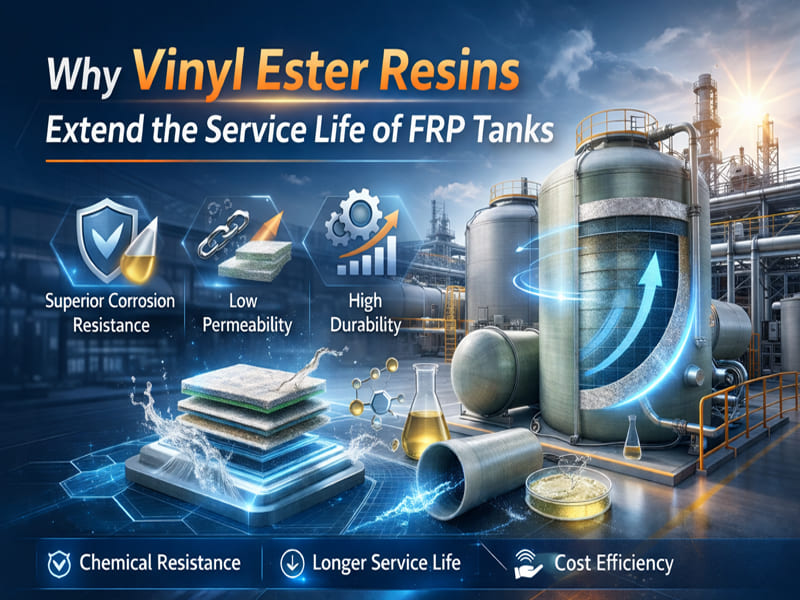
The Durability Challenge in FRP Tank Applications
FRP tanks are widely used in:
- Chemical processing plants
- Wastewater treatment facilities
- Desalination systems
- Power generation and flue gas treatment
- Acid and alkali storage environments
These applications expose tanks to continuous chemical attack, temperature fluctuations, and mechanical stress. Over time, insufficient corrosion resistance or poor resin selection can lead to:
- Microcracking and resin degradation
- Osmotic blistering
- Structural weakening
- Premature failure
Extending service life requires not only proper structural design, but also the right resin chemistry.
Why Vinyl Ester Resins Perform Better
Vinyl ester resins combine the corrosion resistance of epoxy systems with the processing advantages of unsaturated polyester resins. Their molecular structure provides several key advantages:
1. Superior Chemical Resistance
Vinyl ester resins exhibit excellent resistance to acids, alkalis, solvents, and oxidizing environments. The epoxy backbone enhances resistance to hydrolysis and chemical penetration, reducing long-term degradation.
2. Lower Permeability
Compared to standard polyester resins, vinyl ester systems offer lower water and chemical permeability. This limits diffusion through the laminate and reduces the risk of osmotic blistering.
3. Improved Mechanical Strength
Higher tensile strength and better elongation properties help tanks withstand thermal cycling and mechanical loads without cracking.
4. Better Fatigue Resistance
In applications involving pressure fluctuations or vibration, vinyl ester resins provide improved resistance to cyclic stress.
These performance characteristics directly contribute to longer maintenance intervals and reduced lifecycle costs.
The Importance of Proper Formulation and Curing
However, resin selection alone does not guarantee durability. Service life is strongly influenced by:
- Proper initiator and accelerator systems
- Controlled curing temperature and gel time
- Optimized laminate design
- Additives for corrosion and defect control
Inconsistent curing or improper formulation can compromise even high-grade vinyl ester systems.
Industry Perspective: A System-Level Approach
As a supplier focused on composite material solutions, Thousands Technology works closely with FRP tank manufacturers to optimize resin systems for corrosion-resistant applications. The company’s portfolio includes:
- Vinyl ester resins for chemical storage
- Unsaturated polyester resins for structural layers
- Curing agents and initiator systems
- Functional additives for defect reduction and process stability
By aligning material selection with application conditions, Thousands Technology supports manufacturers in achieving longer service life and more reliable tank performance.
Looking Ahead
With industrial environments becoming more aggressive and asset longevity increasingly critical, vinyl ester resins are expected to play an even greater role in FRP tank construction. The industry trend is shifting from short-term cost consideration toward full lifecycle performance evaluation.
For tank manufacturers aiming to enhance durability and reduce long-term maintenance risks, optimized vinyl ester systems are no longer optional—they are becoming the standard for high-performance corrosion-resistant storage solutions.