



Fiber Reinforced Plastic (FRP) products are widely used in industries such as marine, construction, chemical equipment, transportation, and sanitary ware due to their excellent strength-to-weight ratio, corrosion resistance, and design flexibility.
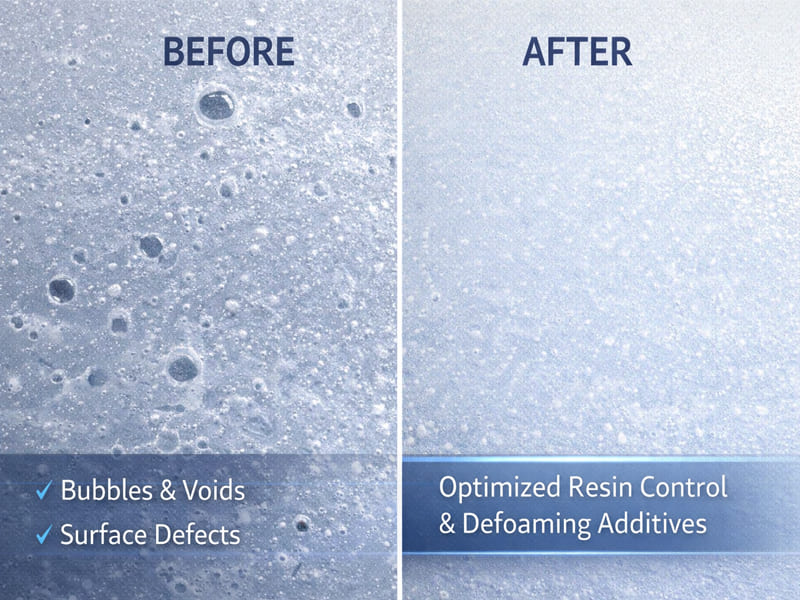
However, one of the most common challenges in FRP manufacturing is the formation of bubbles, voids, and surface defects, which can significantly affect both mechanical performance and appearance.
Understanding the root causes of these defects—and how to control them—is essential for producing high-quality FRP components.
Common Causes of Bubbles and Defects in FRP
Bubbles and internal voids typically originate from a combination of material, process, and environmental factors, including:
- Air entrapment during resin mixing or fiber impregnation
- High resin viscosity, preventing proper wet-out of fibers
- Improper curing systems, leading to uneven gelation
- Moisture contamination in resins, fillers, or reinforcement
- Inadequate degassing or ventilation during molding
If not properly addressed, these issues can result in reduced strength, poor interlaminar bonding, surface pinholes, or even premature failure of FRP products.
Optimizing Resin Selection and Formulation
The foundation of defect control starts with choosing the right resin system.
Low-viscosity unsaturated polyester, vinyl ester, or epoxy resins allow better fiber wet-out and easier air release. In many applications, thixotropy-controlled or pre-accelerated resin systems help balance flowability with sag resistance, especially in hand lay-up or spray-up processes.
Equally important is the correct selection of curing agents and accelerators. A curing system that reacts too quickly may trap air before it has time to escape, while a system that cures too slowly may lead to resin drainage or fiber print-through.
Role of Additives in Reducing Bubbles
Functional additives play a critical role in improving FRP processing and final quality. Common additive categories include:
- Defoaming and air-release additives
These reduce surface tension, allowing trapped air to migrate and escape more easily during molding. - Wetting and dispersing agents
Improved wetting of glass fibers minimizes dry spots and interfacial voids. - Flow modifiers and rheology additives
Controlled resin flow helps prevent turbulence and air entrapment during impregnation. - Moisture scavengers
These help reduce gas generation caused by residual water reacting during curing.
When properly formulated, these additives significantly reduce internal void content and surface pinholes without negatively impacting mechanical properties.
Process Control and Manufacturing Best Practices
Even the best materials cannot compensate for poor processing. Key process-level measures include:
- Controlled resin mixing speeds to avoid introducing excessive air
- Vacuum degassing for critical or thick FRP parts
- Proper rolling and compaction techniques in hand lay-up
- Consistent temperature and humidity control in the workshop
- Gradual curing schedules for thick laminates to prevent exotherm-related defects
Advanced processes such as vacuum infusion, RTM, and filament winding inherently reduce air entrapment, but still rely heavily on optimized resin chemistry and additive systems.
Quality Improvement Through Systematic Optimization
Reducing bubbles in FRP products is not about a single solution—it requires a systematic approach that integrates:
- Resin chemistry
- Additive selection
- Curing system design
- Process control
- Operator consistency
By optimizing each element, manufacturers can achieve smoother surfaces, higher mechanical strength, improved durability, and more consistent product quality.
About Thousands Technology
Thousands Technology specializes in supplying high-performance resin systems, curing agents, and functional additives for composite applications. With extensive experience across FRP processes such as hand lay-up, spray-up, RTM, filament winding, and casting, the company focuses on helping manufacturers improve product quality, processing stability, and long-term performance through tailored material solutions.